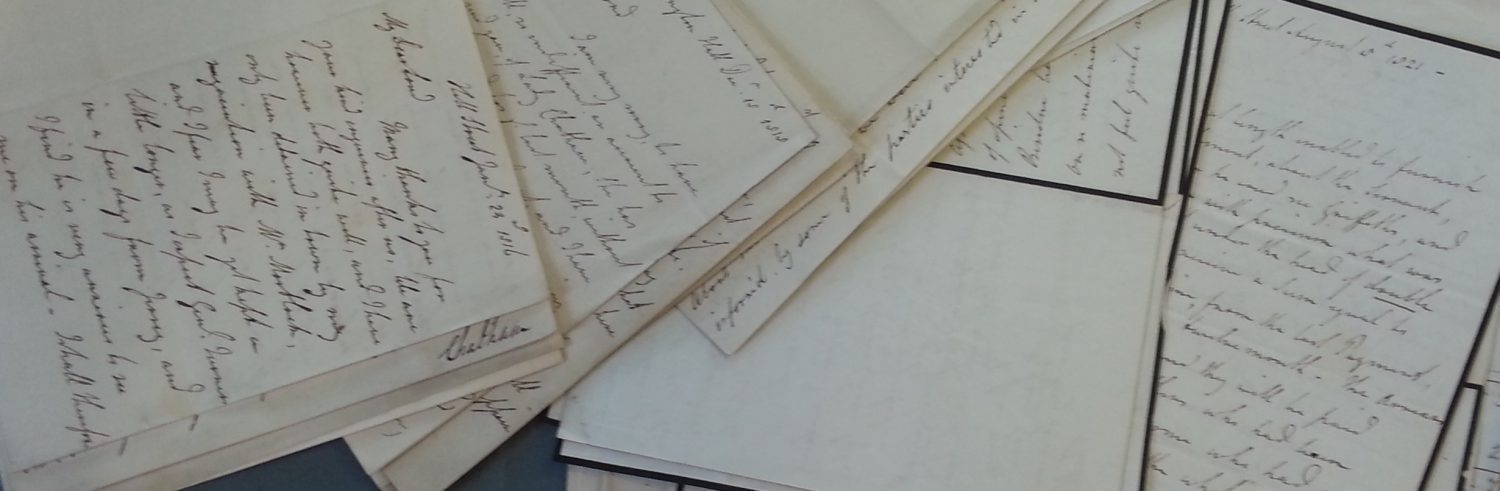
From the Hoare MSS, PRO 30/70/5 f. 345

Here’s a gem I discovered in the Hoare MSS (a kind of add-on to the Chatham Papers at the National Archives) a while back: a glimpse of John’s military life while he was stationed in Quebec from 1774 until early 1776. John was a lieutenant in the 47th Foot and served as one of the aides-de-camp of the governor, Sir Guy Carleton. The letter is written to Lord and Lady Chatham (John’s parents) by J. Wood, presumably John’s valet. I’ve left the English largely as spelled by Wood, so bits may have to be read aloud! (Preferably with a Zomerzet accent!)

—-

Quebec, 13 November 1774

Pleas to acquaint My Lord & Lady my Lord Pitt, is perfectly well, and has been so ever since he left England, his Lordship is not grown much in high, but is spread much thicker which I think his Lordship looks better for, the only inconvenience attends it, is his Cloaths being to little, and have no remedy but letting them out, as thair is no new Regimentals to be got at Quebec, & I will Venter to take the liberty of acquainten my Lord & Lady how my Lord Pitt passes his time in America, as I think it will not be disagreeable, for them, to hear, tho was Lord Pitt to no I had taken such a liberty he might be angery with me, His Lordship is up every morning and Dresst by seven o’clock, reads till nine, then to Breakfast with General Carleton ware his Lordship intirely Boards, attainds the Parade every Day at Eleven as that is the sure of the gard mountain, tho his Lordship his not a great deal to do thair, as the 47 regiment is not here, only som small imployments as being Addecamp to General Carleton. After his Lordship has attainded the Parade he rides or walkes if the wather will permit, if not, Reads fences or exercises with the firelock as he is learning the Exercise of the regiment that is here, as it is different from the Twentyth. His Lordship has been drest and at the Chateau, every day by a Quarter of hour before Dinner time, thare has been generally every week two large entertainments at the Chateau so that his Lordship sees a great deal of different Company. But Quebec is rather dul for his Lordship at present as greatest part of the Military Gentleman is gon to Boston, His Lordship has frequently dined with Major Calwell who lives two Miles from this town, General Carleton and Lady Marria’s [Carleton’s wife] politeness to my Lord Pitt when on board of Ship, and here, is very Great, as they never think they have all their family when my Lord Pitt is not there, I am afeard I shall take to great a liberty in given so long account of my Lord, so that I will conclude with begin leaf to offer my Duty to my Lord and Lady, Lady Hester Lady Harriot, Mr Pitt & Mr James Pitt, pleas to acquaint Mr James Pitt I have not seen any Soldier, in America, that is able to Exercise any Thing like so well as Serjeant Rogers [? I have NO idea what this is about], The wether upon the whole has been very fine ever since we landed here, but know growes rather cold, Heavy rains and a great deal of snow is daily expectd, notwithstanding the severity of the whether every body here perfers winter before Summer, after the snow is down and the frost thoroughly Seting. My Lord Pitt Desires to have sent by the first Ship that Sails for Quebec, Cloath & Buttons & other trimmins for two sutes of Regimentals, with two Epaulettes to each Coat, doe or buckskin to make two pair of Rideing Breeches a new saddle and bridle with bit and Burdoon the same as what his Lordship youst to ride Serjeant in, to send 20th of Pipe Clay, for cleaning of Cloaths.

Pleas to make my best Complits. to Mrs Sparry [the Pitt children’s nurse] Mr Willbeir [former colleague of Lord Chatham and tenant on the Hayes estate] & to all friends at Hayes from your affectionate friend

J Wood

Two interesting pieces from 18th century newspapers about John

The Second Earl of Chatham may be virtually invisible in the history books, but he appeared more or less frequently in the newspapers of the day. Clearly his activities—dull and pedestrian as they often were (“Lord Chatham has gone to his estates/to take the waters/visit a friend/gone hunting” etc etc etc)— were of interest to some. Here are two little snippets that are somewhat illuminating:

I’m afraid I can’t remember where this little snippet comes from (might have been the Morning Chronicle for June 1779), but it’s interesting to note that, before William Pitt became known as a politician (in 1779 he was just beginning his law studies), John was expected to continue the family tradition in Westminster. John’s primary career (as the above extract suggests) was military rather than political; I have not seen any evidence that he had much interest in political affairs prior to becoming First Lord of the Admiralty under his brother in July 1788. And on that note:

(from The World, 15 July 1788)

A slightly ironic one this, as “punctual” is not a word one sees associated with the Second Earl of Chatham very often. A positive and indeed rather defensive paragraph— obviously someone thought it necessary to defend Pitt’s choice of his brother to replace Lord Howe at the Admiralty.  Particularly, as I said, because until then John had shown no sign that I can see of being interested in politics, at least not in a participatory manner. I will give a medal to anyone who can find an instance of his speaking in Parliament, either before or after he took office.

On the other hand I am more than willing to concede “diligent”, at least insofar as he genuinely seems to have cared about business. Chatham attended most cabinet meetings, was a regular attendee at Court functions and levees, and the gazette of his movements in the papers is full of accounts of him attending Admiralty Board meetings, acting on committees and participating in general House of Lords business. He may have been silent but he wasn’t invisible.

Perhaps if he hadn’t been Pitt’s brother his reputation would have been better? But then he would almost certainly not have reached high office in the first place. And I would not be discussing him here.

Should be writing, so obviously I’m setting up a blog

As the title says, really.

I have precisely one day a week entirely set aside for writing—Thursday—and here I am setting up a Tumblr blog. Oh well.

Actually I am trying to clear my mind a bit for a novel reboot, so I might as well try and sort out my thoughts here.

The Long Shadow, for the uninitiated, is (will be?) a historical novel dealing with the relationship between William Pitt the Younger and his older brother John, Second Earl of Chatham. It should probably be the other way round, actually, as the story is told from John’s perspective. I do not pretend that I am not on first-name terms with my exalted subjects, but then reading their private correspondence makes me feel almost like we are friends. (That, or I am a stalker, but I prefer the first version.)

History remembers Pitt the Younger as Britain’s youngest prime minister (aged 24!); he is also the second longest serving (17 continuous years, 19 in all) and reputed to be one of the best. His short but incredibly busy life (1759-1806) was almost entirely encompassed by the reign of one monarch, George III. He took office in 1783, just after the end of the war with America, and masterminded the first half of the wars against revolutionary France. He is the subject of a number of biographies, with John Ehrman’s three volume opus at the academic end of the scale and William Hague’s entertaining work at the popular end. He has appeared in movies, novels, plays, TV series…. oh, you name it. He even has a Facebook page. Perhaps more than one.

And the Second Earl of Chatham? “What, you mean there was more than one?” Exactly…

I won’t go into the reasons why I find John so interesting now, although when I do I hope my enthusiasm will be catchy. I do feel incredibly sorry for him, as I think history has dealt him a rather unfortunate hand. He had an incredibly famous father and an incredibly famous brother; if that wasn’t bad enough, his own personal talents have been completely overshadowed by the disastrous expedition to Walcheren in 1809 (which he generalled) and by a not entirely undeserved reputation for sloth. Yet he was a long-serving cabinet minister, in office from 1788 until the Walcheren disaster, and when he chose to apply himself did so diligently enough.

As Sir Tresham Lever wrote in The House of Pitt (London, 1947, pp. 360-1): “The son of one genius and the elder brother of another, life must have brought him many disappointments; the heir to honours won by another and to an estate impaired and altogether inadequate to support the high rank his father had bequeathed him, his life must have been one long burden”. As sympathetic as this estimate seems, Lever goes on to describe him as “vain, pompous, stupid”, “the most stupid and useless of the Pitts”.

Poor John! Poor, poor John! I can only hope that I can help rectify that impression somewhat. 

And on that note, I should return to what I should be doing….