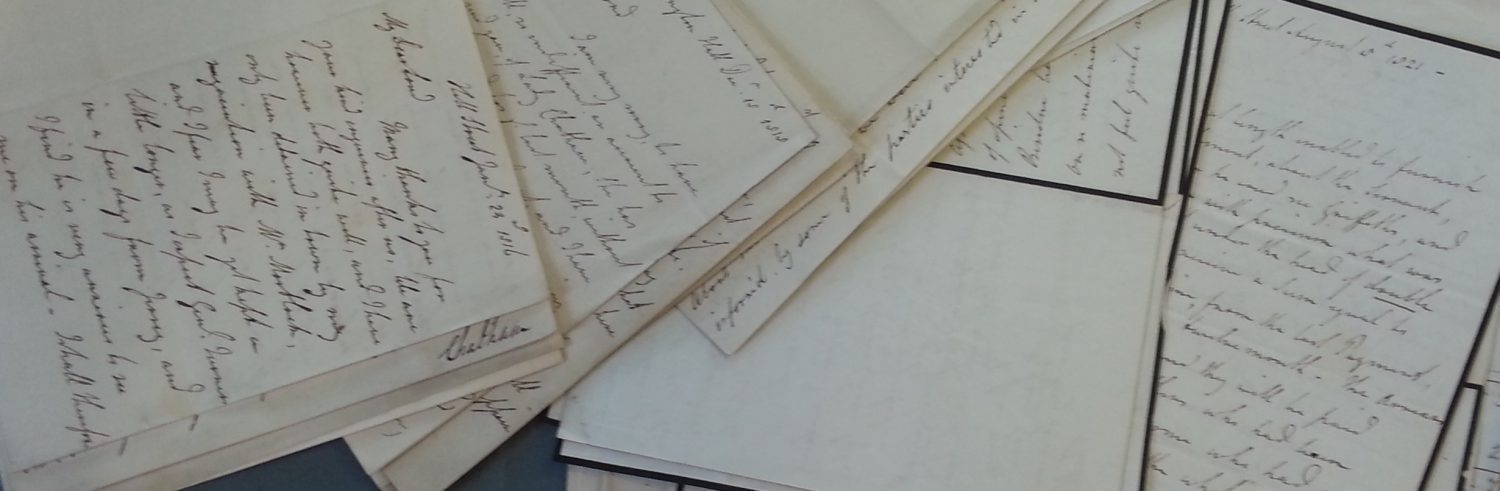
Sticking up for John again

You may recall my post a while ago about my horror at reading Richard Glover’s fulminations against the second Lord Chatham in “Peninsular Preparation”. “Relatively very few documents attributable to [Chatham] are to be found in the Chatham Papers, or elsewhere,” Glover wrote, “and it is surely significant that among them lies a trim little notebook containing lists of garden flowers written in an admirably neat italic printing hand. This suggests where his real interests lay” (Peninsular Preparation, p 39) The flower book story even gets into the latest book on Walcheren, by Martin R. Howard (Walcheren 1809, 2012).

Embarrassingly trivial, yet kind of cute, huh? I was in the National Archives today, so decided to call that little book up.


(Garden Book, from PRO 30/8/370/51)

Well.

I am NOT happy with Richard Glover. John has been traduced. AGAIN.

Who knows what the book of flowers is all about, but one thing is for sure: IT NEVER BELONGED TO JOHN.

How do I know this?

Take a look at this page:

Anything in particular leap out at you? I wouldn’t blame you if you didn’t spot it— it took me a moment. Here’s a clue:

King William the 4th came to the throne in 1830, Victoria in 1837. John Pitt, 2nd Earl of Chatham died in 1835, so could never have owned a book about flowers with names like Queen Victoria.

Even supposing the name referred to another Queen Victoria (I suppose there could have been another Queen of that name on the continent), the notebook has a calendar on the inside of the cover. The calendar has no date, but lists Easter Sunday as falling on 26 March.

According to this website , Easter Sunday fell on 26 March during John’s lifetime in 1758, 1769, 1780, 1815, and 1826. We can safely discount the first three of those. 1815 is I suppose a possibility, as is 1826, but neither of them allows for the presence of a flower named after William IV. That leaves the final possibility: that the book was printed for 1837, the last year before 1967 that Easter Sunday fell on 26 March. This would certainly make it possible to name a flower after Queen Victoria, who came to the throne in 1837.

But if the book was printed for 1837 (presumably in 1836), Chatham was already dead. So he couldn’t have owned the book. And even if the flowers refer to the contents of the garden of his house at Berkeley Square, which is likely given the book is tucked up with a bundle of receipts, house inventories and life insurance documents, he never compiled it.

So much for this one of Glover’s reasons why Chatham was a useless waste of oxygen. Makes a nice story, but ultimately it’s a lie, and poor John comes out looking like an idiot again.

Can you tell I am very, very cross?

An extract from Richard Glover’s “Peninsular Preparation”

“The decline of the [Board of] Ordnance, which began under Cornwallis, continued unabated under his deplorable successor, John, the second Earl of Chatham. Fortescue has well and truly said that, when he chose, Chatham could both think and write. Unfortunately, however, he very rarely made this exacting choice, and in sheer laziness he eclipsed even [William] Windham [Pitt’s Secretary at War in the 1790s]. Any reader of Castlereagh’s military correspondence must be struck by the frequency with which Chatham is to be found at his country home when he ought to have been in London. Relatively few documents attributable to him are to be found in the Chatham Papers, or elsewhere, in the Public Record Office; and it is surely significant that among them lies a trim little notebook containing lists of garden flowers written in an admirably neat italic printing hand. This suggests where his real interests lay … Yet in spite of his lack of interest in the duties of his office, Chatham did his country the disservice of clinging like a limpet to [the Ordnance] from May 1801 to 1810, with only the break of the eighteen months when the Ministry of All the Talents was in power”.

(Richard Glover, Peninsular Preparation, 1963, p. 39)

Jeeeeeeeeeeez. To quote Buffy the Vampire Slayer, “Where do I begin with the bad?”

It certainly had me snorting at certain moments— “he very rarely made this exacting choice”, “clinging like a limpet” in particular— but at base, there’s little evidence here to make such sweeping statements about Chatham’s uselessness. I was kind of hoping there might be more examples to work with, so that I could at least say “OK, fair enough”, but now I’m just left thinking, “Bleagh, poor John.”

And the lack of evidence is, at least in this instance, not overwhelming proof. I agree there are few of John’s papers anywhere; I haven’t had the opportunity to go to Michigan to see those at the Clements Library, nor have I managed to get to Manchester to see the ones held there. The National Archives (as the PRO is now called) is disappointing, but I really get the impression that John’s papers were either destroyed by his executors, who cared more about his father and brother, or they were destroyed by John himself (and let’s face it, he had 25 years of kicking his heels in the political wilderness to sort through his papers).

(Although I am soooo going to look up that gardening notebook next week when I’m at the National Archives. 😉 )

So what a value judgment: and the only concrete evidence for it is from the Castlereagh Papers, where he ought to have been in London but was at his country estate!

I confess I have not read Castlereagh’s correspondence cover to cover, but I have consulted them. Chatham doesn’t appear a great deal (except on the volumes covering Walcheren, obviously). I presume that Glover is mainly talking about the instance also cited by Wendy Hinde in her biography of Castlereagh (London, 1981, p. 119): after describing Chatham as “incurably idle” she relates how he “preferred to remain in the country potting pheasants” rather than come to town for a cabinet in October 1805 to discuss reeling Prussia into the Third Coalition. She continues: “Chatham’s irresponsibility is scarcely more surprising than Castlereagh’s polite—or philosophical—acceptance of it”, thereby implying that this sort of thing happened all the time, ho ho ho, it’s the Late Lord Chatham again, oh well, never mind.

Shall we take a look at this letter in the Castlereagh Correspondence? It’s from Volume 6, p. 19, dated 16 October 1805. I quote it in full:

“My dear Lord,

Colonel Hadden communicated to me this morning your kind offer to come up to town in the course of next week, if there was anything of importance. Things are grown so interesting, that I trust you will forgive me for availing myself of your proposal; and if you could appropriate Sunday to the journey, you would, without wasting a sporting day, catch your brother before his return to Walmer on Monday. I send you by the messenger the outline of our immediate measures, which has been approved by the King, and will be executed without delay. But this subject connects itself so much with the state of the Continent, and the general scheme of our future military views, that I feel extremely desirous of having a full conversation with you upon the whole of this interesting subject.

Believe me &c., Castlereagh.”

What leaps out at me from this immediately is:

1) John is not the only member of the Cabinet currently on holiday (Pitt is “RETURNING” to Walmer, so obviously has also come up for a debrief)

2) John had asked for permission to go (“your kind offer to come up to town in the course of next week, if there was anything of importance”: translates as “I’m off, but if you need me I’ll come back”)

3) Whether this was flattery or not I couldn’t say, but Castlereagh seems to imply he wants Chatham’s views as a military man rather than those as a cabint minister. No mention of ordnance, for example.

I certainly see nothing in the above to justify Glover’s character assassination of Lord Chatham, and I think Hinde was also writing with that good ol’ 20/20 historical hindsight.

After all, people will see what they want to see in anything. (And of course I guess this applies to me too, so I will take my own fulminations with a pinch of salt 😉 )

Ironically the book from which I took the reference to the Glover paragraph quoted above was much nicer to Chatham. I really thought that by following the reference I might find some concrete evidence of Chatham’s incapability … but I am once again disappointed. (And maybe a little relieved too!)

Edited to add:

WHAT country home? In 1805? :-/

The Second Earl of Chatham’s marriage settlement, Bromley Archives 1080/3/1/1/26

image

I’ve missed the 230th anniversary of John, Second Earl of Chatham’s wedding to Mary Elizabeth Townshend by five days, but never mind. A couple of weeks ago I had the opportunity to visit Bromley Archives and check out the marriage settlement drawn up for them and signed by all parties on 5 July 1783 (the marriage took place five days later).

In a nutshell, the settlement designates various sums of money which, together, make a larger sum intended to purchase of stocks on behalf of any younger children born of the marriage. This was two sums of £1000 (an inheritance left to Mary by a relative, and a similar sum of money left to her sister Georgiana, who signed it over), to form a dowry of £2000; plus a little over £3000 expressly set aside to plump up the sum. Lucky John: that was quite a dowry, although John wasn’t allowed to touch the £2000 as it was intended to be Mary’s “pin money” and therefore belonged to her (in the words of the legal text, “for her own separate and peculiar use in the nature of pin money and exclusively of the said John Earl of Chatham who is not to interfere or intermeddle therewith nor is the same or any part thereof to be exposed subject or liable to his debts controul or interference”: get told John!).

The eldest child of the marriage, obviously, stood to inherit the £4000 pension settled by Parliament on John and his mother for four lives in memory of his father William Pitt (the Elder), First Earl of Chatham. John was second in line to receive the pension after his mother, and his eldest son (had he had one … which he didn’t) would have been third. The £4000 pension was also meant to provide for Mary’s jointure of £1000, to be paid out annually in quarterly instalments should John predecease her.

The contract (all ten whopping vellum pages of it) was signed by the bridegroom, the bride, the prospective father-in-law, and four trustees (two on the bridegroom’s side and two on the bride’s), who agreed to make sure the terms were adhered to, and basically to stop John running off with the money intended to provide for his wife and children in case of his early death. The trustees in question were John’s brother William Pitt the Younger, who had just finished a stint as Chancellor of the Exchequer and was yet to become Prime Minister; John’s first cousin Thomas Pitt, later Lord Camelford; Mary’s uncle Charles Townshend; and Mary’s cousin Thomas Brodrick.

image

(Above: signature and seal of Pitt the Younger as trustee of his brother’s marriage settlement)

image

(Above: John, Lord Chatham (bridegroom) and Thomas Townshend, Lord Sydney (the father of the bride) sign and seal the contract)

image

(Above: Mary Elizabeth Townshend (the bride) signs and seals the contract)

We know Mary’s father, Lord Sydney, was a wealthy man (his biographer, Andrew Tink, in Lord Sydney: the life and times of Tommy Townshend (Melbourne, 2011, p. 150). The settlement certainly bears that out. John was … less wealthy, and I imagine the £5000 sum made a sucking sound as it entered his bank account and then, instantly, left it again. :-/

I did wonder if drawing up a marriage settlement contract was, in fact, a reflection of John’s impoverished status— Lord Sydney pretty much saying “OK, you can marry my daughter, but only if you pledge to be sensible with the money I’m giving her!” I was therefore happy to find that marriage settlements were de rigeur in aristocratic families with money and property to pass on.

According to H.J. Habbakuk in “Marriage settlements in the 18th century” (Transactions of the Royal Historical Society, 4th series, 32 (1950), 15), the settlement was intended to limit “the interest in the estate of the father of the husband and, after him, of the husband himself, to that of a life-tenant, and entailing the estate on the eldest son to be born of the marriage”. This is especially interesting because John’s estate is not mentioned at all in the settlement: the only thing that is mentioned is that the title is to descend down the male line, and that the £4000 pension will go with it. In 1783 John had two estates— Hayes Place, in Kent, and Burton Pynsent, in Somerset, which according to the provisions of his father’s will he held jointly with his mother. Neither estate is mentioned in the contract. Hayes and Burton came with very little land, comparatively speaking— although Burton at least had a farm, which brought in some income— but they were both mortgaged (and in the case of Hayes at least, remortgaged) to the hilt, which may be why they were not mentioned. John sold Hayes two years later in any case: perhaps he had already intended to do so in 1783, which is why it is not included in the settlement. This may also be why Sydney stipulated the enormous sum of £1000 to be set aside for Mary’s jointure.

One last interesting fact: Mary was under the age of twenty-one when she married John (her birthday was in September). The contract therefore notes that “the said Mary Elizabeth Townshend is now an Infant under the Age of Twenty one Years (that is to say) of the Age of Twenty years and upwards of the second part”. I’m not sure what I would have thought if I were referred to as an “infant”! (Not to mention the fact it makes John look like an absolute cradle-snatcher!) Sydney, by signing the contract, gave his permission for his daughter to marry even though by law she was under-age.

image

(Above: the parties of the marriage are named)

All in all, I passed a very pleasant morning in Bromley Archives… even though I very nearly got eaten by the document I was reading. (It took up two desks, and I am not exaggerating.)

I am suddenly J.W. Fortescue’s biggest fan

(No reference to Stephen King’s Misery to be made here.)

“In truth Pitt’s brother was no ordinary man. He was very clear-headed, possessed excellent judgment and great firmness of character. In the Cabinet, where he seldom spoke until others had finished speaking, his counsel was sound, independent, and weighty to a remarkable degree. At the Office of Ordnance his administration brought the British Artillery up to a pitch of excellence unknown until his day. His great fault was an incurable indolence, and an unpunctuality which gained for him the nickname of the late Lord Chatham”.

(J.W. Fortescue, History of the British Army volume 7, pp. 54-5)

Always good to know I’m not the only person who thinks Chatham was not utterly useless— even if Fortescue’s main source above is the throwaway comment from Lord Eldon I had previously mentioned:

“Speaking of public men, Lord Eldon said, ‘The ablest man I ever knew in the cabinet, was Lord Chatham. He sat apparently inattentive to what was going on ; but when his turn came to deliver his opinion, he toppled over all the others.’ (I particularly observed his use of the word toppled.)”

(Horace Twiss, The Public and Private Life of Lord Eldon, p. 326: read it here)

Fortescue, of course, was a military historian with a notorious bias towards the land forces and against the navy. This rather helps in his assessment of Chatham, whose performance at Walcheren (an amphibious campaign undermined by lack of communication between the army and navy) is certainly not condemned: “I cannot see that Chatham, in spite of his notorious indolence, showed inactivity or want of judgment; nor do I believe that any man in his place would have acted otherwise than he did” (Fortescue, p. 95). Sir Richard Strachan, the naval commander, is on the other hand roundly castigagted. 😉 I’d say that Fortescue’s agenda in favour of the army is speaking here at least in part, but it is nice to have a military man’s opinion in support of my theory that John was not the useless idiot he is often portrayed to be.

As he is, for example, in the following caricature by George Cruickshank:

Oh dear... ;-) I shall have to find more about this (I.e. who drew it), but it is pretty typical of the scatological humour of cartoons of the time. I haven't seen too many caricatures of John. This one is probably the *cough* least flattering that I have seen. Refers to the Walcheren expedition of 1809 and Lord Chatham's indolence.

I think the less said about this the better, but it is definitely the *least flattering* caricature of John I have ever seen (… and I’ve only seen about five in total…) :-/

Oh, John, John, John… *shakes head*

So. I have one post (… and maybe a bit of another post) attempting to rehabilitate the reputation of John, Lord Chatham. The man known to history (if he’s at all remembered) as the “late” Lord Chatham, so called during his lifetime, obviously. I still stand by my assertion that he wasn’t as bad as hindsight claims (most quoted accounts of his laziness come from post-Walcheren accounts, and so almost certainly benefit from 20/20 hindsight).

And then I found this. *sinks head in hands*

(Public Advertiser, 5 October 1791)

I’ve only just discovered the existence of John’s residence at Cheveley— and that’s a big enough mystery as it is, but I won’t go into that here— and, from my searches on the subject, it seems John went off there to hunt for about a month each year over January and February, and for another month over the period of October/November. This certainly fits in with the hunting seasons. But it looks, from my searches, as though he did it EVERY year, REGARDLESS of what was going on.

But to continue: let’s give John the benefit of a doubt. OK, he was going on holiday. Pitt was obviously going on holiday too. I presume John said “Do you mind if I go now?” and William said “Sure, you go— I’ll chair that last Admiralty meeting for you, don’t worry”. Certainly I cannot imagine Pitt letting his brother go without permission, and if he chaired the Admiralty Board I presume John asked him to do so. Still, asking the busy PM to take on extra work … :-/

If only it was a one off…

(Star, 16 October 1792)

Note how the newspaper makes a point of saying John was not there.

And it’s not even a two-off:

(London Packet or New Lloyd’s Evening Post, 6 September 1793)

Let’s not mention all the times I’ve seen John having to be summoned back to town for an emergency cabinet … although, to be fair, John could not necessarily have foreseen all those occasions, and often other cabinet ministers also had to be recalled (and John always turned up within 24 hours so could apparently hot-foot it if required).

I’m not sure what to make of all this. Perhaps my hindsight is also 20/20, given John’s reputation. Still, it seems to me that the diligence of John’s early years at the Admiralty— he seems not to have missed Admiralty Board meetings very often between 1788 and 1791, or at least that’s my impression— did not last more than a few years. I’m sure he still pulled his weight when required, but it looks like the lure of the countryside, and of sport, was occasionally too much for John.

My verdict? The above extracts suggest that John’s reputation for laziness was not undeserved (something I am certainly not trying to contradict). Whether it suggests he was also irresponsible is a different matter. I get the feeling that’s what the papers are trying to establish (particularly the second extract above). I’d say John was definitely doing himself no favours by putting his love of shooting ahead of his duty as a member of the cabinet.

Oh dear, John. *tuts*

Sir George Hayter’s “Trial of Queen Caroline” (1821)

File:The Trial of Queen Caroline 1820 by Sir George Hayter.jpg

Above: the Trial of Queen Caroline, by Sir George Hayter (1820-3), currently in the National Portrait Gallery, London. A depiction of the “trial” of Queen Caroline, George IV’s wife, in the House of Lords (and incidentally this is a very nice depiction of the old House of Lords as it was prior to its destruction in 1834). The “trial” was in fact a lengthy discussion of the Pains and Penalties Bill, introduced to allow George IV to divorce his wife.

image

Above: detail from the Hayter painting of John Pitt, 2nd Earl of Chatham.  He would have been about 65 at the time this was painted. You can kind of tell from this what Sir Nathaniel Wraxall was talking about in his “Posthumous Memoirs” when he said Chatham “so strongly resembles his father in face and person, that if he were to enter the house of peers, dressed after the mode of George the Second’s reign, and his head enveloped in a full-bottomed tie wig … the spectators might fancy that the great statesman was returned once more upon earth” (I won’t go on to say what Wraxall writes next as it’s not nice).

Must say I love the nose. 😉

Was John, 2nd Earl of Chatham a waste of space? (Part One)

Now, before you all jump up and shout “Yes! Next question!”, bear with me.

My friends and acquaintances will all know that I have a “Thing” (yes, with a capital T) about John Pitt, 2nd Earl of Chatham. This “Thing” has grown and developed over the years since I found myself, somewhat to my own surprise, writing a novel about him.

Perhaps I shouldn’t need to justify my choice of him as a subject, but sometimes I feel that I do. A few months ago I bought a letter off an antiques dealer written by John in 1802. I took it to an art shop to frame. “Very nice,” the man said as he measured it up for me. “But this Earl of Chatham…. what did he do?” This is a question I get asked a lot….

I think I mentioned before that Sir Tresham Lever in “The House of Pitt” wrote John off as “stupid and useless”. Most historians agree: he’s described, variously, as “intelligent but incurably idle” (Wendy Hinde, “Castlereagh” (London, 1981) p. 117); “charming and indolent, slightly over-burdened by the weight of his illustrious name … an incompetent general and a wretched administrator” (Joan Haslip, “Lady Hester Stanhope” (London, 1987) p. 23); “amiable … [but] exhibited signs of a natural lethargy which proved incurable” (Robin Reilly, “Pitt the Younger” (London, 1978) p. 10)… etc etc etc, you get the idea. Even Ehrman, while he admits John “was not untalented” (damned by faint praise!), reports the rumours of John’s slothfulness, drunkenness, incapacity and so on (John Ehrman, “The Younger Pitt: The Reluctant Transition” (London, 1983) p. 379.

I’m not yet ready to write my full “John was not as bad as all that” tirade (hence this is Part One only); that will have to wait till I’ve gone through all my notes. I think it is certainly beyond any historian to suggest that John was not so laid back he was pretty much horizontal. Lots of emotions complicated his relationship with his younger brother William (…. and let’s face it, being an impoverished older brother thoroughly dependent on his younger brother’s influence must have been a weird enough inversion of normality) but jealousy did not feature much, if at all. John was quite happy to let William reap all the political plaudits. Whether things would have been different had John not had a younger brother I do not know, but he never spoke once in the House of Lords that I can find and probably would not have got involved in politics at all had his brother not dragged him in.

So yes, lazy he almost certainly was. And yet when he was appointed to the Cabinet in 1788, as First Lord of the Admiralty, he seems (judging from the newspapers) to have knuckled down to the task with some degree of diligence. Cabinet meetings were held at his house (…. OK, maybe an excuse to be able to roll out of bed and go straight to work); he is often reported at Admiralty Board meetings; he was one of the Commissioners appointed during the Regency Crisis to draw up and present the Regency Bill to Parliament. He was a regular attender of court functions (and it seems George III quite liked him), not just the fun ones but the business ones too. Not, perhaps, a picture of overwhelming zeal, but certainly not one of a complete slacker.

So where did it start to go wrong? Ehrman traces it to the summer of 1793, in other words around the time when the First Coalition assault on the revolutionary French in Flanders was starting to go rather wrong. Chatham’s navy received the blame (along with the Duke of Richmond’s Ordnance) for not supplying the army well enough. Chatham defended himself by pointing out the government had split its pins between Flanders and Toulon, and the navy could not be expected to defend both fronts equally well. He escaped censure on that occasion, but when the Duke of Portland and his followers came over to Pitt from the Foxite side in the summer of 1794 they seem to have made it an express condition that one of their own would take over the Admiralty. Pitt held out five months; in December 1794 he moved his brother to the responsibility-lite post of Lord Privy Seal. Portland Whig Lord Spencer took Chatham’s place at the Admiralty.

Over the summer of 1794 I have seen a number of reports and rumours about John cropping up in newspapers and diaries (Ehrman refers to them, as I noted above). Was the Admiralty as badly run as was suggested? I’m afraid I haven’t done enough research to tell you. Rumour had it that John attended to no business before noon, kept naval officers waiting, and never opened his letters. I haven’t managed to trace any of these rumours to anything concrete (the one about the not opening letters, which is reported in N.A.M. Rodger, “The Command of the Ocean” (London, 2004) p. 363, I have traced to one of Spencer’s underlings, writing thirty or more years after the event). Obviously they all come from people who were not on John’s side, although that fact in itself means very little. As for John, he had little or no doubt he had been stabbed in the back by the Portland Whigs; he feared for his reputation, and it seems he has been right to do so.

What to conclude, therefore? John was not a naval man in any case. He was a military man, and (after Richmond resigned in early 1795) the only military man in a wartime cabinet. He seems to have given plenty of advice on military topics even when it wasn’t his remit: Castlereagh, for example, wrote to John requesting advice on military matters in October 1805 (Castlereagh Correspondence vol 6 (London 1851), 19). Lord Eldon famously said John was the ablest man in the Cabinet, and although it seems this was a throwaway remark I doubt he would have said it had he not thought John at least slightly clever. It is Chatham’s main misfortune that his whole life was blighted by the Walcheren campaign, which he commanded in 1809 and which ended in utter failure. That, however, is quite another story.

I don’t think I need to say here that I do not think John was a waste of space. You’ve worked that out by now, and 400 pages of novel certainly suggests I find him interesting. What I think is most interesting about him— to answer the question asked by the art dealer who framed my John letter— is not what he *did*, but *who he was*. He was a man who had the good fortune, or perhaps the ill fortune, to be the eldest son and elder brother of two very famous, important and brilliant public figures. He must have lived his entire life in their shadow. I hope to bring him out a bit, and round out the “late Lord Chatham” (as he was nicknamed) as a personality in his own right.

And that’s enough blathering on. Humour me. As I said, I have a Thing.

A letter from Pitt to his brother, Kent RO CKS-U1590/S5/C25

This is one of the things I found so interesting today when I went to Maidstone for the archives. It’s a letter from William Pitt to his older brother John, Earl of Chatham, dated 12 October 1778. John was in Gibraltar at the time, having left with his regiment (the 39th) shortly after the death of his father in May. I had initially thought there was little or no correspondence during the early years between the two brothers, but it seems I was wrong, although this letter suggests why I might have got that impression.

What I find so sweet about it is that Pitt is completely aware that his letter might never get to its intended recipient, so he has this awkward air of almost talking to himself. The letter says nothing really beyond “Dear John, I miss you and want you to know that”. I find it poignant, particularly given the relationship the two of them had later in life.

To The Earl of Chatham, Gibraltar

12 October 1778, Hotel, King Street

My dear Brother,

I shall scarcely send you more at present than a single Line, which may perhaps never reach you. If it does, it will at least inform you that I am in the Land of the Living. Nothing has happen’d the least interesting since I wrote last to you, but I am afraid that very few of my Letters have yet reach’d you. I have been writing repeatedly ever since June, thinking to convey my Letters by Col. Mawhood, whose departure has been postponed from Day to Day, and I at least hear that he is not to go at all. He has made over our Letters to another Officer, by whose means, I hope you will at length receive them. At all Events, most of what those Letters contain is by this Time obsolete, besides which I have entirely forgotten most of it; so that I shall not attempt to send you Duplicates. One of my Dispatches has, I find, been intercepted by the French, having been committed to the Helena which unluckily fell in with their Fleet; and I know not how many more may share the same Fate. I left all well at Burton about a Fortnight since, and found Ld and Lady Mahon well at Hayes. I am now immediately going to Cambridge for about a Month. If I have any opportunity, you shall not fail to hear from me soon, whatever may occur.

Your most affectionate Brother, W Pitt.

[PS] I have sent the Stockings and Hats written for by Wood.

John’s Birthday

… is not today, but a friend of mine has expressed surprise at one of my previous posts in which I stated that it was 10 October (rather than 9 October, as believed by Wikipedia, the Oxford DNB and just about every other source you may choose to mention). So I’ve been going through my notes to find out exactly why I believed John to be born on 10 October 1756 and not 9 October 1756.

Item the First: from “Letters written by the late Earl of Chatham to his nephew Thomas Pitt…” (London, 1804): p. 97, Letter XXI, dated “Hayes, Oct. 10, 1756” begins with “Dear Nephew, I have the pleasure to acquaint you with the glad tidings of Hayes. Lady Hester was safely delivered this morning of a son.” I know this isn’t a manuscript source exactly, but unless the printer got it wrong, I trust Pitt the Elder to know both the date and the day of his own son’s birth. Although I guess he could have been so overwhelmed by the event that he could have got it wrong. But we’ll give him the benefit of a doubt for now, won’t we?

Item the Second: again not a MSS source, but still: from Canon Thompson, “A History of Hayes in the County of Kent” (London, 1935, p.  57): the book states that the Register Book of St Mary’s, the Hayes Parish Church, lists John as being born on 10 October 1756.

Item the Third: from “The Correspondence of Richard Grenville, Earl Temple and the Rt Hon George Grenville”, ed. William James Smith (London, 1852), I, 173: the birth of John Pitt is recorded as 10 October 1756 (and apparently he was delivered by the famous surgeon John Hunter, which I had forgotten until now. Yay for John).

But the spanner in the works is this latter, dated *9 October* 1773. It’s from Tomline’s “Life of Pitt” (London, 1821),I, 17, and it is a letter from Lord Chatham to William: “Thursday’s post brought us no letter from the dear traveller: we trust this day will prove more satisfactory; it is the happy day that gave us your brother”.

And yet the parish records clearly state him to have been born on 10 October.

Why did Pitt the Elder change his mind?

Will we ever know when John’s real birthday was?

Am I the only person who cares?

I know the answer to the last one anyway: probably.

Lord Chatham and the HMS Boyne

I came across the following article from The World, 12 August 1789, a while ago. Written to defend the appointment of Chatham (a soldier) to the Admiralty, it included an interesting paragraph at the end:

Really? What on earth is this all about? So off I go to research what happened to the Boyne.

So far I haven’t found anything specifically mentioning John, but I did find out that the Boyne was indeed in the West Indies in the early 1780s and returned in the summer of 1780 as part of a merchant convoy, carrying officers home. Its journey was not an easy one:

(St James’s Chronicle, 14-16 September 1780)

Captain Rice was from the 86th Rutland regiment. John had purchased a captaincy (… or been given one by the Duke of Rutland, I am not sure) in said regiment in December 1779, so I wondered whether he might have been on the same ship and whether this was the occasion mentioned by The World in 1789. Unfortunately it looks like the facts don’t match up: according to the London Chronicle of 24 August 1780, Chatham was *just setting out* for the West Indies, not returning.

On the other hand I also found this:

(London Courant and Morning Chronicle, 24 January 1780)

(… which, incidentally, also explains something I had long been confused about, namely why Lord Chatham would voluntarily go off to serve in the West Indies when most men would have avoided such a disease-ridden place like—-well, like the plague.)

So if Chatham was about to leave in January, why did he not leave till the end of August? Unless the newspapers got their wires crossed, and Chatham was on his way *back* from the West Indies at the end of the summer. This would in fact make more sense to me, as I know for a fact Chatham was back in England between October 1780 and February 1781. Had he sailed to the West Indies at the end of August, he would have had to re-embark almost instantly. Furthermore, the Boyne does not seem to have served again after her adventures in 1780, and was eventually broken up in 1783:

http://en.wikipedia.org/wiki/HMS_Boyne_%281766%29

I’m still looking, so who knows, but I found it interesting to find this little vignette into the life of an officer travelling to and from military outposts in the 18th century. (I suspect it won’t make it into the novel, as interesting as it is!)

If Chatham *was* on the Boyne in 1780, the Pitt family certainly had a narrow squeak on a number of accounts. 1780 was a spectacularly bad year for the family anyway: Hester, Lady Mahon, the eldest Pitt child, died in July of that year and James Charles, the youngest, a captain in the navy, died of fever in Antigua in the autumn. Had Chatham sunk with the Boyne in September, that would have been three out of the five children gone in the space of four or five months. Not to mention the fact that William would have been Third Earl of Chatham at the age of twenty-one, would never have entered the House of Commons, and might never have become PM.

Thank goodness throwing those cannons overboard worked!