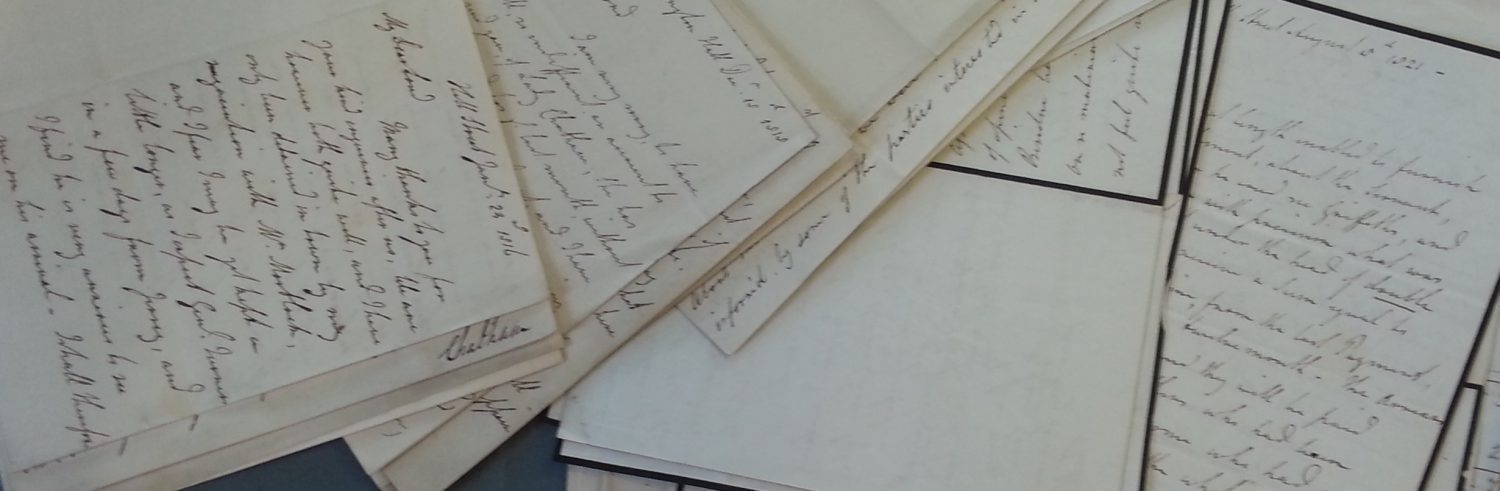
Earl Camden on the collapse of Pitt the Elder in the House of Lords, Kent RO CKS-U840/C173/30

I have been looking for an eyewitness account of the first Earl of Chatham’s spectacular collapse in the House of Lords in April 1778 for some time, and have finally found this account from Lord Camden to his daughter Elizabeth (“dear Betsey”, as the letter begins). I know there is a longer account from Camden to Grafton elsewhere, but I have not seen it so this is as close as I get right now.

The letter is dated 9 April 1778, so two days after Chatham collapsed.  Camden starts with some inconsequential gossip and platitudes (“the plumbs were excellent”) then moves on to the meaty stuff. Camden was present on the occasion: Chatham went to the House of Lords to oppose the Duke of Richmond’s motion for peace with America, and suffered from a stroke halfway through.

Camden writes:

“All our hopes of any material Change of Ministry are checked at once by the fatal Accidt. that happen’d on Tuesday Last in the House of Lords by a sudden fit that seiz’d the E. Chatham just as he was rising to reply to the D. of Richmond. You may conceive better than I can describe the Hurry & Confusion the Expressions of Grieff & astonishment that broke out & actuated the whole Assembly. Every man seemed affected more or less except ye E. of M[ansfield] who kept his seat & remained as much unmoved as the Poor Man himself who was stretch’d Senseless across a Bench. He continued some time in that posture till he was removed into the Painted Chamber. Assistance was sent for in an instant, & Dr Brocklesby was the first Physician that cd be got. In about an hour Addington [Dr Anthony Addington, Chatham’s personal physician] came, & soon after the Earl [revived?] the first Symptom of life being an Endeavour to reach, wch at last had its effect by discharging a Load from his Stomach wch probably was the Occasion of the fit, for it was actually no Apoplexy, but in truth very similar to that Seizure wch took him the beginning of last Summer, for all the Appearances were the same in both. He recover’d, if you remember, from the first very soon; & was better afterwds than we had seen him for many years. I pray to God this may have no worse Consequence. He was carry’d that Eveng to Mr Strutt’s in Palace Yard, where he still remains & is this day to be removed to Serjeant’s in Downing Street. He recover’d his Senses perfectly that Eveng & slept remarkably well. He continued well all yesterday & I hear he slept this morng till ½ past 6 o’clock. I hope the best, but according to my desponding temper, I fear the worst.”

Camden was right to “fear the worst”: Chatham never fully recovered and died on 11 May 1778.

A letter from Pitt to his brother, Kent RO CKS-U1590/S5/C25

This is one of the things I found so interesting today when I went to Maidstone for the archives. It’s a letter from William Pitt to his older brother John, Earl of Chatham, dated 12 October 1778. John was in Gibraltar at the time, having left with his regiment (the 39th) shortly after the death of his father in May. I had initially thought there was little or no correspondence during the early years between the two brothers, but it seems I was wrong, although this letter suggests why I might have got that impression.

What I find so sweet about it is that Pitt is completely aware that his letter might never get to its intended recipient, so he has this awkward air of almost talking to himself. The letter says nothing really beyond “Dear John, I miss you and want you to know that”. I find it poignant, particularly given the relationship the two of them had later in life.

To The Earl of Chatham, Gibraltar

12 October 1778, Hotel, King Street

My dear Brother,

I shall scarcely send you more at present than a single Line, which may perhaps never reach you. If it does, it will at least inform you that I am in the Land of the Living. Nothing has happen’d the least interesting since I wrote last to you, but I am afraid that very few of my Letters have yet reach’d you. I have been writing repeatedly ever since June, thinking to convey my Letters by Col. Mawhood, whose departure has been postponed from Day to Day, and I at least hear that he is not to go at all. He has made over our Letters to another Officer, by whose means, I hope you will at length receive them. At all Events, most of what those Letters contain is by this Time obsolete, besides which I have entirely forgotten most of it; so that I shall not attempt to send you Duplicates. One of my Dispatches has, I find, been intercepted by the French, having been committed to the Helena which unluckily fell in with their Fleet; and I know not how many more may share the same Fate. I left all well at Burton about a Fortnight since, and found Ld and Lady Mahon well at Hayes. I am now immediately going to Cambridge for about a Month. If I have any opportunity, you shall not fail to hear from me soon, whatever may occur.

Your most affectionate Brother, W Pitt.

[PS] I have sent the Stockings and Hats written for by Wood.

Archives!

I have just got back from the Kent Library and History Centre in Maidstone, where I spent the day up to my elbows in manuscripts and as happy as the proverbial pig in the proverbial you-know-what. It was my first time in the archives in seven years and, although I did feel a teensy bit like a fraud (last time I was in an archive I was a legit research student; now, I’m… well… I guess technically I’m a novelist, but I still feel kind of odd describing myself as such given I’m not published yet). But I now have that lovely almond-crossed-with-gunpowder old-document-handling-smell on my hands and I can’t believe how much I have MISSED it.

I unearthed a few treasures, some of which I will have to share at greater length later:

1) Unexpectedly opening a folder to find http://www.historicalportraits.com/Gallery.asp?Page=Item&ItemID=54&Desc=William-Pitt-by-Sir-Thomas-Lawrence-PRA-|-Sir-Thomas-Lawrence-PRA staring back at me (… which I find odd as apparently it is also held in a private collection, according to the site I’ve linked to here: presumably there were several copies floating about as the one I saw was definitely in pencil and looked legit)

2) Comedy moments as I tried to decipher the first Lord Camden’s handwriting, which looked like a number of spiders caught in a pile-up on the M25

3) Finding a bundle of notes on Pitt’s household expenditures around the turn of the 19th century, in which he clearly had his mind on other things (one of them has a pencil drawing of the ground plan of a stately home on the back….)

And much, much more.

It only took on average 5 minutes to get the documents up when I ordered them, too. That’s a vast improvement on what I remember. In this respect a certain record office which will remain anonymous, but which we will refer to here as Bloucestershire Brecord Boffice, holds the record at an hour and a half per order.

Feeling quite blissed out now.

Lord Chatham and the HMS Boyne

I came across the following article from The World, 12 August 1789, a while ago. Written to defend the appointment of Chatham (a soldier) to the Admiralty, it included an interesting paragraph at the end:

Really? What on earth is this all about? So off I go to research what happened to the Boyne.

So far I haven’t found anything specifically mentioning John, but I did find out that the Boyne was indeed in the West Indies in the early 1780s and returned in the summer of 1780 as part of a merchant convoy, carrying officers home. Its journey was not an easy one:

(St James’s Chronicle, 14-16 September 1780)

Captain Rice was from the 86th Rutland regiment. John had purchased a captaincy (… or been given one by the Duke of Rutland, I am not sure) in said regiment in December 1779, so I wondered whether he might have been on the same ship and whether this was the occasion mentioned by The World in 1789. Unfortunately it looks like the facts don’t match up: according to the London Chronicle of 24 August 1780, Chatham was *just setting out* for the West Indies, not returning.

On the other hand I also found this:

(London Courant and Morning Chronicle, 24 January 1780)

(… which, incidentally, also explains something I had long been confused about, namely why Lord Chatham would voluntarily go off to serve in the West Indies when most men would have avoided such a disease-ridden place like—-well, like the plague.)

So if Chatham was about to leave in January, why did he not leave till the end of August? Unless the newspapers got their wires crossed, and Chatham was on his way *back* from the West Indies at the end of the summer. This would in fact make more sense to me, as I know for a fact Chatham was back in England between October 1780 and February 1781. Had he sailed to the West Indies at the end of August, he would have had to re-embark almost instantly. Furthermore, the Boyne does not seem to have served again after her adventures in 1780, and was eventually broken up in 1783:

http://en.wikipedia.org/wiki/HMS_Boyne_%281766%29

I’m still looking, so who knows, but I found it interesting to find this little vignette into the life of an officer travelling to and from military outposts in the 18th century. (I suspect it won’t make it into the novel, as interesting as it is!)

If Chatham *was* on the Boyne in 1780, the Pitt family certainly had a narrow squeak on a number of accounts. 1780 was a spectacularly bad year for the family anyway: Hester, Lady Mahon, the eldest Pitt child, died in July of that year and James Charles, the youngest, a captain in the navy, died of fever in Antigua in the autumn. Had Chatham sunk with the Boyne in September, that would have been three out of the five children gone in the space of four or five months. Not to mention the fact that William would have been Third Earl of Chatham at the age of twenty-one, would never have entered the House of Commons, and might never have become PM.

Thank goodness throwing those cannons overboard worked!

Years ago I saw this…

Visit of George III to Howe's Flagship, the 'Queen Charlotte', 26 June 1794 by Henry Perronet Briggs - print

It’s a painting by Henry Perronet Briggs (1828) in the Royal Maritime Museum, Greenwich, and depicts the visit of King George III and Queen Charlotte to Portsmouth on 24 June 1794 to congratulate Admiral Lord Howe on his victory over the French at Ushant (the battle became known as the “Glorious First of June”). George III is shown handing Howe a ceremonial diamond-hilted sword on the quarterdeck of Howe’s flagship, the Queen Charlotte. Various members of the Royal family and the court watch. I can’t identify too many of them off hand, but conspicuous among them are the two main characters of my novel: prime minister William Pitt the Younger on the far left, and (immediately to the right of the chap in the rather dashing red and gold pelisse) Pitt’s brother John, Second Earl of Chatham. Chatham was, of course, First Lord of the Admiralty at the time and so had a prominent role in the celebrations.

I think it’s pretty cool. One day I might even go and see it in person!

Should be writing, so obviously I’m setting up a blog

As the title says, really.

I have precisely one day a week entirely set aside for writing—Thursday—and here I am setting up a Tumblr blog. Oh well.

Actually I am trying to clear my mind a bit for a novel reboot, so I might as well try and sort out my thoughts here.

The Long Shadow, for the uninitiated, is (will be?) a historical novel dealing with the relationship between William Pitt the Younger and his older brother John, Second Earl of Chatham. It should probably be the other way round, actually, as the story is told from John’s perspective. I do not pretend that I am not on first-name terms with my exalted subjects, but then reading their private correspondence makes me feel almost like we are friends. (That, or I am a stalker, but I prefer the first version.)

History remembers Pitt the Younger as Britain’s youngest prime minister (aged 24!); he is also the second longest serving (17 continuous years, 19 in all) and reputed to be one of the best. His short but incredibly busy life (1759-1806) was almost entirely encompassed by the reign of one monarch, George III. He took office in 1783, just after the end of the war with America, and masterminded the first half of the wars against revolutionary France. He is the subject of a number of biographies, with John Ehrman’s three volume opus at the academic end of the scale and William Hague’s entertaining work at the popular end. He has appeared in movies, novels, plays, TV series…. oh, you name it. He even has a Facebook page. Perhaps more than one.

And the Second Earl of Chatham? “What, you mean there was more than one?” Exactly…

I won’t go into the reasons why I find John so interesting now, although when I do I hope my enthusiasm will be catchy. I do feel incredibly sorry for him, as I think history has dealt him a rather unfortunate hand. He had an incredibly famous father and an incredibly famous brother; if that wasn’t bad enough, his own personal talents have been completely overshadowed by the disastrous expedition to Walcheren in 1809 (which he generalled) and by a not entirely undeserved reputation for sloth. Yet he was a long-serving cabinet minister, in office from 1788 until the Walcheren disaster, and when he chose to apply himself did so diligently enough.

As Sir Tresham Lever wrote in The House of Pitt (London, 1947, pp. 360-1): “The son of one genius and the elder brother of another, life must have brought him many disappointments; the heir to honours won by another and to an estate impaired and altogether inadequate to support the high rank his father had bequeathed him, his life must have been one long burden”. As sympathetic as this estimate seems, Lever goes on to describe him as “vain, pompous, stupid”, “the most stupid and useless of the Pitts”.

Poor John! Poor, poor John! I can only hope that I can help rectify that impression somewhat. 

And on that note, I should return to what I should be doing….