George Romney’s portrait of Pitt the Younger … and its companion

(From here)

A little while ago, ardentpittite drew my attention to a book listing all the portraits painted by the artist George Romney and their sitters. The book can be found here. John sat for his portrait primarily in May and June 1783 (around the time he proposed to his future wife Mary Townshend), and William mainly in July 1783. Interestingly, the portraits were commissioned by Rev. Edward Wilson, their childhood tutor, for his vicarage at Binfield near Windsor.

While at the archives yesterday I spent some time searching through Wilson’s letters to the Dowager Countess of Chatham. Wilson remained a family connection long after the Pitt children grew up, and it turns out that his letters to Lady Chatham are full of lovely little details about them, particularly John and William, the only two who managed to live beyond the age of thirty. Wilson was clearly very proud of William, for obvious reasons, but he seems also to have been very fond of John too, and it’s not John’s fault that nearly all historians who have quoted from Wilson’s letters cut him out almost entirely from them.

Wilson does not forget to tell Lady Chatham about the arrival of one of the commissioned portraits. William’s, it seems, was a long time in coming (it wasn’t paid for till 1798!), but John’s was ready in March 1786 and Wilson reports its arrival to John’s mother as follows (7/8 March 1786, PRO 30/8/67 f 121):

“I must not forget to tell your Ladyship that we have had an accession to the Parsonage within these few days that has occupied no small share of our attention during our improvements viz my Lord Chatham’s Picture by Romney. It arriv’d four days ago, & we all think it an admirable likeness, & a charming Picture. It is in quite a plain undress; but we are all agreed that it is the richest ornament we cou’d have [on one] side of our Chimney; & I hope before long to match it [with] another as rich by the same hand. … The Picture has been in a very advanc’d state a great while, & I think the likeness admirably caught but somebody has been simple enough to say they thought otherwise, & that damper added to an infinity of business does but ill accord with our longings”.

I won’t attach a copy of John’s portrait here, but it can be found in Sir Tresham Lever’s House of Pitt (London, 1947) opposite page 346. This is only a black and white of course  credited to Earl Stanhope at Chevening, but I have managed to track down the colour version. It’s still at Chevening (which is now, of course, the summer home of the Foreign Secretary and Deputy Prime Minister), and the Estate Office was kind enough to e-mail me a photograph. They retain the copyright so I can’t share it here, but … oh my god… I can’t describe what it does to me, I just can’t. *starry eyes* 

So next time you see the above Pitt portrait knocking about on tumblr or elsewhere, remember: it was commissioned for the man who taught the boy to read and write. I reckon he had a right to be proud.

Thoughts on Sir Martin Archer Shee’s portrait of John, Second Earl of Chatham

theironduchess said: I like the portrait of John (by Martin Archer Shee) having a bad-hair day the best

What, this one?

File:John Pitt, 2nd Earl of Chatham (1756-1835) by Martin Archer Shee.jpg

(From here)

Hmmm, I’m not keen. I know this was my avatar for ages, but the reasons I don’t like it are the following:

1) He’s having a terribly bad hair day, as you mention (John, John, John … I know you like to keep abreast of fashion, but why does your hair have to look like you’ve just inserted yourself into an electrical circuit?)

2) He looks like he’s thinking “………. Why the heck am I here? I’m not sure I like the artist and he seems to be painting me with a very funny expression on my face” (and there’s a nice recursive reference there for you)

3) The eyes are WRONG wrong wrong WRONG (where’s the Grenville sleepy-eyed look that we all know and love?! Unless he’d had his coffee that day!)

4) The mouth … ditto (John had his father’s mouth, not this tiny cupid’s bow affair)

I actually don’t think it looks much like him at all … although I guess, given I have never actually met him in person (and I’m never going to unless I get my hands on that time machine), this could be the most accurate of all the portrayals. I have a feeling it was painted in 1786 when John was in Ireland for a few weeks, so maybe it was done quite hurriedly on a spur-of-the-moment decision after a night on the lash with the Duke of Rutland (would explain the expression anyway). But I just don’t like it. Sorry.

Mostly it’s the hair.

Country vs Pies vs ??? – Pitt the Younger’s last words

A nice happy topic for a sunny Wednesday afternoon ;-). Possibly I ought to do this another day (because as usual, I should actually be writing the novel right now) but I feel the need to talk about this.

I had the good fortune to be invited to the dinner held at Pembroke College, Cambridge on 23 January 2006 to commemorate the 200th anniversary of Pitt the Younger’s death. (Nothing particularly special about this, as all history graduate students working on the period were invited.) This was the menu:
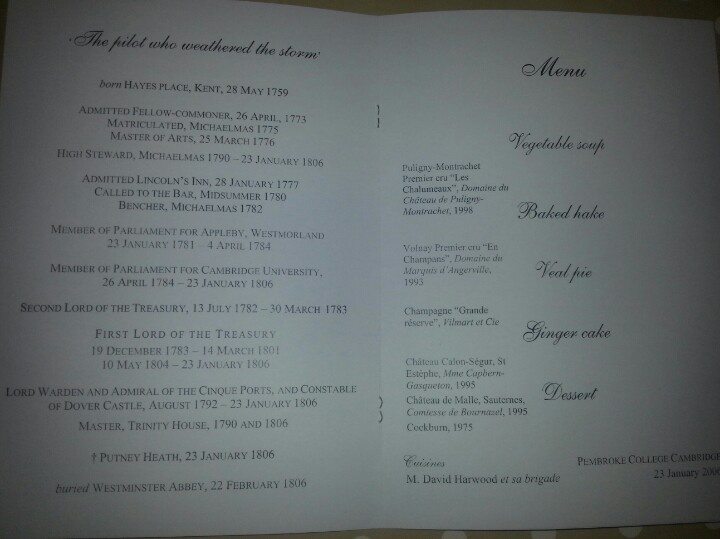
Commemorative Pitt dinner at Pembroke 2006 : programme page 3. Yes, yes, I know,  veal pie for the main course? I was halfway through before I realised what they'd done there. Ha ha.

I was halfway through the main course, which was rather nice, when I suddenly realised why veal pie was on the menu. Strangely nobody else seemed to have worked it out, or if they did nobody said anything.

The veal pie referenced, of course, Benjamin Disraeli’s story about Pitt the Younger’s last words. Disraeli’s story is recorded by Lord Rosebery in his “Pitt” (1891, p. 258), although had Rosebery known quite what he was starting he might have held back:

“Mr. Disraeli, in the more genial and less majestic days before 174, used to tell a saturnine story of this time [Pitt’s death]. When he first entered Parliament, he used often to dine at the House of Commons, where he was generally served by a grim old waiter of prehistoric reputation, who was supposed to possess a secret treasure of political tradition. The young member sought by every gracious art to win his confidence and partake of these stores.

One day the venerable domestic relented. ‘You hear many lies told as history, sir,’ he said; ‘do you know what Mr. Pitt’s last words were?’

‘Of course,’ said Mr. Disraeli, ‘they are well known … “O my country! How I love my country!”’ for that was then the authorised version.

‘Nonsense,’ said the old man. ‘I’ll tell you how it was. Late one night I was called out of bed by a messenger in a postchaise, shouting to me outside the window. “What is it?” I said. “You’re to get up and dress and bring some of your meat pies down to Mr. Pitt at Putney.” So I went; and as we drove along he told me that Mr. Pitt had not been able to take any food, but had suddenly said, “I think I could eat one of Bellamy’s mutton pies.” And so I was sent for post-haste. When we arrived Mr. Pitt was dead. Them was his last words: “I think I could eat one of Bellamy’s meat pies.”’ (Mr. Disraeli mentioned the meat—veal or pork, I think, but I have forgotten.)”

Amazingly enough, this story of Pitt’s last words—relayed, fourth-hand, by Rosebery, from Disraeli, who had it from Bellamy’s waiter, who had it from the messenger from Putney—is believed by some to be actually true. Amusing as it may be (insofar as it can ever be considered amusing to joke about someone’s dying words) I have no doubt Disraeli either made it up, or misremembered his source. I’m not saying Pitt did not ask for one of Bellamy’s pies at some stage of his final illness, but if he did it wasn’t right at the end. The last record of him eating anything much is I think on the 18th January when he was given a choice of egg or broth. I can’t see how his doctors would have considered feeding him a whole veal pie to be a good idea, even if they would have been happy to hear him asking for one.

If veal pie did not form part of Pitt’s last words, then what did he say? Disraeli above quotes Stanhope’s original (1861) version, printed in his biography of Pitt: “Oh my country, how I love my country!” (vol IV, 382). He later altered it to “how I leave my country” upon rereading his source, and this is now accepted as standard.

Stanhope took this from the notes written on 24 January 1806 by James Stanhope, Pitt’s “nephew” (… that is to say, the son of Pitt’s brother-in-law by his second marriage). James Stanhope was in Pitt’s room for the whole night before Pitt died and was, as far as I can gather, virtually the only person present. Ehrman in The Consuming Struggle (829, n. 2) claims Sir Walter Farquhar (Pitt’s doctor) and George Tomline, Bishop of Lincoln were in the room as well, but according to James Stanhope’s account Farquhar at least was not present (Stanhope IV, 381). George Rose, Pitt’s friend and political facilitator, recorded Pitt’s last words as “My country, oh, my country”. His authority was Pitt’s servant Pursler, who was definitely present. Farquhar, apparently, told Lord Malmesbury that Pitt’s last words were “Oh what times! Oh my country!” (Diaries of Lord Malmesbury, IV, 346). Pretty much the only person who disagreed with this version was George Canning, who decided (purely on the basis that he thought it more likely) that Pitt said “I am sorry to leave the country in such a situation”. According to Ehrman this was on Tomline’s authority, although going back to the source (Granville Leveson Gower’s Private Papers, II, 169) Canning is not reporting this as Pitt’s last words but simply as something Pitt said to Tomline before he died.

Basically, however, all sources who were present, or near, agree: Pitt’s last words, or very nearly last words, revolved around the situation of the country (and what else would he have been thinking of, I suppose? Ulm and Austerlitz had destroyed the Third Coalition, Britain was once again without allies on the continent, and Napoleon was thoroughly unchallenged). It seems clear that Pitt did say something of the sort on his deathbed.

Why, then, am I rather sceptical?

I think it is probably due to James Stanhope’s account. Apart from Tomline’s daily (and sometimes twice or even thrice-daily) letters to his wife from Putney, kept at Ipswich Record Office (HA119/T99/26 for those who are interested — although they were in the process of recataloguing when I visited so heaven knows what call number they are using now), Stanhope’s account is the only on the spot account worth going by regarding Pitt’s death. Farquhar wrote an account many years afterwards, and numerous interested parties wrote down their recollections of the stories they were told later (Rose, for example, and Pitt’s secretary William Dacre Adams), but only Tomline and Stanhope were writing on the spot at the time. Stanhope’s account thus has to be taken at face value, and its simple, factual tone lends both poignancy and credibility. But this is what Stanhope has to say about Pitt’s last words:

“At about half-past two Mr. Pitt ceased moaning, and did not speak or make the slightest sound for some time … I feared he was dying; but shortly afterwards, with a much clearer voice than he spoke in before, and in a tone I never shall forget, he exclaimed, ‘Oh, my country! How I leave my country!’ From that time he never spoke or moved” (Stanhope IV, 382)

So according to Stanhope, Pitt had spent the night moaning and muttering incoherently, then suddenly mustered up the strength to “exclaim” his last words, before subsiding into silence. Hmmm. Is that likely to happen? Could it happen? It sounds like Pitt was lapsing into a coma, woke up conveniently to speak his last words clearly and commandingly, then returned to his coma. Could this happen? I don’t know. I have precisely zero experience of death beds (… and quite happy for it to remain that way actually).

It’s definitely credible that Pitt would have spoken about his country on his deathbed— and yet how convenient that he came out with such a quotable line! I cannot possibly be the only person who thinks it almost sounds as though the parties present got together to work out a safe, “canon” version of the last words for posterity to chew on. Although I find it hard to believe James Stanhope would have colluded with Tomline and Farquhar on this, especially as Lady Hester Stanhope, James’s sister, was always quite happy to cry humbug at Rose/Tomline et al’s attempts to sanctify Pitt’s memory.

All in all, I have nothing but a hunch to suggest that Pitt’s last words may not, in fact, have been his last words. That he said those words, or something like them, seems likely, especially as everyone who was around Putney at the time agreed on a similar version. But did he say anything afterwards? Were they spoken much earlier? Who knows? The only thing I can say for sure is this — Pitt did NOT ask for one of Bellamy’s veal pies.
John is here!

John is here!!!!!!!!!!!!

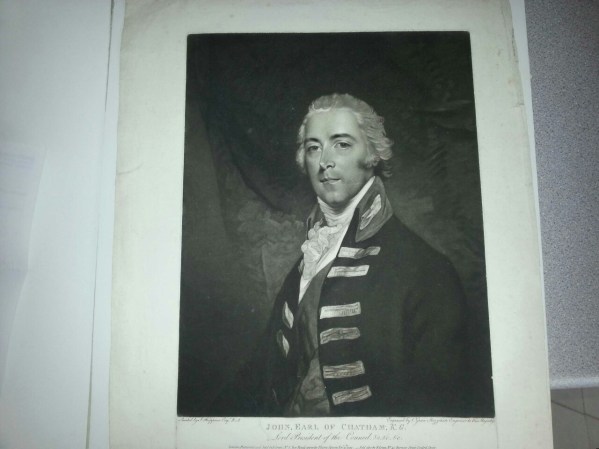
“John, Earl of Chatham, K.G. Lord President of the Council &c.&c.&c. Painted by J. Hoppner Esqr. R.A. Engraved by V. Green Mezzotint Engraver to His Majesty.  London. Published and Sold by V. Green, No. 2, New Road, opposite Fitzroy Square, Novr 9th 1799. Sold also by R. Green, No 42, Berners Street, Oxford Street.”

There was some provenance for the print, but I stupidly assumed they would send it to me so didn’t note it down. Will have to email.

That was one well wrapped parcel — paper, bubble wrap, cling film (yes you read that right), sealed card, tissue paper and the above. I think getting into Fort Knox would have been easier.

It’s huge — about A3!

*dies*

Edited to add: I have a feeling this may be the print referred to by Lady Hester Stanhope in a letter written to her grandmother the Dowager Countess of Chatham, undated but probably around 1800 or so: “Before this you must have received the likeness of the King & my two dear Uncles. The King & Mr Pitt I think perfect! & so is Ld Chathams air, but the nose I think rather defective, not being quite long enough” (pahahahahahahahahaha!). (National Archives, Hoare MSS, PRO 30/70/6/15/48)

Also have now received notice of the provenance of the print. It belonged to William Fitzwilliam Burton of Burton Hall, Carlow, Ireland (1796-1844). No idea who had it between 1844 and 2013, but it’s mine now, muahahahahahaha.

I’m getting John for my birthday!

It’s official — I’m getting John for my birthday! 😀

No, really, I am. Managed to find a copy of the Valentine Green print of the Hoppner portrait for sale. I know it’s a little early, but I wanted to grab it before anyone else did (BWAHAHAHAHAHAHAHAA I am the only person daft enough to want to buy it, I know, but still…)

John Pitt, 2nd Earl of Chatham, by Valentine Green, after  John Hoppner, published 1799 - NPG D1283 - © National Portrait Gallery, London

Why hello there. ;-D

I will post a picture of it when I have it and have had it all framed and ready.

*excited*

Lord Chatham … Lord Lieutenant of Ireland?

A bit of a puzzle this. Which is to say, no, it’s not a puzzle, but it is curious. When I was at the National Archives a few weeks ago I was thumbing in a bored and rather desultory manner through roughly four zillion equally illegible fluffy content-free letters from various members of the Royal Family to Mary, Countess of Chatham (“Your handkerchief at the drawing room yesterday was just sublime, can I borrow it?” “I love the way you do your hair— can we borrow your hairdresser?” “I hear dear Lord Chatham has a headache again” — the alarming thing is I am only slightly paraphrasing :-/). I was just about to switch my brain off in self-defence when I came across the following letter to Lord Chatham from King George III:

“Queen’s House Feby 18th 1801

The King is so much convinced of the Attachment and He flatters himself Affection of the Earl of Chatham that He prefers writing to the Lord President [Chatham was Lord President of the Privy Council] than in conversation calling upon Him (when the Marquess Cornwallis’s Resignation of the Lieutenancy of Ireland shall arrive) to accept that Office. The Manners, Integrity and Correct Line of Conduct of the Earl of Chatham certainly point Him out as the Person most proper for the Station; besides His having returned to His Military Profession, He as Lord Lieutenant must of course take the Supreme Command of the Troops stationed in Ireland, and the Commander in Chief only act under His Orders; the Military business must consequently be transmitted by the Lord Lieutenant to the Duke of York, as Commander in Chief of my Army, who when He has received my Approbation to the Successions proposed, will transmit them to the Successors of Mr Wyndham [sic – William Windham was Secretary at War], and the Commissions be prepared by the Secretary of State as those of the rest of the Army. – George R” (PRO 30/8/364 f 149)

Uhm, what now?

Some background, and I realise this is one of the most intricate and complicated topics in European history but I will have to be brief. In May 1798 Ireland (long disaffected and a target of repeated attempts of the French to invade the British Isles) exploded into rebellion. The rebellion was quickly put down, but the Lord Lieutenant at the time, Earl Camden, a civilian, was replaced by Lord Cornwallis, a military man. Pitt the Younger’s government decided to force through an Act of Union binding Ireland to Britain, dissolving the Irish Parliament and creating the United Kingdom of Great Britain and Ireland in January 1801. A great deal of patronage and corruption was required to persuade the Irish Parliament to dissolve itself (read Patrick Geoghegan’s The Irish Act of Union (2000) if you want to know more: it’s excellent). Part of the fallout was the collapse of Pitt’s own administration when the King got wind that Pitt was possibly considering making Catholic Emancipation (allowing Catholics in the United Kingdom to sit in Parliament and hold high office) part of the Union package. As far as the King was concerned this would lead to a violation of his Coronation Oath to defend the Anglican establishment. The resulting ruckus led to Pitt’s resignation and half his cabinet followed. Cornwallis, the Irish Lord Lieutenant and up to his ears in the Catholic business, was one of those who followed Pitt out of office. Lord Chatham, Pitt’s own brother and an opponent of Catholic Emancipation, stayed on under Pitt’s successor Henry Addington.

Given the circumstances it was clear Cornwallis was going to have to resign with Pitt, so to find the King ruminating on a possible replacement for him is not surprising. The main problem was that the shape of Ireland’s post-Union government was not clear. Very possibly there would not be a Lord Lieutenant at all, and if there was then he might well be of no more consequence than his county counterpart in Britain (county lords lieutenant still exist but on a purely ceremonial scale nowadays). One of the main reasons for the Union in the first place had been to tie Ireland’s government closer to London. Edward Cooke, one of the Irish under-secretaries of state, wrote to Lord Camden that “the Administration of the two Islands must be one” (18 July 1800, Kent RO, Camden MSS U840/C104/1). How this was to be achieved in practice was not clear, and remained in a state of lamentable confusion for decades after the Union was so hurriedly implemented, unfortunately much to Ireland’s detriment.

But Ireland could not really be considered as equivalent to an English county. So long as Ireland remained in a state of near unrest, it would also be best if the King’s representative in Ireland, Lord Lieutenant or no, was also a military man. In this context Chatham was to an extent a natural choice. In fact it was by no means the first time his name had been connected with Ireland. He was rumoured on numerous occasions in the 1780s to be a possible successor to the Marquis of Buckingham as Lord Lieutenant, although these were probably just rumours. In the summer of 1800, however, in the midst of the Union manoeuvrings, he seems to have been seriously considered. Lord Camden wrote to Lord Castlereagh on 30 June “that the Rumour you have heard of Ld Chatham coming over is not entirely without foundation” (PRONI, Castlereagh MSS D3030/1385). Camden later wrote to Pitt that Chatham’s “nomination [is] very desirable in many respects. His name & close connexion with you, His Manners & good sense would be advantageous there. The decided Preference He has for the Military Service would make it eligible for himself as the Command would be more considerable” (Camden to Pitt, 1 August 1800, Kent RO Camden MSS U840/C30/6). Having a military man who was also close to the Prime Minister in Ireland would have been of obvious benefit. (Incidentally Camden also mentioned that Chatham could do with the salary, although he seems to have struck that bit out of his draft to Pitt! 😉 )

What startled me most about finding the King’s letter was, firstly, the idea of Lord Chatham as Lord Lieutenant (…because let’s face it, this is John Pitt, 2nd Lord Chatham, known by all and sundry as the “Late Lord Chatham” we’re talking about) and, secondly, the fact that the King seems to have originated the proposal.

I checked with a friend of mine, Charles J. Fedorak, author of Henry Addington, Prime Minister 1801-4, to find out whether Addington had even been aware the King was offering Chatham the Lord Lieutenancy of Ireland (I’d say the above quoted letter suggests he was not). He referred me to Pellew’s Life of Henry Addington, Lord Sidmouth (1847, I, 301-4) in which it is clear that it was indeed the King who came up with the idea. Chatham wrote to Addington offering to continue in his office as Lord President of the Council on 8 February 1801, and on 11 February the King wrote to Addington as follows regarding “the natural, nay necessary, return of the Marquess Cornwallis from Ireland”:

“At present it is neessary to fill up that office [Lord Lieutenancy] with a person that shall clearly understand that the Union has closed the reign of Irish jobs; that the civil patronage may be open to his recommendation, but must entirely be decided in England. Earl Chatham, if he can be persuaded, is the man who, from his honour, rectitude of mind, and firmness, is best calculated for that station, particularly from his love for the military profession to which he is again returned; and though of too inferior a rank in the army for a separate command, his employment as Lord Lieutenant would of necessity place him above the commander in chief of the troops in Ireland. He would thus embrace both the civil and military command.”

Chatham was much more of a courtier than his brother was and had spent much of the previous summer drilling his regiment at a camp near Windsor. He and his wife seem to have been in charge of entertaining the Royal Family when they came to visit the encampment and Chatham had obviously made an impression. On 12 February 1801 the King wrote to Addington that “I truly bear the warmest affection for him [Chatham]” (Pellew I, 304).

Chatham had clearly already been quite definite in his refusal to serve in Ireland (and who can blame him— Ireland cannot have been a good place to go in 1800 or 1801). He replied to the King on 18 February declining the Lord Lieutenancy, politely but firmly in tones that evoke echoes of the “Hell no, not again!” that may have crossed his mind on first reading the King’s letter:

“Lord Chatham has been long persuaded that the office of Lord Lieutenant of Ireland was one which he cou’d neither hold with any comfort to himself or with any prospect ot advantage to your Majesty’s service. At the same time, if personal difficulties (however strong) alone stood in the way of the possibility of his undertaking that situation, Lord Chatham would have readily sacrificed them at such a moment as this, to a sense of dutiful obedience to your Majesty’s commands. But being firmly convinced, on considering all the circumstances of the present times, as well as on a review of the past, that he shou’d be, of all others, the most unfit to advance (what must be always nearest his heart) your Majesty’s service, he presumes to hope that he cannot more strongly evince the sincerity of his attachment or the warmth of those sentiments which he must ever gratefully entertain towards your Majesty, than by supplicating your Majesty to permit him to decline a station to which your Majesty’s partiality has induced you to call him.”

(Aspinall, Later Correspondence of George III, III, 504)

George III seems to have been anxious to see Chatham provided for under the new administration. His response to Chatham’s letter on 19 February suggests that, although he accepted Chatham’s answer on the Lord Lieutenancy, he was determined Chatham should have some reward. I wonder what Addington would have thought had he known the King was offering Chatham not only another cabinet office, but also a pay rise:

“The King should not do justice to His Affection for the Earl of Chatham if He Bid him farther on a Station in His Service which His Majesty is convinced the Earl of Chatham is more capable to fill with Efficiency than any Person. His Majesty thinks the Marquess Cornwallis will certainly resign the Office of Master General of the Ordnance, the Irish Ordnance ceasing, the King will think it but right on the encrease of business to raise the Salary of that Office to an equality with the President of the Council, iun which case He should hope the Earl of Chatham will accept of that Employment; His Integrity would be highly useful in Controuling that Great Branch of Military Service. – George R” (PRO 30/8/364 f 151)

Chatham did in fact take on the Ordnance but not for another few months. I do find it interesting that the King seems to have been taking it upon himself to make so many of the arrangements for his new government in February 1801, at least before he caught his chill and slid into a brief relapse of mental illness. I also find it interesting that the King obviously took such a personal interest in Lord Chatham— who, after all, took the King’s side in the Catholic Emancipation debate.

Sorry it’s so long, but I found this fascinating and felt I had to share.

John, Earl of Chatham as a …….. goose?

Spent my lunch break today searching the British Museum’s print catalogue for caricatures of John, 2nd Earl of Chatham.

*scream face*

*slams head onto desk*

May I ask why John is nearly always portrayed as a goose, or riding a goose, in caricatures referring to Walcheren? Is it an extremely unsubtle joke on the fact that geese are supposed to be stupid? Or is there some other reason that escapes me? (I’m probably reading too much into it)

For example:

FOR DESCRIPTION SEE GEORGE (BMSat)<br />
Etching

Probably the only print that made me giggle even slightly was this one:

FOR DESCRIPTION SEE GEORGE (BMSat)<br />
Etching

From the description: “Chatham sits in an arm-chair attended by doctors; he wears a night-cap, and over his uniform and boots a patterned dressing-gown, and holds a copy of ‘The Times’. He looks up at a hideous doctor (left), who feels his pulse, holding a watch. The doctor says: “Your Pulse is going with uncommon Expedition indeed my Lord, you have too much Blood in you. you must lose a few Ounces”. Chatham: “Don’t mention that word [Expedition] again Doctor, it brings an [sic] a Flushing in my face, and sets me in a palpitation”.” (From here)

Yes, I am a sucker for bad puns. :-/

Pitt the Younger was not a Tory

“Oh! It makes me sick to think that … they [Lord Liverpool and George Canning] must even bring discredit to his [Pitt’s] memory by attributing to him a line of conduct he never pursued. To think of Canning’s going about and saying, ‘This is the glorious system of Pitt’; and the papers echoing his words—‘This is the glorious system of Pitt!’”

(Charles Meryon, Memoirs of the Lady Hester Stanhope (London, 1845), III, 168)

Lady Hester, I salute you. You may have been barmy as a sackful of squirrels but you saw something that many of your contemporaries had lost sight of, and most historians too.

I have been recently getting quite hot under the collar about this topic (always sure to raise my blood pressure), so much so that I am contemplating getting a huge flashing neon sign pinned up on every single social network platform I frequent reading “PITT THE YOUNGER WAS NOT A TORY”.

Can I say that again? PITT THE YOUNGER WAS NOT A TORY. (Yes, I am shouting. So shoot me.)

I’m not just talking about his self-identification as an “Independent Whig” — something he declared publicly only once to my knowledge, and which was less a statement of his Whiggery (which he would have taken for granted, much as, say, I take for granted the fact that I am female) than a declaration that he was attached to no other political leader available at the time.

Perhaps historiography has moved on a little in the past ten years since I studied this academically, and I would be very grateful if anyone could pass any more recent references my way, but to my mind Jennifer Mori in William Pitt and the French Revolution, J.J. Sack in From Jacobite to Conservative and his super article “The memory of Burke and the memory of Pitt” (Historical Journal 30(3) 1987), and Michael Duffy’s biography Pitt the Younger have it covered. In sum, Pitt’s ideologies were drawn from very traditional Whig sources (unsurprisingly). Conservative (with a small “c”), yes, undoubtedly; rooted in tradition, absolutely; not very creative perhaps either—but Tory? Big T Tory? “Founder of the modern-day Conservative Party” (……..and at this point I would like to bitch-slap William Hague) Tory? No.

Even Pitt’s immediate followers struggled to fit him into the strait-jacket of party political ideals. Even in his own lifetime Pitt (during the short time he spent in opposition to Henry Addington between 1803 and 1804) drove Canning half-mental by refusing to shackle himself to a particular line of conduct, going out of his way to stay aloof to such an extent that he managed to drive off half his old political following by the time he ended up back in office. (Incidentally John Ehrman deals with this confusing period excellently in his chapter of The Younger Pitt: The Consuming Struggle entitled “The pursuit of ‘Character’”). When the old “Pittite” following was splintering and reforming itself in the 1820s Pitt’s stance on parliamentary reform, abolition of the slave trade and Catholic Emancipation (to name only the most important) allowed men who identified with him to invoke his name in support of all sorts of diametrically opposed political positions. At the annual Pitt Club dinner Pitt was toasted as the opponent of religious toleration, which I find especially ironic as Pitt’s support of the issue led to his resignation in 1801. True enough the modern-day Conservative Party traces its ancestry back to Pitt, but not directly by any means, and to say “But modern Tories come from Pitt” is like saying Gladstone was a Liberal Democrat.

So what was Pitt? The question would have astounded him. Why, he was a Whig, of course. And it wasn’t his fault that Fox’s followers were much more ideologically organised than his own were, and able to lay claim to that label far more successfully.

(And incidentally, WHY is Lord Grenville described as a “Whig” when he was MUCH more ideologically conservative than Pitt was? Is it because he was in government coalesced with the Foxites? Give me strength!)

So, are we clear? 🙂

/soapbox

By the way I welcome any discussion of the above points. I’m sure many of you have a very different opinion. 🙂

*Falls off chair*

Was just scouring the AMAZING Wellington Database at the University of Southampton (http://www.archives.soton.ac.uk/wellington/) to see if I could find any reference to John’s correspondence with the Duke, and found this in regard to the Catholic Emancipation issue in 1829.

It’s from a letter to Lord Camden, 29 March 1829:

“I received your note last night. It is very difficult for me to find a moment to go to LordChatham again who is visible only at the time that others must see me upon business.” (WP1/1007/46)

In other words, John and the Duke of Wellington were only both awake for a short period of the day 😉 (In John’s defence it looks like his health was already poor.)

Incidentally it seems John opposed Catholic Emancipation, which doesn’t surprise me as he seems to have been rather against it in 1800-1801 when Pitt the Younger thought of proposing it. He sent a letter to Camden, 1 April 1829, asking Camden to make use of his proxy vote in the House of Lords in favour of the Bill, but explained “I cannot say that I am quite satisfied of the urgency there was of pressing forward the measure of concession, but I am clear that there is now but one course to be pursued and from my confidence in the Duke of Wellington and my anxious wish to support his government, I shall certainly vote for the bill.” (WP1/1008/8)

This does slightly sadden me as one of the things that initially attracted me to Pitt was his willingness to keep an open mind on the Catholic question (… oh, goodness what a contentious point: watch the reams of emails from outraged historians come rolling in!), but I’ve always known Chatham was the more conservative of the two brothers and after all I can’t judge him by modern standards. (And yet.)

By the way if you haven’t found this database … check it out. It absolutely rocks.

Very cute, John

Third post today, but why the hell not?

Without giving too much away (…….. if you want spoilers just check out the passages from Volume 2 of Ehrman’s biography of Pitt the Younger that first inspired my novel), the second Earl of Chatham and his brother had a relationship that was at times quite troubled. Lord Ashbourne wrote that “relations between the two brothers remained on the most affectionate and harmonious basis” (Pitt: Some chapters of his life and times (1898), p. 178), but Ashbourne can’t have read any of John’s correspondence because John was anything but subtle in expressing his feelings.

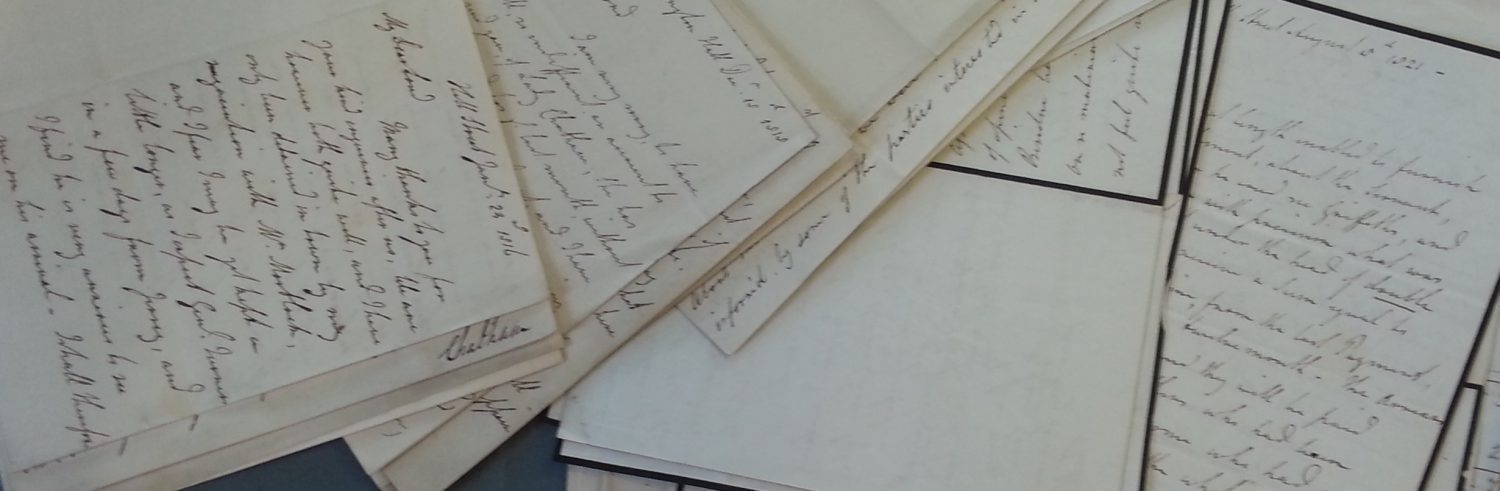
The breach was patched up well enough, and by September 1795 the two brothers were corresponding, perhaps ever so slightly stiltedly as the following signature from a letter from Chatham to William on 29 September 1795 suggests:

(PRO 30/08/122 f 137)

It’s not as sweet, though, as this letter from Chatham to Pitt on 20 May 1799. The first half of the letter is devoted to political ruminations and thoughts on upcoming cabinet discussions, and then all of a sudden Chatham comes over all “um, ah, I’ve run out of things to say” and starts talking about the weather:

“It is a good while since I have seen so much of the Spring in ye Country, and I have had but a bad specimen of the weather, as I think, with the exception of two or three days, it has been uncommonly bad, but the heavy rains of yesterday and today will I hope bring about, a favorable change”.

(PRO 30/08/122 f 142)

I presume John realised he had a page and a half of paper left to write on and wanted to make it worth his brother’s while, but still, pahahahaha, I had to laugh when I read that.

At least he signs off in a slightly less abrupt and self-conscious way: