The Helder Campaign, 1799: research visit to Noord-Holland, Part 1

About a year ago I did a considerable amount of research on the Anglo-Russian Helder expedition of 1799 (you can read more about that here). John Pitt, 2nd Earl of Chatham had returned to his military career in 1798, and was appointed to the command of the 7th Brigade in the expedition. My novel follows him to Holland, and last week I finally got the opportunity to do some location research. My husband and I hired a tandem, took a train from Amsterdam to Den Helder, and cycled through the most important locations associated with the campaign.

noord-holland_map

Day One: Amsterdam – Den Helder – Callantsoog – Schagerbrug – Schagen

 The train up to Den Helder was instructive. We sat with a friendly and chatty local who was interested to hear the purpose of our visit and helpfully pointed out a number of towns from the train window as we travelled up. My impression was of comparatively small, tight towns interspersed by long stretches of flat countryside. We passed through Castricum, Alkmaar and Schagen before finally arriving at Den Helder, in 1799 Holland’s northernmost point ….. about at the same time as the thunder.

OLYMPUS DIGITAL CAMERA

My husband with our hired tandem at Den Helder station


We set off as swiftly as we could, getting briefly lost in town while I got used to our map. At last we found the coastal cycle path, cycling up a steep incline to reach the top of the dyke surrounding the seaward-side of the town. From here we paused to take in the beautiful view towards the island of Texel: a significant strategic point for the navy in the 18th century.


Looking out to Texel from Den Helder

Looking out to Texel from Den Helder


Shortly after I took the above photograph, the heavens opened with an almighty peal of thunder. I was at first quite glad about this — the 1799 Helder expedition was plagued by bad weather, and I had hoped to have the “full Helder experience” for at least a little while — but there was a strong south-easterly wind and, after a few minutes, we had to stop cycling because neither of us could see. Honestly I never knew rain could actually be painful. Even standing still it felt like being repeatedly whipped in the face by a wet pincushion. (At least it was warm!)

Eventually the rain died down, but did not completely stop all afternoon. Still, at least we were able to cycle on, passing Kirkdijn Fort (1811, I believe) and turning southwards down the side of the coast towards Callantsoog.

I did not take too many photographs at this point, because any attempt to stop made us cold as well as wet. Luckily the tandem we had hired was a complete tank, built for city use rather than up-and-down coastal paths, complete with a dicky first gear which (after getting stuck in it a few times) we avoided using unless utterly necessary.


Dunes around Den Helder

Dunes around Den Helder


By this time we were entering the dunes. These run down the majority of the Helder peninsula coast, separating the flat mainland from the turbulent sea. Most of the 1799 Helder fighting took place in this terrain, so I was very interested to see it. Now it is a nature reserve, but I doubt it has changed a great deal in 200 years. The sand was quite dense and held together with scrub. Cows and sheep roamed everywhere. Whenever we joined the roads we saw little draining canals everywhere, criss-crossing the countryside in all directions.

What with the rainfall making the roads slick with water I could see why some British soldiers, retreating at the end of the campaign in torrential rain, occasionally mistook the canals for roads and fell in.

In mid afternoon we reached Keeten near Callantsoog, where the British made their first landing on Dutch soil on 27 August 1799. They were immediately challenged by the Dutch General Daendels, whom they beat back on a narrow strip of beach only wide enough for one battalion to face front at a time. It was the first pitched battle of the campaign and set the tone for the rest: short, sharp and bloody. The sand was very difficult to walk on, soft and giving way underfoot. I cannot imagine how hard it must have been for the British, who had to wade up through the surf to the beach, probably still feeling seasick, then fight their way inland.
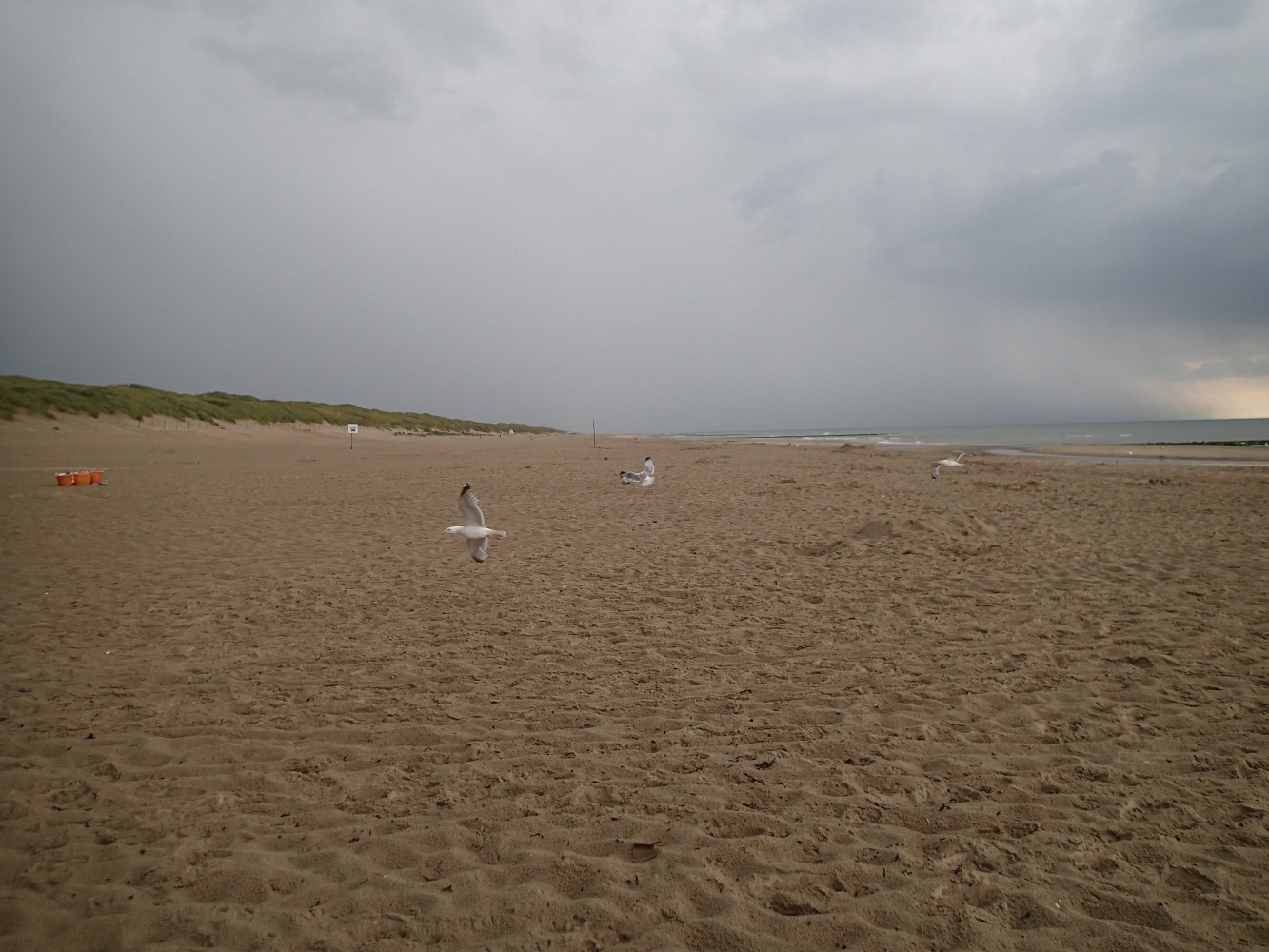
 

Keeten Beach, where the first battle of the Helder campaign took place

Keeten Beach, where the first battle of the Helder campaign took place


By now we were sopping, so we hastened to our destination for the night: Schagen. On the way we passed through Schagerbrug, a tiny hamlet which (as the name suggests) consisted mostly of a bridge over the North Holland Canal, a church, and … er … that’s about it. For some reason Schaberbrug was the Duke of York’s first headquarters as Commander in Chief of the Allied British and Russian army. No clue where he stayed but I did not have time to hang around and search as the weather was so awful. I have no idea why York chose Schagerbrug as his HQ when Schagen, a much larger market town, was only just down the road (can anyone enlighten me?) but I paused only to take a photograph or two.


Schagerbrug Church

Schagerbrug Church


We arrived at Schagen shortly afterwards. Schagen is a much bigger place than Schagerbrug, a collection of traditional Dutch brick houses with the stereotypical step-faced fronts clustered around a beautiful church. We stayed in the Castle, which it turns out was used as a barracks for British soldiers in 1799. Unfortunately the Brits trashed the joint and the castle was largely demolished in 1819.

This was, incidentally, the only place where I saw a plaque commemorating the 1799 Helder campaign.
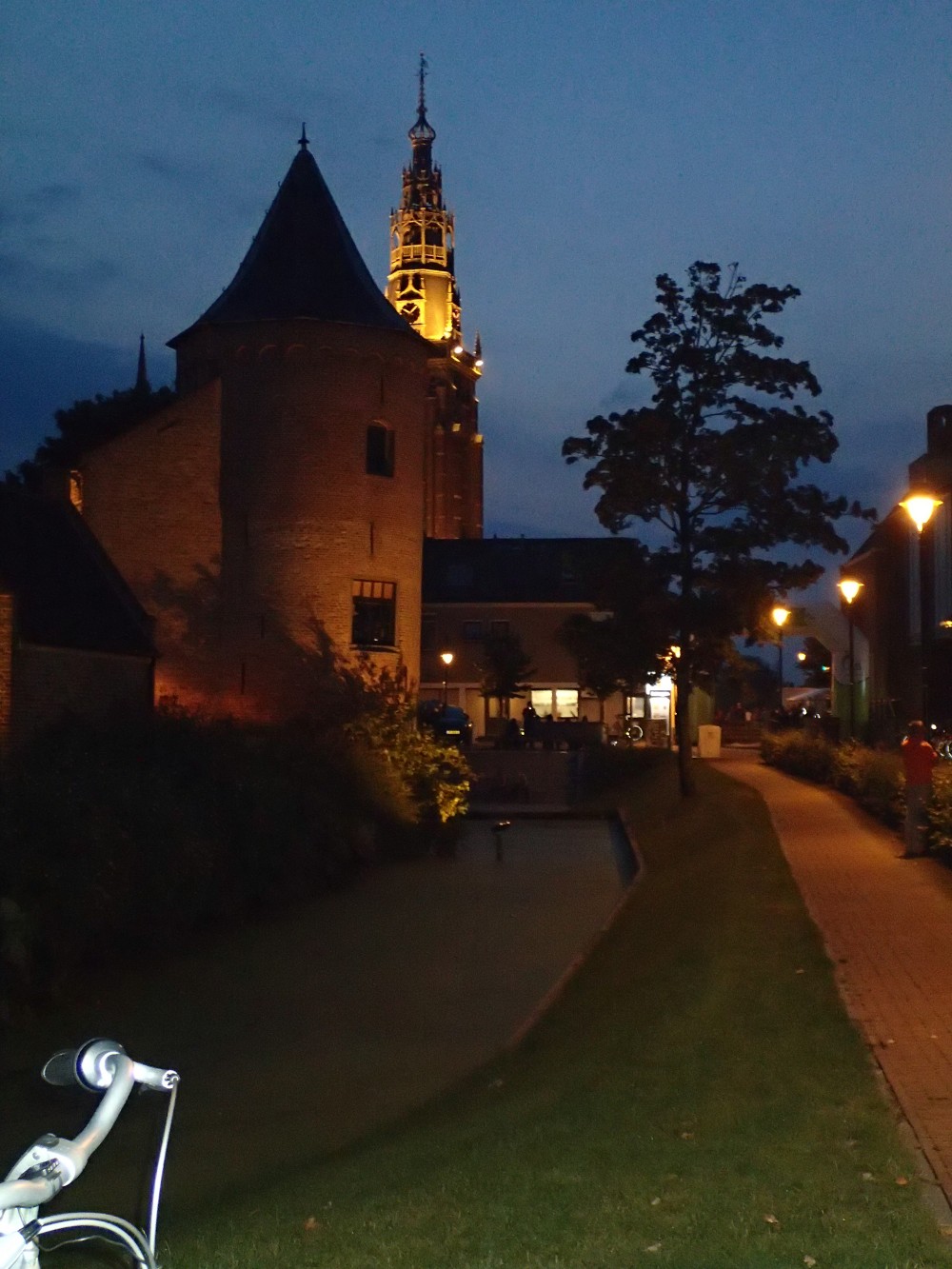
 

Schagen Castle looking out to market square and church

Schagen Castle looking out to market square and church

Plaque commemorating the 1799 Helder expedition in Schagen

Plaque commemorating the 1799 Helder expedition in Schagen


Day Two: Schagen – Schoorl – Alkmaar

The next day was dry! Hallelujah! We were glad about this, as we had both had enough of the complete 1799 experience and our shoes were still wet. We set off about eleven across the flatlands back towards the coast, cycling largely along the top of dykes and alongside the canals veining the flat “polders” landscape.

We were making for Schoorl at the base of the dunes. Our objective was to follow, as much as possible, the route John, Lord Chatham would have taken with his brigade on 2 October 1799 during the battle for Bergen (alas we ran out of time and were not able to visit Bergen itself, but I do not think John set foot there either). Chatham was attached to General Dundas’s brigade and tasked with acting as a reserve force for the Russians. The Russian force did most of its fighting in the towns of Schoorldam and Schoorl, but, once they had cleared Schoorl of French, refused to proceed to take Bergen. British General Coote said the Russians lay down on the ground and refused to get up when he ordered them to march.

Chatham’s brigade then marched into the sand dunes to assist General Dundas, whose battalions had become scattered in the terrain. Chatham’s men helped form a stronger line and, under strong fire from French artillery in the trees on top of the sand dunes, cleared the field of enemy.

We cycled in the direction I guessed John would have taken his men. The countryside was, as before, perfectly flat, but before long the dunes loomed ahead of us on the horizon.
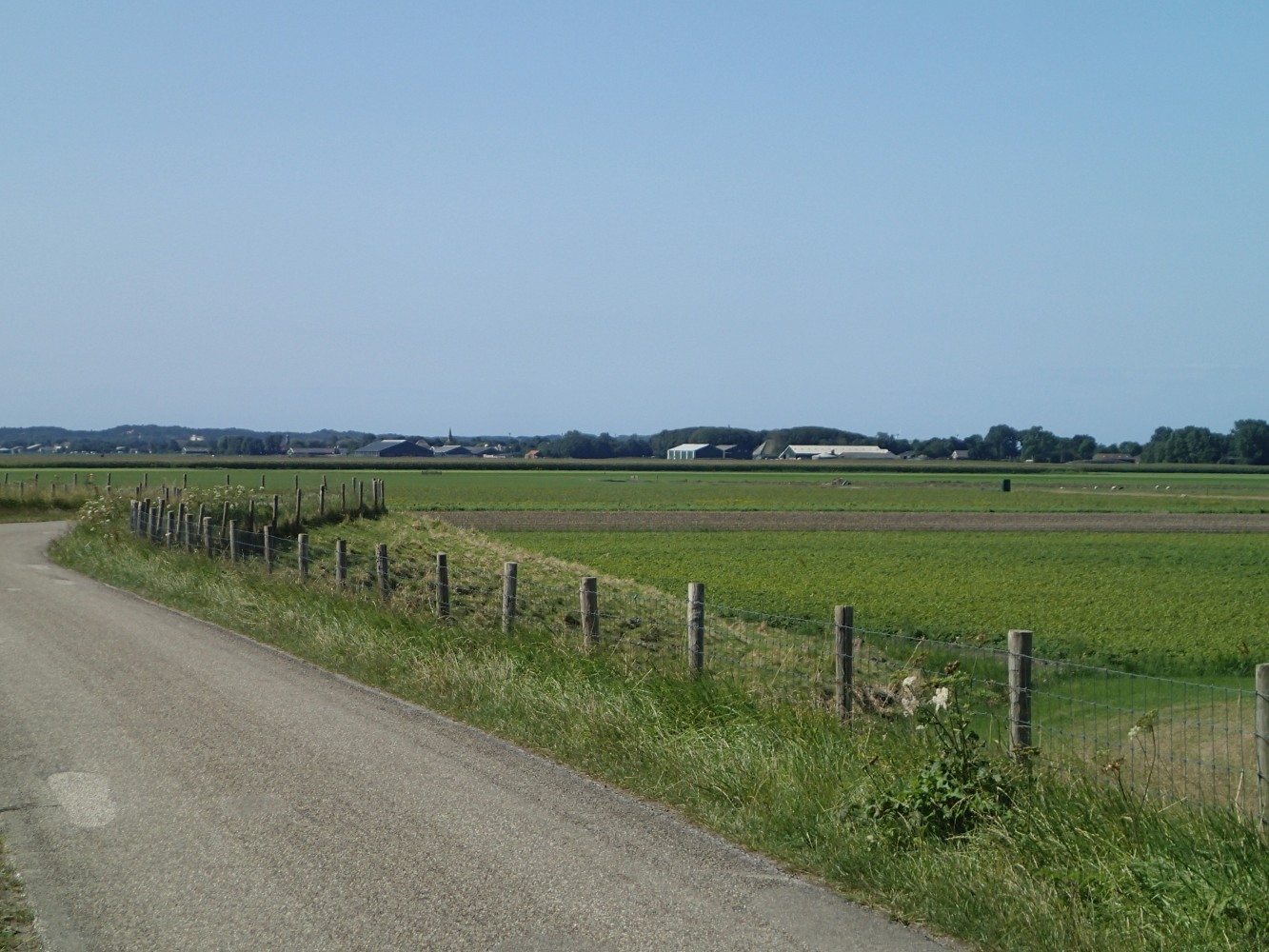
 

Road to Schoorl, looking towards sand dunes

Road to Schoorl, looking towards sand dunes


The terrain here is quite different from northern Helder: heavily wooded, with the most enormous, steep, impressive dunes. The ones at Schoorl were the biggest of all, between 150-200 feet high. Forget everything you’ve ever known about dunes: these were BIG, like small mountains with a couple of kilometres worth of undulating landscape on top covered with trees. I immediately began to appreciate why all eyewitness accounts of the campaign laid such stress on the “intricate” nature of the landscape.

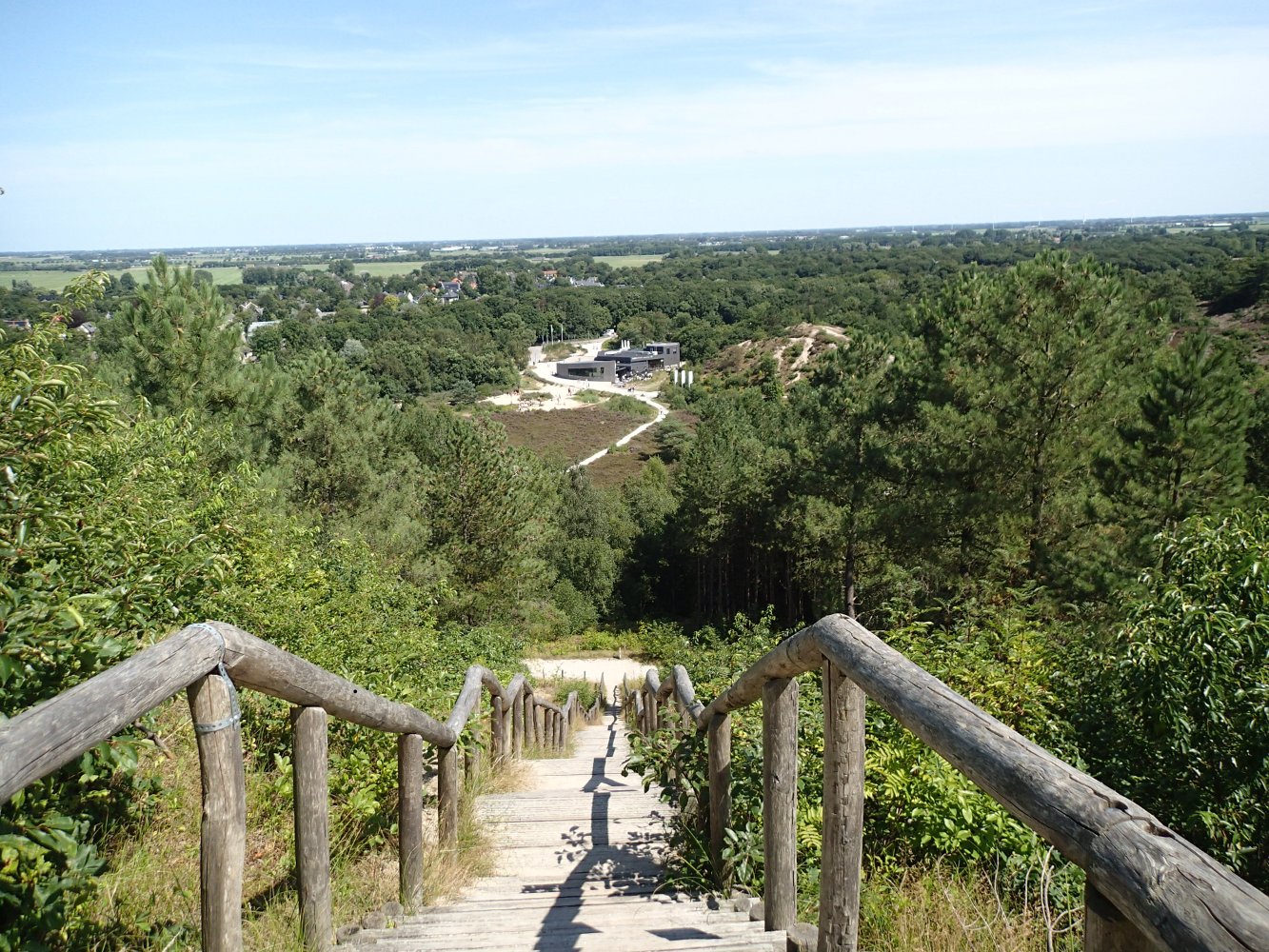
 

OLYMPUS DIGITAL CAMERA

OLYMPUS DIGITAL CAMERA


On top of the dunes, the trees were very dense. I got the impression many of them had been planted since 1799 — they were predominantly pine, and I seem to recall contemporary accounts described mainly beech and birch — but I could easily see how the French could launch ambushes from the trees on attacking troops, and there were so many tree-roots criss-crossing the ground it must have been extremely difficult to march up the sandy ground.


OLYMPUS DIGITAL CAMERA

The terrain flattened out a bit here, but remained undulating for several kilometres towards Bergen. I immediately realised how easy it would be to lose whole brigades in such terrain. The fact that the British seemed to have completely lost sight of whole branches of their force no longer surprised me.
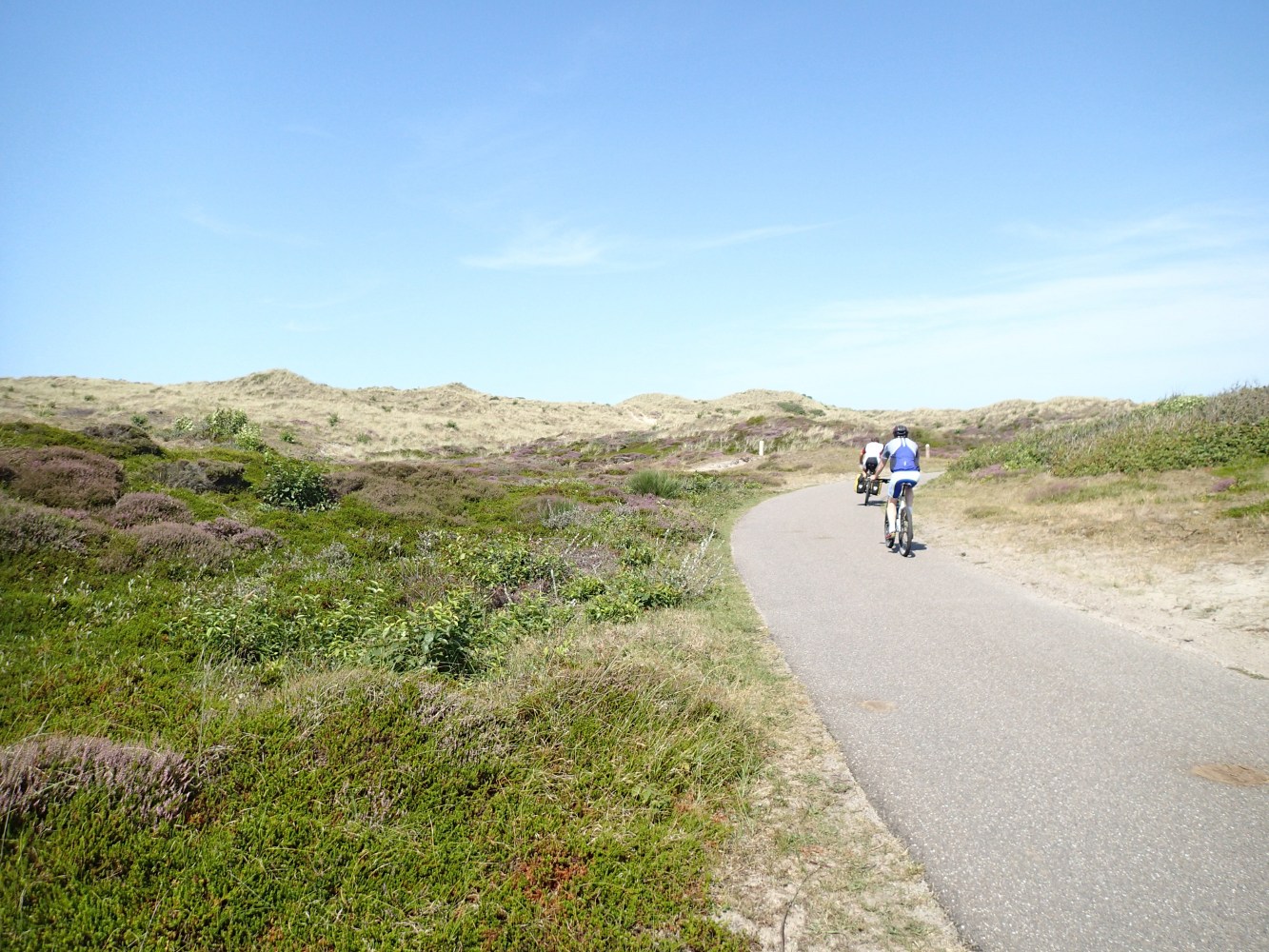
OLYMPUS DIGITAL CAMERA

We knew there had been forest fires in the Schoorl area within the past five years, and there were unfortunately still signs that the landscape is recovering. It appears the fires were started by arsonists. Many trees were blackened stumps and a lot of the terrain still smelled strongly of ash.


OLYMPUS DIGITAL CAMERA   


The second half of our journey through the dunes took us past Egmond-aan-Zee, in 1799 known as Egmont-op-Zee. The worst of the fighting on 2 October took place in the dunes around Egmont, where Sir Ralph Abercromby came to grips with the bulk of the French and Dutch armies defending Bergen. The dunes here are less tall than near Schoorl, but much denser. Eyewitness reports suggest it was very difficult for the British to form up in their traditional lines, and the fighting got very bloodthirsty:

We marched forward … to a place where … the sand rose pretty high, in the form of a semicircle; into this opening we wheeled, and were instantly exposed to a fire upon both our flanks and front … We continued to stand still and fire for a few seconds, and then began to move forward, firing as we advanced; the other two divisions had wheeled into various openings in the sandhills in our rear …

In some instances, parties of our troops came suddenly ipon parties of the enemy. In one instance, one of our parties haveing climbed to the top of a sand ridge, found that a party of the enemy was just benearth, and instantly rushed down the ridge upon them; but the side of the ridge was so steep and soft, that the effort to keep themselves from falling prevented them from making regular use of their arms. They were involuntarily precipitated amongst the enemy, and the bottom of the ridge was so narrow, and the footing on all sides so soft, that neither party were [sic] able, for want of room, to make use of the bayonet; but they struck at each other with the butts of their firelocks, and some individuals were fighting with their fists. (Narrative of a private soldier in His Majesty’s 92nd Regiment of Foot … (London, 1820) pp 46-7)

This part of the trip was quite amazing. Some of the landscape was truly astounding. For some reason I seem to have lost the photos I took though, so you’ll have to extrapolate based on the shots I took above, and this short video I took while cycling through the landscape:

We arrived in Alkmaar early in the evening, and went straight to our hotel. Alkmaar was the Duke of York’s second headquarters after the successful push on Bergen on 2 October, when the British line moved forwards closer to Amsterdam. I will, however, cover that in greater depth in my next post, when I will conclude the account of our trip to Den Helder.
“Your Grace’s most devoted servant”: the 18th century patronage game

Yesterday I spent a few hours in Nottingham University’s manuscripts department. Nottingham holds the bulk of the papers of the 3rd Duke of Portland, prime minister 1782-3 and 1807-9. Portland started out as Charles James Fox’s political leader but, after the French revolution, distanced himself from the Foxite Whigs and eventually coalesced his following with Pitt the Younger in 1794.

There was lots of fun stuff to look at, but nothing quite like the following exchange between Portland and Sir George Collier over Collier’s search for patronage. Dry and dull the subject may be, but as the correspondence unfolded I found myself snorting into my laptop. I’d like to share bits of it here, because it gives a flavour of the less savoury underbelly of the 18th century political game.


The naval hero

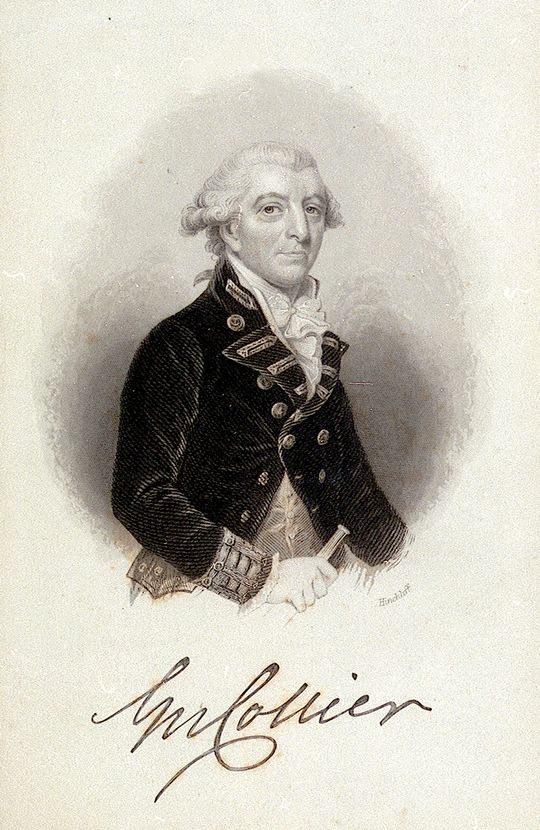
Sir George Collier was a British naval hero from the American War of Independence (… well, that’s how he would no doubt have put it). He had been successful in clearing parts of the American coast of ships and privateers, and also engaged in some spectacular one-on-one ship battles with the Spanish. Despite his almost unbroken record of success he had not received the public recognition he felt he deserved — probably because of his political affiliation with the opposition Whigs under the Marquis of Rockingham and, later, the Duke of Portland.

Admiral_Sir_George_Collier

After Portland’s coalition with Pitt in the summer of 1794 Collier decided it was high time he got that recognition. He was hard-up and needed cash. What does an 18th century public figure who is hard-up and needs cash do? Why, he unashamedly grovels for a government-funded office, of course.

Collier was not shy about his objective:

“My Lord, As the Motives for my not hoisting my Flag are certainly at an End by your Grace’s having been pleas’d to support Ministry, & to take a part in it, I beg to express to your Grace my Wish to have a Command, if you will have the Goodness to interest yourself with the First Lord of the Admiralty for that purpose.”

Subtlety not being Collier’s strong point, he informed Portland exactly what he wanted: “There is no Flag Officer at Chatham, tho’ there is at Sheerness … An appointment for that Post might easily be reviv’d, if Lord Chatham [the First Lord of the Admiralty] chuses it.”[1] Collier felt his health was “so tender & indiffferent, that it is ill calculated (I fear) to encounter the Fatigues & Hardships of foreign Service”, as a result of which he wanted to remain at home. Creating a new post at Chatham was his favourite plan, but he expressed himself just as happy to take the admiralty of any of “the other Royal Ports (Portsmouth, Plymouth & Sheerness)” or the command of the Downs.[2]


Is it something I said?

A week later Portland had not replied, and Collier began to get edgy. “I have been more than anxious to have had the Honor of one Line from You … This great Impatience & Anxiety, makes me again venture to take this fresh Liberty”.

Why was Portland ignoring him? There could be only one reason: Collier’s political record stood against him with Pitt’s government. As a supporter of the Portland interest, after all, Collier had opposed the government on a number of issues, most notably the Regency Crisis in 1788/9.

It seems Collier had already forfeited considerable naval advancement by his alienation of Lord North’s First Lord of the Admiralty in the 1770s, and now in the 1790s Collier feared he had made another high-placed enemy:

“I perceive I don’t stand well, with Lord Chatham by his Inattention on several occasions, nor can I divine or guess the Reason Why, tho’ I have taken some Pains to know; but all Conjecture is quite at a loss.” In fact Collier thought he knew exactly why he was getting Chatham’s cold shoulder, but at this stage of the correspondence he was loath to set it down in black and white.

His nervousness translated itself into excessive flowery fawning. I’m guessing this was de rigueur for 18th century scroungers, but it makes for slightly uncomfortable reading from a 21st century perspective:

“[I wish] to know I have the Happiness of continuing to possess … your Grace’s good Opinion, to me inestimable … If Your Grace with that most kind & benevolent disposition you possess, woud have the Goodness … to tell me if there is a Thing in which Lord Chatham, or any one else can blame me for … I shall to the end of my Life acknowledge your Goodness, with Gratitude, & true Sensibility.”[3]

Duke_of_Portland_by_Pratt

The Duke of Portland

What Portland thought of all this I can’t say as I have found only one letter from him in return, but presumably at this stage he could do little anyway. Lord Chatham was away from his desk due to ill health from the end of August to the end of September, so Portland would in any case have been unable to do anything but pass on Collier’s letters.

In early October, however, Chatham was back at work and Portland evidently promised to speak with him in person on Collier’s behalf. Collier again urged his desire for a new command to be created at Chatham dockyards, and wrote a memorandum for the First Lord of the Admiralty explaining his opinion on why “the King’s Service woud be so much expedited & better carried on by having a Commander in Chief at so principal a Port”.[4]


“A numerous family”

When Portland’s silence continued still longer, Collier’s tetchiness increased several notches. All floweriness dropped away from his correspondence, and he became much more direct as the suspicion that he was being deliberately ignored solidified in his mind: “I am entirely at a Loss respecting my future destination … had You (my Lord) had an Opportunity of speaking to Lord Chatham on the Subject, I flatter myself your great kindness woud have relieved my anxiety”.

I suspect Collier was much more accustomed to directness than courtly language, but even so his blunt statement of his urgent necessity is quite startling: “A numerous family of 7 Children are strong calls upon my exertions for their Welfare”. And as though the tone of the letter itself was not cheeky enough, Collier clearly decided, while he was about it, he would add another claim on Portland’s “goodness” on behalf of his eldest son, just back from India:

“He is well educated, & I shoud wish Him to have the Honor of being in the Secretary of States Office [Portland was Home Secretary] if your Grace woud have the Goodness to appoint Him to a situation in it.”[5]


Wherein Lord Chatham expresses his dislike of scroungers

Remarkably, Portland did not do what I would have been tempted to do in his situation (tell Collier to get stuffed). He wrote back agreeing to take Collier’s son on in the Home Department (cue Collier’s relapse into overly orotund flattery: “I received with sincere Gratitude of Thanks, your Grace’s most obliging Letter … the knowing I have the Felicity to be esteemed by your Grace, is a most powerful & pleasing Cordial to me”).[6]

He also wrote that he had finally seen Lord Chatham at court, before the King’s levee. His account of the meeting was not exactly encouraging: “He said, on casting his Eye over it [Collier’s memorandum on the Chatham command], that he was too well acquainted with your merits & claims, to want to be reminded of them; & regretted his not having been able to give you a proof of that opinion.”

johnprint

John Pitt, 2nd Earl of Chatham

This coldness of that did not go unnoticed with Portland, who asked outright if Collier might expect the command of Chatham. “I will not enter into any engagement of that sort,” Chatham replied. Portland tightened the screws a little and urged “the cruelty & injury of a refusal”, whereupon Chatham totally flew off the handle:

“He exclaimed that nothing could be so hard upon a man in his situation as such a construction. That he wished, most earnestly, that he could employ every flag, & indeed every other officer, who is capable & willing to aserve his country, but that if Gentlemen in general who happened not to be employed, conceived that the omission was to be attributed to any reference either to their Political, or Naval Conduct, they equally wronged him & themselves; & they ought, he said, to consider the number of Admirals as well as Captains to whom it was impossible to give commands. So we parted…”[7]

(In other words: “Tell Collier to join the end of the queue.”)

“I admit there was nothing definite in his answer,” Portland concluded with comical restraint, “nor can I say, He gave me any reason to hope for the Chatham command”. He nevertheless thought from something Chatham had said that a naval command might soon be found.


Wherein Collier nearly calls Chatham out

This was, obviously, not what Collier had been hoping to hear. He reminded Portland that he did not want a naval command, and concluded that this was yet another example of political blackballing: “I am afraid, my Lord, that my Sins have arisen out of my political Character … I am passed over … as the Beacon to deter others from venturing to have an Opinion in future”. He reminded Portland again, pointedly, of the “7 strong Claims upon me”, and there the correspondence rested for a month or so, presumably to Portland’s relief.[8]

At the start of December Collier renewed the assault. The commander-in-chief at Plymouth was dying and Collier saw an opportunity to get his domestic command after all. But when Plymouth went instead to Admiral Sir Richard King, Collier’s indignation overflowed in an extraordinary letter to Portland, waxing lyrical and with liberal use of exclamation marks:

“It is hardly possible to restrain my Indignation at the provoking & rude Refusal Lord Chatham has cast upon your Grace! You have with that Goodness so intimately connected with your noble Nature & Family, condescended to help a feeble Plant whom you were pleas’d to think not unworthy [of] your Support … But when the most excellent & best of Men, born to the highest Rank and professing a great & ostensible Station, condescends to offer to the Naval Minister a Person who has serv’d his Country honorably & well, for a certain Post, shall it be presumed to be told this great Character (by the Naval Minister) that ‘He had given Assurances to Sir R[ichar]d King on his quitting one lucrative Command, that he should have another & that the first which fell vacant!!![‘] — & venturing to inform the same excellent Man of this, who had before ask’d the Chatham Command (for his humble Friend) to whom He had ventured to say He ‘woudl not enter into an Engagement of that Sort‘ … !!!!”

At this point Portland was probably reaching for strong stuff to support him, but Collier went further still:

“I own his Inconsistency & affronting Absurdity almost overpowers my Senses, & I can with difficulty keep within the bounds of moderation [… so going up to five exclamation marks, presumably, was right out]. … I despise it [Chatham’s affront], & should be truly happy to express to Lord Chatham some little of my feelings, on this ungenerous occasion: but I restrain myself out of the Respect I owe your Grace”.

Thank goodness for that restraint, because I am fairly certain Collier’s telling Chatham what he thought about him to his face would have led to nothing good. To show he had no hard feelings for Portland, however, Collier signed off in the most effusive manner yet:

“It is only then left me with a Heart flowing with grateful sensations to assure Your Grace they never will be eras’d, & that I shall never fail to remember your Goodness; I am with a fervency not to be expressed & more strong if possible than if your generous Endeavours had been crowned with the Success you wish’d for me, Your Grace’s most devoted & much obliged servant George Collier”.[9]


At last!

Luckily for Collier, even as he was recording his desire to poke Chatham in the eyes the First Lord of the Admiralty was in the throes of being sacked by prime minister Pitt. Chatham’s successor at the Admiralty, Lord Spencer, was a Portland Whig. Collier saw his chance and finally got something he requested: the Command of Sheerness, which he obtained in January 1795.

Unfortunately he did not live long enough to enjoy his salary, and died four months later.

Still, persistence!


References

[1] Sir George Collier to the Duke of Portland, 6 August 1794, Portland MSS, Nottingham University, PwF 3.001

[2] Sir George Collier to the Duke of Portland, 7 August 1794, Portland MSS, Nottingham University, PwF 3.002

[3] Sir George Collier to the Duke of Portland, 13 August 1794, Portland MSS, Nottingham University, PwF 3.003

[4] Memorandum by Sir George Collier, October 1794, Portland MSS, Nottingham University, PwF 3.005

[5] Sir George Collier to the Duke of Portland, 17 October 1794, Portland MSS, Nottingham University, PwF 3.006

[6] Sir George Collier to the Duke of Portland, 24 October 1794, Portland MSS, Nottingham University, PwF 3.007

[7] Duke of Portland to Sir George Collier (copy), 20 October 1794, Portland MSS, Nottingham University, PwV 108 f 123

[8] Sir George Collier to the Duke of Portland, 24 October 1794, Portland MSS, Nottingham University, PwF 3.007

[9] Sir George Collier to the Duke of Portland, 3 December 1794, Portland MSS, Nottingham University, PwF 3.009


Pitt the Younger’s death mask: a post by Stephenie Woolterton

Readers may be interested in (if ever so slightly creeped out by) my friend Stephenie Woolterton’s latest post on her excellent blog, The Private Life of William Pitt the Younger.

She has unearthed some previously unseen photographs of Pitt the Younger’s death mask, taken for the sculptor Nollekens the day after Pitt died.

They are amazing– rather gruesome, and it is certainly evident that Pitt was in a very, very bad way, but without a doubt the closest we will get to a photograph of Mr Pitt’s face.

Brace yourselves and take a look.

Marriage of the 2nd Earl of Chatham and Mary Elizabeth Townshend, 10 July 1783

Mary, Countess of Chatham and John, 2nd Earl of Chatham by Charles Rosenburg (ca 1800)

Mary, Countess of Chatham and John, 2nd Earl of Chatham by Charles Rosenburg (ca 1800)

I know it’s a day early, but I’d like to post in honour of the 231st wedding anniversary of John, 2nd Earl of Chatham and his wife Mary Elizabeth Townshend and I can’t guarantee I’ll manage tomorrow. They are obviously the main characters of my WIP and I have done a lot of research on their lives in the past year. Not all my discoveries have been pleasant, but I have learned a lot about them and I feel much closer to them now than I did this time last year. (You can read last year’s post about their marriage settlement here.)

John and Mary were married by special licence at the house of Mary’s father, Thomas Townshend, Lord Sydney, on 10 July 1783. John was twenty-six, Mary twenty. They had known each other since they were children and it was a love match between longtime sweethearts. Despite rumours that John had a mistress I have not been able to substantiate them, and on the contrary all the evidence points to the closeness of their relationship. The marriage was destined to last nearly thirty-eight years, coming to an end when Mary died on 21 May 1821 at the age of fifty-eight.

As husband and wife the pair suffered more than their fair share of trials and tribulations. Mary’s health was always poor. She suffered from some sort of premature-onset arthritis in her hip that left her permanently lame, and never managed to carry a child to term, although she miscarried at least once. She shared in all her husband’s twists and turns of fortune, accompanying him as much as she could on his military postings throughout Britain, and retiring with him into political obscurity after he commanded the disastrous Walcheren expedition in 1809. In 1807 Mary suffered a prolonged mental breakdown, and although she recovered she relapsed more or less permanently in 1818. You can read more about John and Mary in my guest posts for “Madame Gilflurt’s” excellent blog.

I’d like to leave you with a short excerpt from my WIP in which I describe John and Mary’s wedding. Please join me in raising a glass of claret to the happy couple!


Albemarle Street, July 1783

`My lord Chatham, if you will repeat after me…’

Mary’s heart beat a hectic rhythm in her chest as Dr Courtenay, the parish rector, took the ring off the Bible and slipped it onto her finger. She did not take her eyes off John for a moment. He wore a cream silk suit trimmed with silver to match her gown. His hair was immaculately curled and powdered and his eyes held hers with an intensity that made her heart beat faster. He echoed Courtenay’s words, precisely and with great concentration.

`With this ring I thee wed. With my body I thee worship, and with all my worldly goods I thee endow. In the name of the Father, and of the Son, and of the Holy Ghost, Amen.’

`Those whom God hath joined together let no man put asunder,’ Courtenay said. John put his hand over Mary’s; the sensation of his warm flesh pressing the cold band of the ring into her finger sent a shiver of excitement through her. `I pronounce that they be man and wife together. My lord, you may kiss your bride.’

The wedding guests applauded as John leaned down to bestow a chaste kiss on his wife’s lips. Mary saw his eyes dart towards the chairs arranged before the windows of her parents’ drawing-room. Her father, created Viscount Sydney in one of Lord Shelburne’s parting acts as minister, sat beaming a few feet away. Arrayed beside him were his wife and Mary’s six siblings, from Georgiana to three-year-old Horatio, sucking his thumb on his eldest sister’s lap. Behind were William and Harriot, both grinning broadly.

Mary knew how self-conscious John could be in front of an audience, but she had no intention of letting him get away with that kiss. She wrapped her arms around her husband’s neck and murmured into his ear. `Does Mary, Countess of Chatham not return your kisses so sweetly as Miss Mary Townshend?’

His face cleared instantly. `I do not know. Perhaps we should put it to the test?’

He cupped her chin and kissed her again. In an instant her world narrowed down to the sensation of his lips against hers and Lord Sydney’s elegant drawing-room, with all its inhabitants, was lost to her.

Mary kept her hand in John’s as the guests came over to congratulate them. Her father and mother led the way, enormous smiles on their faces. Lady Sydney kissed John on each cheek. Lord Sydney pumped John’s hand up and down, unable to say anything other than `Well done, Chatham, well done indeed,’ for all the world as though John had just won Mary in single combat.  Last came William and Harriot. Harriot slipped her hand through her new sister-in-law’s arm and William clasped John’s hand with genuine pleasure.

`You look fine, John, very fine,’ William said.

`Marriage suits you,’ Harriot observed. Her eyes were like John’s: they had the same heavy-lidded, almond shape, the same shade of greyish-blue flecked with brown, fringed with the same dark lashes, but Harriot’s were full of a mischief Mary had never seen in her husband’s. `Why, you nearly look handsome.’

`Only nearly?’

`You know Harriot,’ William said. `She never flatters. But as far as I am concerned you look splendid. Lady Chatham too.’ Mary glanced over her shoulder, half-expecting to see that John’s mother had just entered the room, then realised William was talking about her and felt the blood rush to her cheeks. `Congratulations, my lady. Welcome to our family.’

`Too late to change your mind I’m afraid,’ Harriot put in.

`I don’t think I want to,’ Mary said. She could not help slanting a mischievous look up at her husband. John smiled back and dropped a brief kiss on her lips.

`I am glad to hear it!’

He spoke flippantly and Harriot and William laughed, but Mary detected strain in his voice. When he was not paying attention she looked at him more carefully, peeling away the silver-lined coat, the pomaded, curled hair, and the aura of quiet gentility and pride he wore like a cloak. She saw the pallor of his skin and the tightness around his eyes and thought: He is as nervous as I am. She wondered if she was the only one to notice, for even William and Harriot continued to jest at him as though they did not see his jaw tighten further with each joke.

It was as though she could see him better than anyone else in the room, as though her love were a filter stripping away everything but the raw thoughts and emotions that made him John. She took his arm and he turned to her with a smile she was beginning to recognise belonged only to her. The connection between them felt more than physical, as though if Mary withdrew her arm she would still be holding him, even if they were hundreds of miles apart.

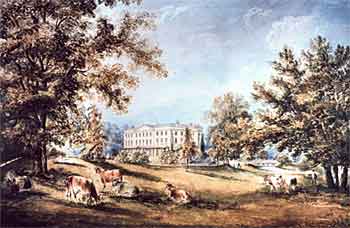
Abington Hall, Cambridge: the 2nd Earl of Chatham’s rented country home

Two months ago I made a tragic discovery about the later life of John, 2nd Earl of Chatham: his wife Mary succumbed to severe depression, and was considered “insane”, in 1807-8 and again in the late 1810s. For those not in the loop I blogged about it here. I am bringing it up again because I recently had the opportunity to visit the place where Mary suffered for much of her second illness: Lord Chatham’s rented property of Abington Hall, Cambridge.

Abington Hall, ca 1750.From TWI Library Archive, sourced from http://www4.twi.co.uk/libarchive/lib_who_lived.html

Abington Hall, ca 1750.From TWI Library Archive, sourced from here


 Lord Chatham had no country estate of his own. He had sold Hayes Place, his father’s seat, in 1785 and sold Burton Pynsent, his remaining property, in 1805. He had periodic access to other properties, either rented or borrowed: he used Cheveley Park, the Duke of Rutland’s hunting lodge, as a country estate from 1787 to 1797, and (mysteriously) had access to a property in Kent known only as “Gedding” from 1808 onwards (if anyone can assist me in tracking “Gedding” down I would be most grateful!).

In 1816 Chatham was looking for a property conveniently located for access to London that would allow him to indulge in his favourite pastime of hunting. He settled on Abington Hall, slightly less than ten miles from Cambridge, close to Cheveley and also to Audley End, where he had cousins. In March 1816 John wrote to the Bishop of Lincoln that he had “at length brought my negociation [sic], with Mr Mortlock to a successful issue”, following two months of bartering.[1] John Mortlock, Chatham’s new landlord, was by all accounts a prickly sort: he was a banker who served thirteen times as Mayor of Cambridge, which if nothing else shows perseverance.

So far, not a great deal is known about John’s tenancy of Abington Hall. I’m not even sure when he moved out. The History of the County of Cambridge and the Isle of Ely volume VI (Victoria County History, 1978) says he rented it “up to 1820” but a Heritage Assessment compiled in 2010 suggests he moved out in 1825.[2] Cambridge Archives dates the “Survey of Dilapidations” compiled on Chatham’s vacating the premises as 15 January 1824.[3] Neither of these dates makes perfect sense, since Chatham was in Gibraltar from November 1822 to July 1825, but he was certainly still at Abington in February 1821.[4] I did not manage to find out if John indulged in any planting, although it sounds from Dr Brown’s Heritage Assessment like he did to a limited extent (see references to “a small plantation”); but he is credited with white-washing the facade of the red brick house.[5]

As you can see the white-washing has seen better days:

20140602_110853

When Chatham got his hands on it the house consisted of 40 acres, including extensive stabling and a walled garden. The house itself has been in the possession of The Welding Institute (TWI) since 1946, and the estate would be almost totally unrecognisable to John today, covered as it is in warehouses, workshops and staff facilities. The house itself has probably changed remarkably little, at least on the ground floor. (The piano nobile and servants’ quarters have both been converted into open-plan offices and bear no resemblance to their original layout.) I found it surprisingly small, given the kind of house I would have expected John to live in. I counted three drawing rooms/parlours and a dining room running along the back of the house looking away from the road.

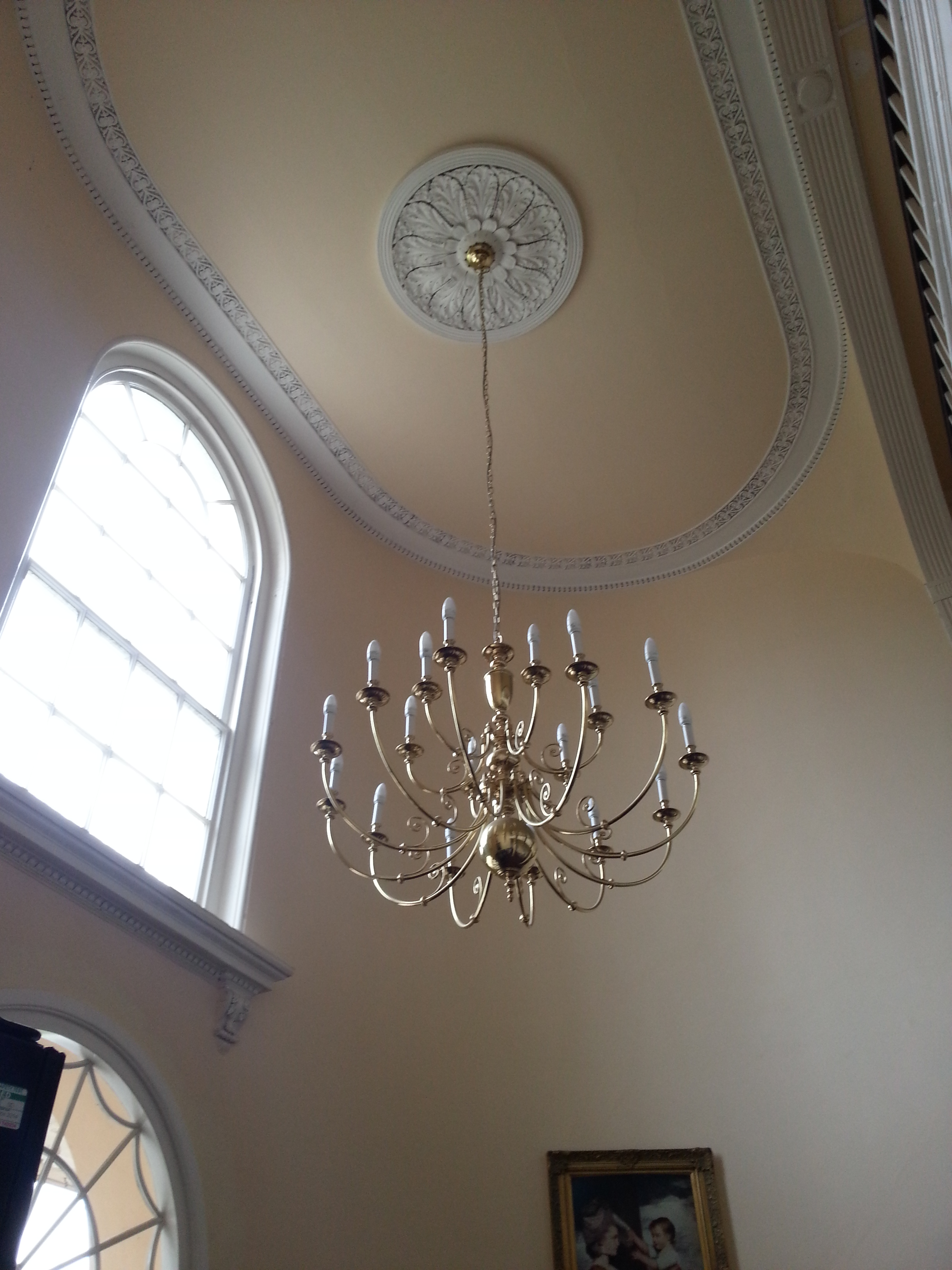
20140602_112612  20140602_111246  20140602_111235

Above: three photos of Abington’s entrance hallway

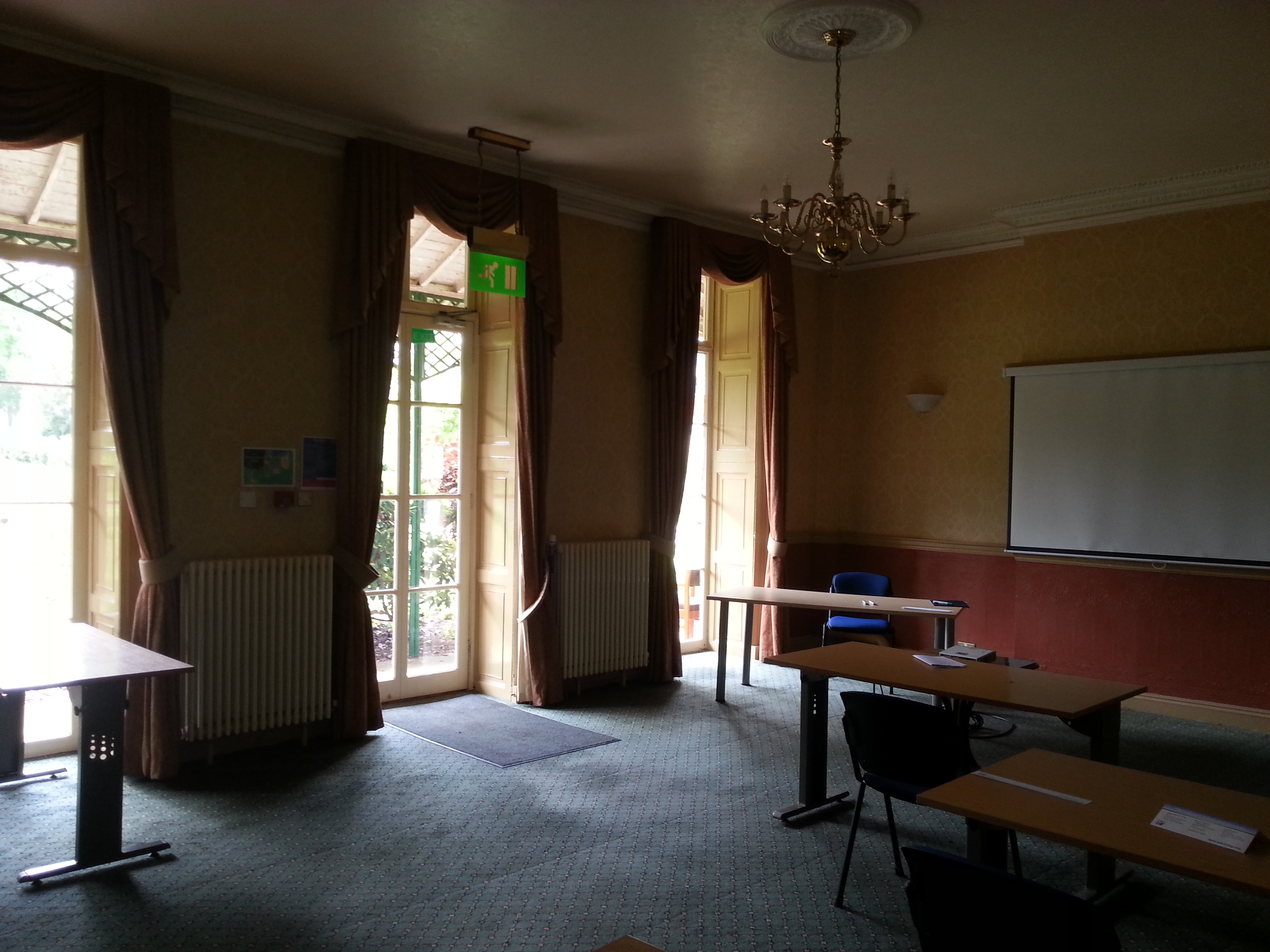
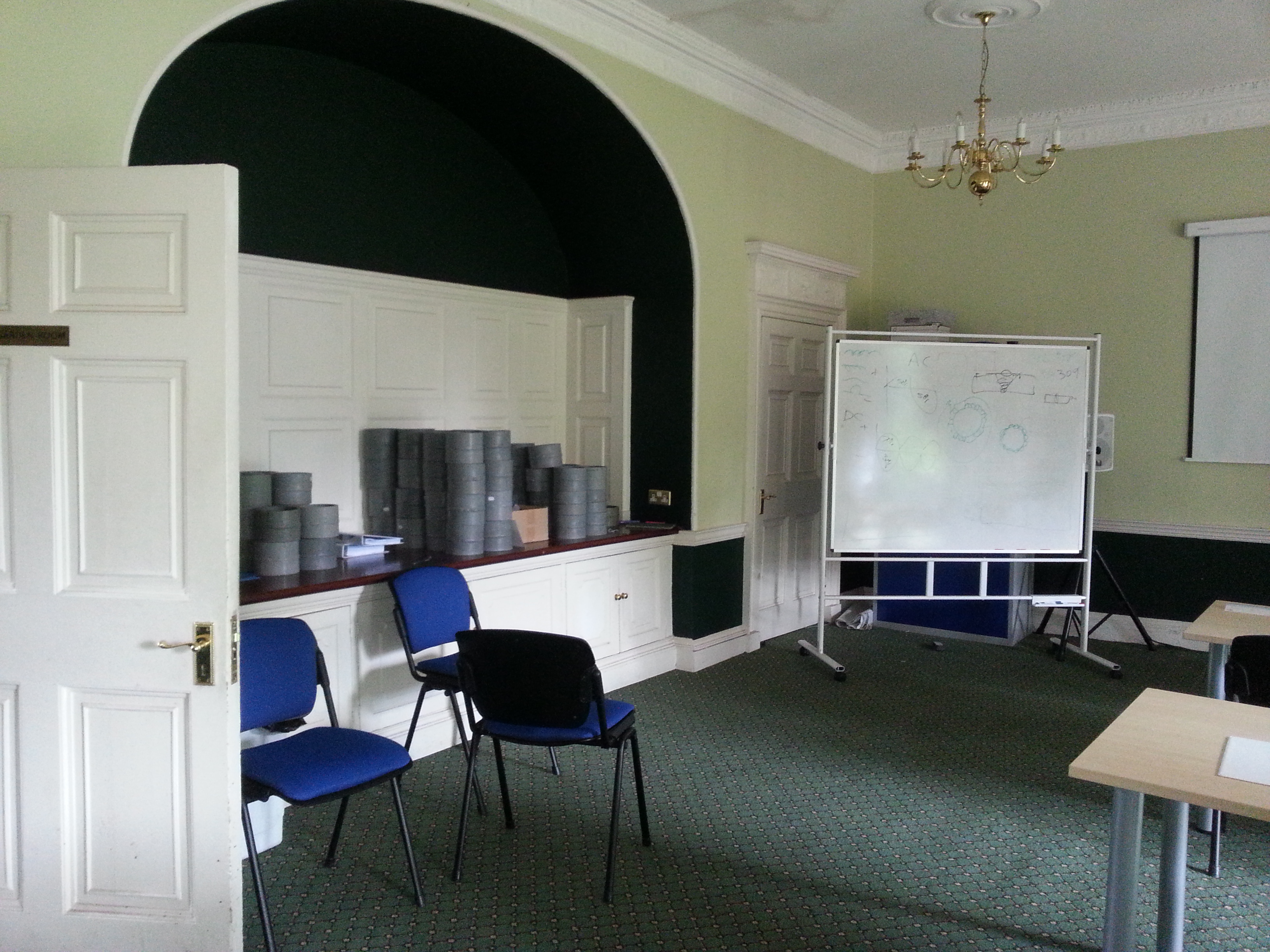
20140602_112229  20140602_111909  20140602_113519

Above: two of the drawing rooms and (on the right) the dining room. The dumb waiter hatch was in the corridor just behind. The third drawing room (small enough possibly to be a parlour) was in use as an office so I did not photograph it.

As you can see, the rooms are largely recognisable as 18th century formal rooms.

20140602_111854  20140602_112314  20140602_111446

Above: some of the original features in the Hall

TWI’s Records Officer very kindly walked through the house and estate with me, and together we tried to guess at what the rooms might have been used for. He was very informative indeed and pointed out to me the road Chatham and his guests would have taken to approach the house from London (now with a warehouse built over it), where there had once been a bridge over the river leading to the village and church, and the location of the stables and walled garden, among other things.

I need to do some more research on Abington Hall to see if I can work out how Chatham would have used it and what he did to it (apart from white-wash it, obviously…), but it was thrilling to have the opportunity to visit a house that he lived in. Even if he almost certainly did not have happy memories of his time there.

References

[1] Lord Chatham to George Pretyman-Tomline, 23 January and 18 March 1816, Ipswich RO HA 119/562/688

[2] “Heritage Assessment of effects on the historic landscape associated with Abington Hall”, compiled July 2010 by Dr David Brown, found here

[3] 15 January 1824 Survey of Dilapidations at Great Abington Hall on lease from Thomas Mortlock, esq. deceased, to the Earl of Chatham. Cambridge Archives, K296/B/A/29

[4] Lord Chatham to George Pretyman-Tomline, 4 February 1821, Ipswich RO HA 119/562/688

[5] Brown, “Heritage Assessment” paragraph 2.12.

Acknowledgments

Many thanks to Hazel Jackson and Lee Pretlove of TWI and Abington Hall Conference Centre.


Guest post for Madame Guilflurt on Mary, Countess of Chatham

A few days ago I guest blogged again for Madame Gilflurt. The subject of my post was Mary, Countess of Chatham, and the post went up on the 193rd anniversary of her death:

http://www.madamegilflurt.com/2014/05/a-salon-guest-mary-elizabeth-countess.html

Image

As regular readers know, I am very fond of Mary, the more so given my recent discoveries about her later life. She is a totally underrated and ignored historical figure: you will not find this much about her anywhere else, I guarantee it.


Leading by a…? : Lord Chatham’s nose

Come on. You *knew* this post was coming. (If you didn’t, you should have guessed…)

I have long been aware of Sir Nathaniel Wraxall’s description of John, Lord Chatham in his Posthumous Memoirs of his Own Time (volume 3, 129 if you’re interested). Shortly before launching into a fairly damning echo of all the nasty stories he’d ever heard about John, Wraxall states:

“Lord Chatham inherited … his illustrious father’s form and figure … The present earl so strongly resembles his father in face and person, that if he were to enter the house of peers, dressed after the mode of George the Second’s reign … the spectators might fancy that the great statesman was returned once more upon earth”.

Hmmm, really? I’d never really thought of John being a spit for his father. (Although I will admit he inherited Daddy’s jaw… compare the original Hoppner of John, not the Valentine Green print, with the Hoare painting of Pitt the Elder, and the resemblance in the lower half of the face is astounding.)

And yet clearly there was something in it. Witness the philosopher Jeremy Bentham, writing to George Wilson in 1781 (quoted in Benthamiana, or select extracts from the works of Jeremy Bentham… London, 1843, p. 333): “Do you know Lord Chatham? … He has his father’s Roman nose…”

Wait, what?!

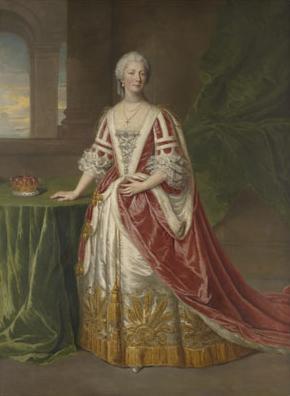
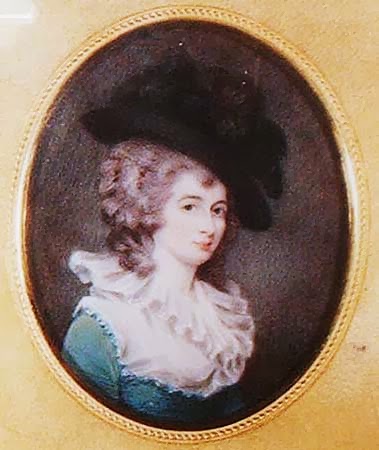
I always assumed the two older Pitt brothers looked like their mother (John’s jaw notwithstanding). John definitely had his mother’s eyes, and I thought her nose (and probably her dress sense, although I digress):

image

(from here)

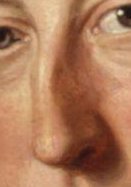
And yet Bentham got me thinking (and yes, Wraxall too, although mostly I’d like to slap him silly, but I’m digressing again). John being the main character in my novel, I’d like to think I know what he looks like. I have seen five bona fide John-sat-in-person-for-this-portrait paintings of Lord Chatham now in addition to three derivatives, all of the Hoppner. They are all sufficiently similar that I can say, with absolute certainty, that John had sleepy blue almond-shaped eyes, a strong chin, and VERY dark hair (those eyebrows…!). BUT HIS NOSE KEEPS CHANGING SHAPE.

I’m inclining now to think that John’s nose was not as straight and pointy as I first thought. I’m not sure I can go quite so far as Bentham and say he had a “Roman nose” like his father:

image

… but I think he definitely did not have a perfectly straight nose.

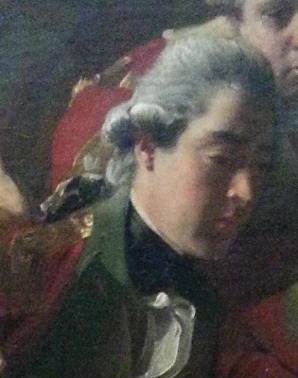
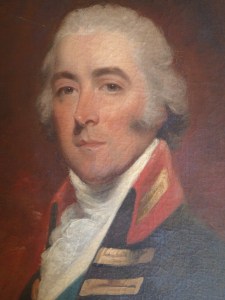
Of the two paintings I have seen of John, two depict a short, straight nose:

image

(from The Death of the Earl of Chatham by John Singleton Copley: sorry it’s a bit blurred, but I was trying to look like I was checking my phone messages at the time :-D)

and

OLYMPUS DIGITAL CAMERA


(studio of John Hoppner, courtesy of the Royal Marines Commando Barracks Officers’ Mess, Plymouth)

So far, so similar to Hester, Countess of Chatham and … definitely … NOT Roman.

But how about this?

image

(from the Martin Archer Shee portrait, which I otherwise loathe… you can see it in its full glory here)

Or this?

image

(from The Trial of Queen Caroline by Sir George Hayter: you can see the full painting [and good luck picking out John in THAT!] here)

I think the Hayter one, particularly, gives a flavour of why Wraxall might have thought John might look like Pitt the Elder if dressed up in a periwig, although it’s still not quite a classic “Roman” nose in my opinion.

And incidentally the Valentine Green print of the Hoppner gives John’s nose a rather less straight aspect than the original appears to:

image

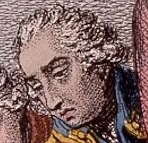
For bonus points, here’s Gillray’s depiction of John in “The Death of the Great Wolf” (1795), in which John’s nose is clearly not straight:

image

There is another portrait of John that falls somewhere midway between straight and not straight:

image

It’s pretty straight on the whole and could easily be mistaken for his brother’s. And on that note, here’s Pitt the Younger’s nose by the same artist (George Romney):

image

… from which you can see that John and William’s noses were, basically, the same shape. So if John had a Roman nose… maybe William did too?

Or maybe it was just the name “Chatham” that made people think he *must* take after his father in some way?

Either way, I’m going to have to stop here, because I’ve run out of noses to post……..

John’s later years, Part 3: “the venerable Earl”

Yesterday I thoroughly pillaged the British Library’s excellent 19th Century Newspapers database (… well, *nearly* excellent: I have one or two reservations about the search interface, but that’s another story). I habven’t used it much before, largely because I keep forgetting the 2nd Earl of Chatham clung to life until September 1835, but I found some excellent stuff about John’s later years. Slowly but surely it’s all fleshing out for me, although I still need to find more manuscript sources on the subject.

Beginning, then, with John’s return from Gibraltar in July 1825— because I’m still not quite sure what he actually did while in Gibraltar as governor— I can confirm a few things I already knew, which was that he spent August at Leamington Spa, presumably recovering from whatever illness completely floored him and knocked two and a half stone off his weight (for more see my first post on John’s later years). When in London he stayed at Thomas’s Hotel, 25 Berkeley Square, a fashionable establishment in an area he knew very well indeed.

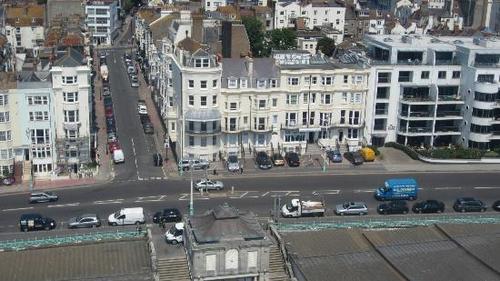
He then moved on to Brighton, where he rented a house on Marine Parade— from 1830, and possibly earlier than that, it was Number 20 (now a hotel and nightclub— appropriately the kind of place where the patrons probably sleep all day)— and frequented Molineux’s Turkish Baths on East Cliff.

image

(This photo of New Madeira Hotel is courtesy of TripAdvisor)

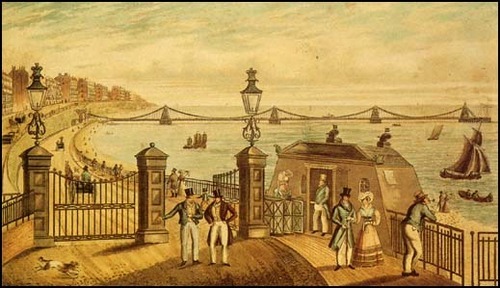
He clearly enjoyed Brighton, as he went back every year from September or October until as late as March or April (one year he was there until May). Although his proxy vote was still deployed in the House of Lords, he does not appear to have attended, and seems to have considered himself retired: fair enough I suppose, since he was by this time seventy years old. What his health was like generally I couldn’t say: the newspapers talk about him being in “pretty good health”, for his age at least, and his main activities at Brighton seem to have included riding along Marine Parade and walking on the new pier. By the end of 1832, however, he was described as having a “weakness in his legs” that prevented him walking unaided: he still managed to ride every day though, at least until 1834, when his strength was described as “failing”.

image

Marine Parade, Brighton, ca 1830, from here

(No idea what might have caused the leg weakness, but you will recall from a previous blog post that John seriously injured his leg on two occasions, in 1788 and 1791: perhaps that had something to do with his later inability to walk?)

Otherwise the information pretty much accords with what I had previously found about John. He was reported as having died in March 1831: the newspapers, red-faced, later had to retract their incorrect statement. In August 1834 he had “a paralytic stroke”, but he completely recovered and spent the winter and spring in Brighton as usual. His death in September 1835 seems to have been sudden: he was reported just under a week before his death as being daily expected at his house in Brighton. I suspect another stroke may well have carried him off, as he had supposedly been in pretty good health before that.

Interestingly he seems to have been well-regarded in the press, described from 1830 onwards without fail as “venerable”. The state of his health was assiduously followed, partly perhaps because of all the pensions and emoluments that would fall vacant when he died but also, it seems, because people cared about the last surviving member of the Pitt family. The journalists’ tone was often respectful, even fond, which I found somewhat surprising given John’s reputation even in his own lifetime. The Standard wrote on 8 November 1833:

“The venerable Earl of Chatham is gone to Brighton for six months. This amiable nobleman, notwithstanding the retired habits of his life, and his extreme taciturnity in general society, was held in the highest esteem by his brother, the Right Hon. William Pitt. It was always understood that Mr. Pitt took the advice of Lord Chatham on all important measures relating to finance.”

Admittedly the first occasion I have seen of anyone suggesting John might have had input into Pitt’s financial measures, and I certainly haven’t seen any evidence to support that assertion, but I’d say there is a flavour of truth in the suggestion that Pitt was in the habit of talking things over with John and in any case it makes a nice change from “he was a complete idiot”. (And a quiet giggle at the “taciturnity” comment…)

So much for John’s very last years. I get the impression he faded away, spending most of his life on the seafront at Brighton, contributing funds to local building efforts (he was a subscriber to the chain pier, for example), occasionally using the Turkish baths and hauling himself on horseback long after he lost full use of his legs. His last years won’t make a novel any time soon: but it’s interesting to read, at least for me. I like to think that, after the horror that must, for him, have been the late 1810s, his wife’s death, and the homesickness and depression he experienced in Gibraltar, John finally found his peace on Brighton seafront.

“From Day to Day”

Image

Contents of HA 119/562/688: letters from Lord Chatham to George Pretyman-Tomline, 1816-25 (Ipswich Record Office)

On 17 March 1818 John Pitt, 2nd Earl of Chatham folded a sheet of foolscap, dipped his pen in ink, and began to write a difficult letter. His correspondent was George Pretyman-Tomline, Bishop of Lincoln. Tomline was an old family friend: he and John had been joint executors of John’s brother’s will and had become close over the years. Since 1816 John had been renting Abington Hall near Cambridge, which was very close to Tomline’s palace as Bishop of Lincoln in Buckden.


Image

Abington Hall, Cambridge

In writing his letter John was breaking a long silence. This was not unusual for John, who was not a particularly efficient correspondent at the best of times. As his letter made clear, however, this was not the best of times.


“I have been meditating a letter to you, for the purpose of saying, that whenever you move towards London, Abington is but a few miles out of ye road … But unfortunately I have from day to day been obliged to put off writing to you, from a cause, which I know you will be concerned to hear. Lady Chatham has now been for above three weeks extremely unwell, and still continues so. She had at first a severe bilious attack, attended with a good deal of fever, and which is not yet entirely removed, tho she is better, but it has so much reduced her, as to leave her in a very uncomfortably low and nervous state.”[1]


Six weeks later he wrote to Tomline to report the “low and nervous state” had not improved: “I had deferred writing to you … in the hope from day to day, that I shou’d have been able to have sent you a more favourable account of Lady Chatham … But I am sorry to say, that … Lady Chatham has … continued without gaining any ground”.[2]


John had no way of knowing, but he would continue to live “from day to day”, waiting for his wife to recover and return to normal, for more than two years. Mental illness is treated much more sympathetically today than it was in the eighteenth century, when it was labelled as “insanity” and treated horrifically. Rank was not proof against this: witness the treatment of George III– bled, purged, gagged, straitjacketed– in the desperate attempts to restore him to health. Ironically John’s own father, Pitt the Elder, was almost certainly bipolar, and John must have watched his wife sink into depression with a cataclysmic sense of deja vu.


Image

Mary, Countess of Chatham, in earlier years

John was a taciturn and deeply private correspondent; he generally kept his letters brief, factual and to the point, with perhaps a short discussion of the weather towards the end but little of a personal nature. After half a year, however, he could not keep his distress from showing, and words like “harassed” and “distressed” began to appear in his letters.[3]


Image

Sir Henry Halford

In September 1818 John persuaded Mary to see Sir Henry Halford, the King’s personal physician. Halford was optimistic: a change of air was required, so John took Mary to the fashionable spa at Leamington in Warwickshire. Unable to make any plans whatsoever– still drifting “from day to day”– this was the first time John had left Abington since spring. Understandably he needed a break, but Mary was having none of it. When John suggested she stay with her brother Lord Sydney at Frognall in Kent, she insisted she was getting better. In February, nearly a year after Mary first fell ill, John finally managed to get her to Frognall. Mary’s state can best be gauged from the tone of the letter John sent to Tomline, which he only placed in the post after leaving in case the plans fell through at the last minute: “I have remained here [at Abington] in one continual state of suspense, having fixed generally one or two days every week for removing to Frognall, and having been as constantly disappointed. We now intend going tomorrow … Lady Chatham, is I am sorry to say not the least better, and my situation has been most distressing”.[5]


John was finally able to have a rest: “after the confinement I have had, I trust [exercise] will be of use to me”.[6] He certainly needed it, for apart from Mary’s family he had nobody–no children, no remaining siblings– to assist him. Over the next few months he managed to get away from Mary’s sickbed long enough to go on a few hunting parties with friends, where presumably he took out his frustration on anything that had fur or feathers. But always he returned to Mary after a week or two, and the strain of living “from day to day” was taking its toll.


By now John was beginning to guess Mary’s illness might never improve. “I fear she is losing ground,” he reported in June. In August, though, there was a glimmer of hope, and John thought she seemed a little more open to the idea of company. He wrote to the Tomlines hesitantly suggesting that “should it be convenient to you to give us the pleasure of your company … we shou’d be most happy to see you”.[7]


The Tomlines arrived on Friday 3 September. “Lady C[hatham] received us … in her usual manner,” Mrs Tomline later recorded for Mary’s physician Sir Henry Halford. All, however, was far from well, and Mary was unable to keep up the pretence of normality very long. “On Friday Evening, when Lord C[hatham] rose to ring the bell to remove the Tea tray supposing her [Mary] to have finished her tea, her eyes became frightfully wild”. As soon as she saw she was observed, however, Mary “recovered her composure– gradually became calm”.


This ability to impose self-control impressed Mrs Tomline, who noted that, “though rather Agitated, there was nothing in her manner to excite remark … We shoud have left [Abington] on Monday satisfied with this appearance of tranquillity had we judged only from seeing Lady C[hatham] in company.” But “the sad reverse, when alone” was “painful to describe”, and Mrs Tomline particularly dwelled on a disturbing conversation:


“She talked to me for some time about her illness in a way that affected me more than I chose to show. …. She was told exertion was necessary, but that she could not control herself when— and after a sudden stop, added in a wild way, ‘I must not talk of myself– but I often think it must end in madness’ – looking with eager eyes for my opinion.”


Tragically for Mary, Mrs Tomline did not recognise this as a cry for help from a desperately depressed woman. Her response was, essentially, that Mary should pull herself together:


“Of course I placed her feelings to the account of nerves & urged the absolute necessity of controuling her agitation when ever it occurred … and expressed perfect confidence that she would again recover, provided she kept herself calm, for controul in some way or other was absolutely necessary”.


Surrounded by unsympathetic listeners, Mary’s self-esteem was low and her frustration was extremely high. “She spoke with great concern of the trouble she gave Lord C[hatham] ‘to whom I am sure (she said) I ought not to give a moment’s pain’”. Having forbidden herself from confiding in her own husband, Mary found an outlet in self-harm. Mrs Tomline reported “her screams are often heard over the whole house” and how her maid had “to prevent the poor Sufferer from striking herself with a dangerous force … she is indeed covered with bruises she has given herself in various ways and with various things often with clenched hands and shut teeth”. Sleep was an issue: Mrs Tomline seemed to think it was not, but John reported her staying in bed most of the day– no doubt seeing her bedroom as a refuge from the need to put on a pretence of normality. She was certainly suicidal: “her threats respecting her own life are most alarming”.[8]


Image

John, Lord Chatham, in 1821, from Sir George Hayter’s “The Trial of Queen Caroline”

Something had to be done. John had never been robust, and his health was poor. “He cannot much longer support such a score of suffering,” in Mrs Tomline’s words. Halford’s response was not encouraging. “The matter appears to me to be coming to a Crisis,” he wrote, “and I can scarcely suppose that many weeks more will pass before the poor Creature is put under restraint.” His recommendation was to straitjacket the patient to save her husband’s health, for “it will be well if ever we see him Himself again”.[9]


John was horrified. He had spent eighteen months nursing his wife, and was amazed at Halford’s diagnosis: “I am at a loss to understand to what he coud allude … when he spoke of any Crisis to be expected in a few weeks”. He dreaded the idea of “any change of System, unless it were deemed indispensable”, and naturally feared the effect of such “severity and cruelty” on his wife, particularly, as he saw it, to little purpose. To his credit he never referred to his wife as anything other than just that– no subhuman “poor Creature” such as is found in Halford and Mrs Tomline’s letters– and invariably passed her best compliments to Tomline at the end of his letters. Even when Mary’s state was clearly poor, he always wrote of “we” rather than “I”. But however much he disapproved of Halford’s recommendations, John was desperate. Under pressure from Halford and the Tomlines, and half-staggered under the burden of Mary’s illness, he agreed to appoint a “companion” who had experience with insanity.[10]


Image

27 April 1818, HA 119/562/688

This “companion” was intended to impose “a restraint which the presence of Lord C[hatham] no longer produces”,[11] but it may not have worked. In the new year Mary was “very unwell, so much so, as to render her state, a very anxious one for a couple of days”, and John morosely reported to Tomline that “her state of irritation seems rather encreased”. Had Mary attempted suicide? John’s letter is ambiguous, but perhaps it is significant that they were immediately visited by their niece, Harriot Hester, Lady Pringle, who had lived with them for three years prior to her marriage in 1806. At any rate he managed to get up to Belvoir to hunt with his former ward the Duke of Rutland in February, “for I stand much in need of some recruiting having passed a sad time here”.[12]


After that the correspondence breaks off until July 1821, when John reports, on black-edged paper, that he cannot attend George IV’s levee as “there is an Order for no Person, to appear in mourning, which precludes me”.[13] John was in mourning because Mary died on 21 May, aged 58. Her obituary in the paper simply states that she died at five o’clock in the evening “after an indisoposition of nearly two years”.[14]


Mary’s physical health had never been good, so it is possible she died of natural causes, but given her history and her age I cannot help wondering if she helped herself along a little. This is obviously speculation, and John never refers to her in his letters again. I’m not sure I will ever find out the answer for certain, but whatever the truth Mary’s last years were neither happy nor healthy.


So ends the tragic tale, at least for Mary. John was destined to outlive her fourteen years; his adventures can be read about in a previous blog post of mine in two parts, found here and here. He never complained of loneliness but there is more than an echo of it in his last letters to the Tomlines before leaving England to take up the governorship of Gibraltar in October 1821: “I have been but indifferent, indeed I cou’d not well expect otherwise”. “I can not say much for myself,” he wrote the following year. “I am tolerably well in health, but I do not gain much ground, otherwise … There is a great deal of constant business [as Governor], which occupies my mind, and from this, I think I have found most relief”.[15]


Poor Mary, and poor John. It’s no secret that I feel a strong bond with these two; they are, after all, the main characters of my work in progress. But until yesterday I had no idea their story ended so tragically. I cannot tell you how much I wish it had been otherwise.


References


All manuscripts are from the Pretyman-Tomline MSS, held at Suffolk Record Office (Ipswich).

[1] Chatham to Tomline, 17 March 1818, HA 119/T108/24/7

[2] Chatham to Tomline, 24 April 1818, HA 119/562/688

[3] Chatham to Tomline, 14 October 1818, HA 119/562/688

[4] Chatham to Tomline, 18 December 1818, HA 119/562/688

[5] Chatham to Tomline, 1 February 1819, HA 119/562/688

[6] Chatham to Tomline, 19 February 1919, HA 119/T108/24/8; same to same, same date, HA 119/562/688

[7] Chatham to Tomline, 2 June, 17 August 1819, HA 119/562/688

[8] Mrs Tomline’s letter to Sir Henry Halford is at HA 119/562/716. John’s observations on Mary’s lying later in bed are from HA 119/562/688, 22 and 27 September 1819

[9] Sir Henry Halford to Mrs Pretyman, 10 September 1819, HA 119/562/716

[10] Chatham to Tomline, 22 September 1819, HA 119/562/688; 27 September 1819

[11] Mrs Tomline to Sir Henry Halford, HA 119/562/716

[12] Chatham to Tomline, 19 January 1820, 5 February 1820, HA 119/562/688

[13] Chatham to Tomline, 25 July 1821, HA 119/562/688

[14] The European Magazine and London Review 1821, vols 79-80, 561; The Ezxaminer 1821, 335.

[15] Chatham to Tomline, 6 October 1821, 27 February 1822, HA 119/562/688


Picture of Abington Hall from here.

Picture of Sir Henry Halford from here.

Guest blog for Madame Gilflurt: Collapse of the Earl of Chatham in the House of Lords, 7 April 1778

Busy doesn’t cover it, but I have been guest blogging again for madamegilflurt. Check out my piece on Pitt the Elder’s collapse in the House of Lords on 7 April 1778 at:

http://www.madamegilflurt.com/2014/04/a-salon-guest-collapse-of-earl-of.html?spref=tw&m=1