“From Day to Day”

Image

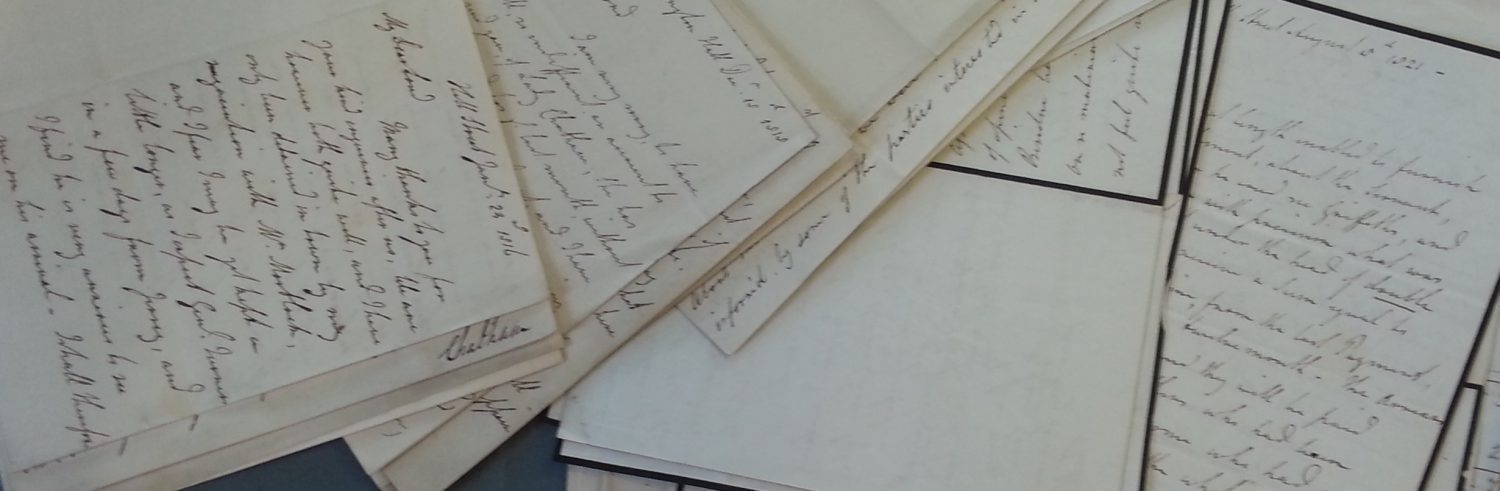
Contents of HA 119/562/688: letters from Lord Chatham to George Pretyman-Tomline, 1816-25 (Ipswich Record Office)

On 17 March 1818 John Pitt, 2nd Earl of Chatham folded a sheet of foolscap, dipped his pen in ink, and began to write a difficult letter. His correspondent was George Pretyman-Tomline, Bishop of Lincoln. Tomline was an old family friend: he and John had been joint executors of John’s brother’s will and had become close over the years. Since 1816 John had been renting Abington Hall near Cambridge, which was very close to Tomline’s palace as Bishop of Lincoln in Buckden.


Image

Abington Hall, Cambridge

In writing his letter John was breaking a long silence. This was not unusual for John, who was not a particularly efficient correspondent at the best of times. As his letter made clear, however, this was not the best of times.


“I have been meditating a letter to you, for the purpose of saying, that whenever you move towards London, Abington is but a few miles out of ye road … But unfortunately I have from day to day been obliged to put off writing to you, from a cause, which I know you will be concerned to hear. Lady Chatham has now been for above three weeks extremely unwell, and still continues so. She had at first a severe bilious attack, attended with a good deal of fever, and which is not yet entirely removed, tho she is better, but it has so much reduced her, as to leave her in a very uncomfortably low and nervous state.”[1]


Six weeks later he wrote to Tomline to report the “low and nervous state” had not improved: “I had deferred writing to you … in the hope from day to day, that I shou’d have been able to have sent you a more favourable account of Lady Chatham … But I am sorry to say, that … Lady Chatham has … continued without gaining any ground”.[2]


John had no way of knowing, but he would continue to live “from day to day”, waiting for his wife to recover and return to normal, for more than two years. Mental illness is treated much more sympathetically today than it was in the eighteenth century, when it was labelled as “insanity” and treated horrifically. Rank was not proof against this: witness the treatment of George III– bled, purged, gagged, straitjacketed– in the desperate attempts to restore him to health. Ironically John’s own father, Pitt the Elder, was almost certainly bipolar, and John must have watched his wife sink into depression with a cataclysmic sense of deja vu.
 

Image

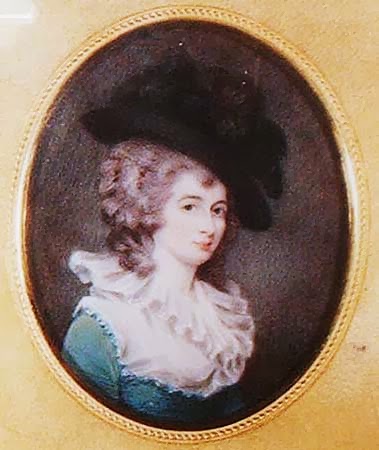
Mary, Countess of Chatham, in earlier years

John was a taciturn and deeply private correspondent; he generally kept his letters brief, factual and to the point, with perhaps a short discussion of the weather towards the end but little of a personal nature. After half a year, however, he could not keep his distress from showing, and words like “harassed” and “distressed” began to appear in his letters.[3]


Image

Sir Henry Halford

In September 1818 John persuaded Mary to see Sir Henry Halford, the King’s personal physician. Halford was optimistic: a change of air was required, so John took Mary to the fashionable spa at Leamington in Warwickshire. Unable to make any plans whatsoever– still drifting “from day to day”– this was the first time John had left Abington since spring. Understandably he needed a break, but Mary was having none of it. When John suggested she stay with her brother Lord Sydney at Frognall in Kent, she insisted she was getting better. In February, nearly a year after Mary first fell ill, John finally managed to get her to Frognall. Mary’s state can best be gauged from the tone of the letter John sent to Tomline, which he only placed in the post after leaving in case the plans fell through at the last minute: “I have remained here [at Abington] in one continual state of suspense, having fixed generally one or two days every week for removing to Frognall, and having been as constantly disappointed. We now intend going tomorrow … Lady Chatham, is I am sorry to say not the least better, and my situation has been most distressing”.[5]


John was finally able to have a rest: “after the confinement I have had, I trust [exercise] will be of use to me”.[6] He certainly needed it, for apart from Mary’s family he had nobody–no children, no remaining siblings– to assist him. Over the next few months he managed to get away from Mary’s sickbed long enough to go on a few hunting parties with friends, where presumably he took out his frustration on anything that had fur or feathers. But always he returned to Mary after a week or two, and the strain of living “from day to day” was taking its toll.


By now John was beginning to guess Mary’s illness might never improve. “I fear she is losing ground,” he reported in June. In August, though, there was a glimmer of hope, and John thought she seemed a little more open to the idea of company. He wrote to the Tomlines hesitantly suggesting that “should it be convenient to you to give us the pleasure of your company … we shou’d be most happy to see you”.[7]


The Tomlines arrived on Friday 3 September. “Lady C[hatham] received us … in her usual manner,” Mrs Tomline later recorded for Mary’s physician Sir Henry Halford. All, however, was far from well, and Mary was unable to keep up the pretence of normality very long. “On Friday Evening, when Lord C[hatham] rose to ring the bell to remove the Tea tray supposing her [Mary] to have finished her tea, her eyes became frightfully wild”. As soon as she saw she was observed, however, Mary “recovered her composure– gradually became calm”.


This ability to impose self-control impressed Mrs Tomline, who noted that, “though rather Agitated, there was nothing in her manner to excite remark … We shoud have left [Abington] on Monday satisfied with this appearance of tranquillity had we judged only from seeing Lady C[hatham] in company.” But “the sad reverse, when alone” was “painful to describe”, and Mrs Tomline particularly dwelled on a disturbing conversation:


“She talked to me for some time about her illness in a way that affected me more than I chose to show. …. She was told exertion was necessary, but that she could not control herself when— and after a sudden stop, added in a wild way, ‘I must not talk of myself– but I often think it must end in madness’ – looking with eager eyes for my opinion.”


Tragically for Mary, Mrs Tomline did not recognise this as a cry for help from a desperately depressed woman. Her response was, essentially, that Mary should pull herself together:


“Of course I placed her feelings to the account of nerves & urged the absolute necessity of controuling her agitation when ever it occurred … and expressed perfect confidence that she would again recover, provided she kept herself calm, for controul in some way or other was absolutely necessary”.


Surrounded by unsympathetic listeners, Mary’s self-esteem was low and her frustration was extremely high. “She spoke with great concern of the trouble she gave Lord C[hatham] ‘to whom I am sure (she said) I ought not to give a moment’s pain’”. Having forbidden herself from confiding in her own husband, Mary found an outlet in self-harm. Mrs Tomline reported “her screams are often heard over the whole house” and how her maid had “to prevent the poor Sufferer from striking herself with a dangerous force … she is indeed covered with bruises she has given herself in various ways and with various things often with clenched hands and shut teeth”. Sleep was an issue: Mrs Tomline seemed to think it was not, but John reported her staying in bed most of the day– no doubt seeing her bedroom as a refuge from the need to put on a pretence of normality. She was certainly suicidal: “her threats respecting her own life are most alarming”.[8]


Image

John, Lord Chatham, in 1821, from Sir George Hayter’s “The Trial of Queen Caroline”

Something had to be done. John had never been robust, and his health was poor. “He cannot much longer support such a score of suffering,” in Mrs Tomline’s words. Halford’s response was not encouraging. “The matter appears to me to be coming to a Crisis,” he wrote, “and I can scarcely suppose that many weeks more will pass before the poor Creature is put under restraint.” His recommendation was to straitjacket the patient to save her husband’s health, for “it will be well if ever we see him Himself again”.[9]


John was horrified. He had spent eighteen months nursing his wife, and was amazed at Halford’s diagnosis: “I am at a loss to understand to what he coud allude … when he spoke of any Crisis to be expected in a few weeks”. He dreaded the idea of “any change of System, unless it were deemed indispensable”, and naturally feared the effect of such “severity and cruelty” on his wife, particularly, as he saw it, to little purpose. To his credit he never referred to his wife as anything other than just that– no subhuman “poor Creature” such as is found in Halford and Mrs Tomline’s letters– and invariably passed her best compliments to Tomline at the end of his letters. Even when Mary’s state was clearly poor, he always wrote of “we” rather than “I”. But however much he disapproved of Halford’s recommendations, John was desperate. Under pressure from Halford and the Tomlines, and half-staggered under the burden of Mary’s illness, he agreed to appoint a “companion” who had experience with insanity.[10]
 

Image

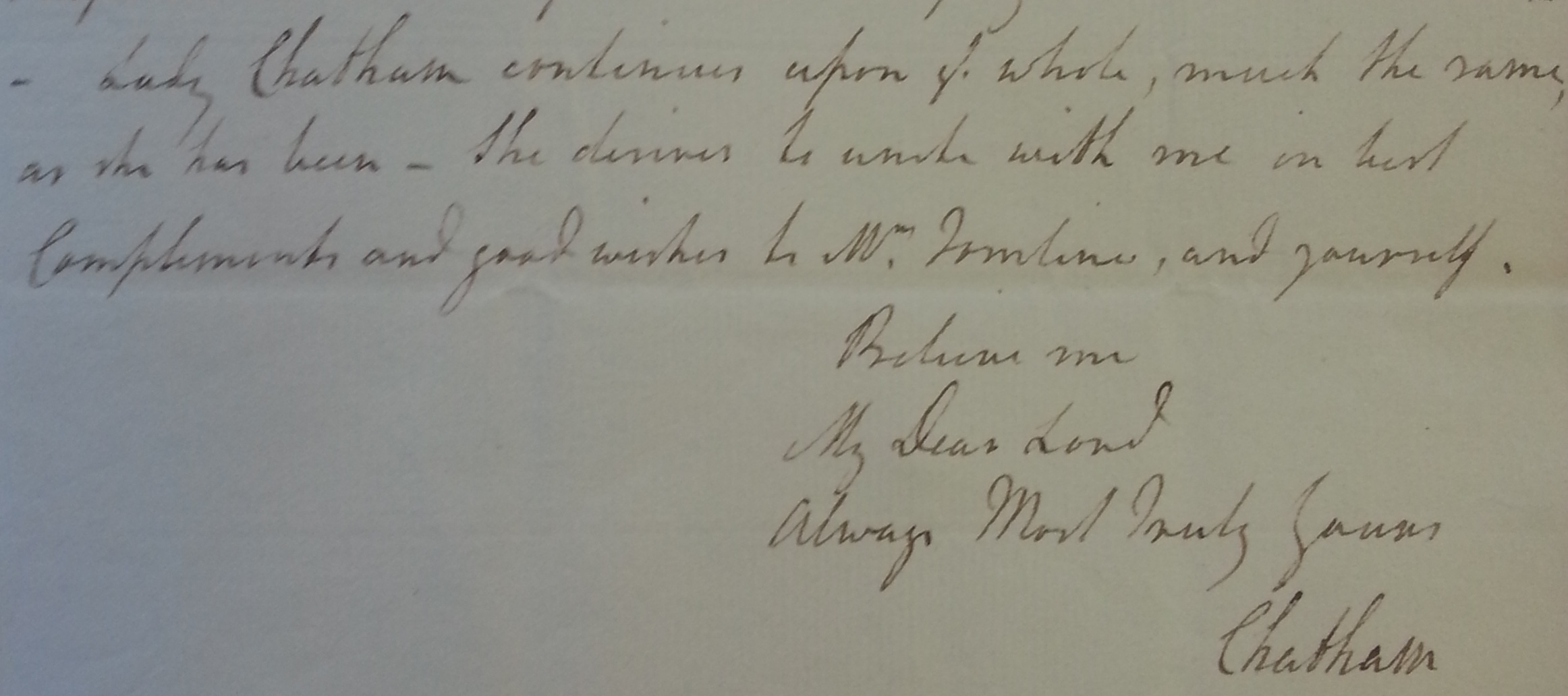
27 April 1818, HA 119/562/688

This “companion” was intended to impose “a restraint which the presence of Lord C[hatham] no longer produces”,[11] but it may not have worked. In the new year Mary was “very unwell, so much so, as to render her state, a very anxious one for a couple of days”, and John morosely reported to Tomline that “her state of irritation seems rather encreased”. Had Mary attempted suicide? John’s letter is ambiguous, but perhaps it is significant that they were immediately visited by their niece, Harriot Hester, Lady Pringle, who had lived with them for three years prior to her marriage in 1806. At any rate he managed to get up to Belvoir to hunt with his former ward the Duke of Rutland in February, “for I stand much in need of some recruiting having passed a sad time here”.[12]


After that the correspondence breaks off until July 1821, when John reports, on black-edged paper, that he cannot attend George IV’s levee as “there is an Order for no Person, to appear in mourning, which precludes me”.[13] John was in mourning because Mary died on 21 May, aged 58. Her obituary in the paper simply states that she died at five o’clock in the evening “after an indisoposition of nearly two years”.[14]


Mary’s physical health had never been good, so it is possible she died of natural causes, but given her history and her age I cannot help wondering if she helped herself along a little. This is obviously speculation, and John never refers to her in his letters again. I’m not sure I will ever find out the answer for certain, but whatever the truth Mary’s last years were neither happy nor healthy.


So ends the tragic tale, at least for Mary. John was destined to outlive her fourteen years; his adventures can be read about in a previous blog post of mine in two parts, found here and here. He never complained of loneliness but there is more than an echo of it in his last letters to the Tomlines before leaving England to take up the governorship of Gibraltar in October 1821: “I have been but indifferent, indeed I cou’d not well expect otherwise”. “I can not say much for myself,” he wrote the following year. “I am tolerably well in health, but I do not gain much ground, otherwise … There is a great deal of constant business [as Governor], which occupies my mind, and from this, I think I have found most relief”.[15]


Poor Mary, and poor John. It’s no secret that I feel a strong bond with these two; they are, after all, the main characters of my work in progress. But until yesterday I had no idea their story ended so tragically. I cannot tell you how much I wish it had been otherwise.


References


All manuscripts are from the Pretyman-Tomline MSS, held at Suffolk Record Office (Ipswich).

[1] Chatham to Tomline, 17 March 1818, HA 119/T108/24/7

[2] Chatham to Tomline, 24 April 1818, HA 119/562/688

[3] Chatham to Tomline, 14 October 1818, HA 119/562/688

[4] Chatham to Tomline, 18 December 1818, HA 119/562/688

[5] Chatham to Tomline, 1 February 1819, HA 119/562/688

[6] Chatham to Tomline, 19 February 1919, HA 119/T108/24/8; same to same, same date, HA 119/562/688

[7] Chatham to Tomline, 2 June, 17 August 1819, HA 119/562/688

[8] Mrs Tomline’s letter to Sir Henry Halford is at HA 119/562/716. John’s observations on Mary’s lying later in bed are from HA 119/562/688, 22 and 27 September 1819

[9] Sir Henry Halford to Mrs Pretyman, 10 September 1819, HA 119/562/716

[10] Chatham to Tomline, 22 September 1819, HA 119/562/688; 27 September 1819

[11] Mrs Tomline to Sir Henry Halford, HA 119/562/716

[12] Chatham to Tomline, 19 January 1820, 5 February 1820, HA 119/562/688

[13] Chatham to Tomline, 25 July 1821, HA 119/562/688

[14] The European Magazine and London Review 1821, vols 79-80, 561; The Ezxaminer 1821, 335.

[15] Chatham to Tomline, 6 October 1821, 27 February 1822, HA 119/562/688


Picture of Abington Hall from here.

Picture of Sir Henry Halford from here.
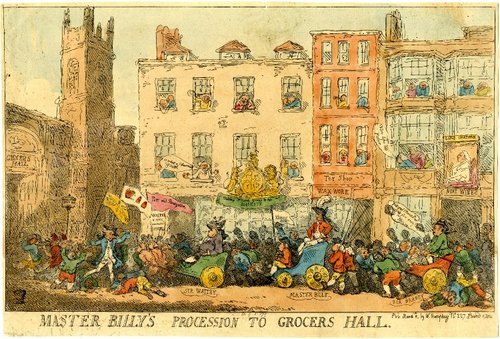
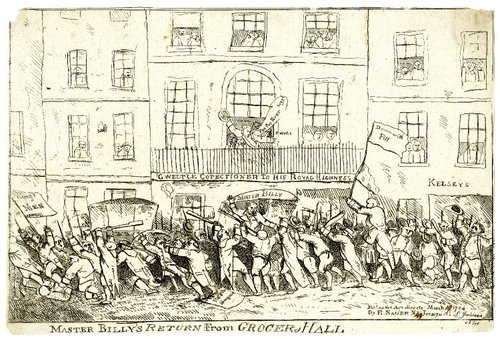
“Master Billy’s return from Grocer’s Hall”

image

(“Master Billy’s procession to Grocer’s Hall” by Thomas Rowlandson, from here)

It has just been brought to my attention that I missed an anniversary yesterday (28 February). On 28 February 1784, William Pitt the Younger received the Freedom of the City of London at a banquet held at Grocer’s Hall. This was towards the end of the so-called “constitutional crisis” triggered by George III’s dismissal of the Portland ministry and appointment of 24-year-old Pitt at the head of a minority government. Assisted by a combination of behind-the-scenes bribery, eloquence in Parliament, his reputation for purity, and downright luck, Pitt had been slowly gathering public support and chipping away the opposition’s majority throughout February. The Freedom of the City was a great coup for him, since the City traditionally held itself independent of the monarch and had a great deal of political influence. Pitt’s carriage was drawn from Berkeley Square, where he was living with his brother, to Grocer’s Hall by his supporters.

image

(“Master Billy’s return from Grocer’s Hall”, anonymous, from here)

The way home was, unfortunately, not quite so uneventful. Once again Pitt was drawn through the streets “by a great concourse of people, many of the better sort … as well as by a considerable Mob” (in the words of Pitt’s brother Lord Chatham, who, along with Pitt’s brother-in-law Lord Mahon, later 3rd Earl Stanhope, was also in the carriage). Chatham later set down his recollections of what happened next for Pitt’s biographer, the Bishop of Lincoln, in 1821 (this can be found at Ipswich Record Office, Pretyman MSS HA119/562/688). Chatham wrote:

The Populace insisted on taking off the Horses and drawing the Coach. A Mob is never very discreet, and unfortunately they stopped opposite Carlton House and begun [sic] hissing, and it was with some difficulty we forced them to go on. As we proceeded up St James’s Street, there was a great Cry, and an attempt made to turn the Carriage up St James’s Place to Mr Fox’s house (he then lived at Ld Northingtons) in order to break his windows and force him to light, but which we at last succeeded in preventing their doing.


I have often thought this was a trap laid for us, for had we got up, there, into a Cul de Sac, Mr Pitts situation would have been critical indeed. This attempt brought us rather nearer in contact with Brooks, and the moment we got opposite (the Mob calling for lights) a sudden and desperate attack was made upon the Carriage in which, were Mr Pitt, Lord M[ahon] and myself, by a body of Chairmen armed with bludgeons, broken Chair Poles &c (many of the waiters, and several of the Gentlemen among them).


They succeeded in making their way to the Carriage, and forced open the door. Several desperate blows were aimed at Mr Pitt, and I recollect endeavouring to cover him, as well as I cou’d, in his getting out of the Carriage. Fortunately however, by the exertions of those who remained with us, and by ye timely assistance of a Party of Chairmen and many Gentlemen from Whites, who saw his danger, we were extricated, from a most unpleasant situation, and with considerable difficulty, got into some of the adjacent houses, without material injury, and from there to Whites. The Coachman, and the Servants were much bruised, and the Carriage nearly demolished.

I do not recollect having particularly seen Genl Fitzpatrick, but I distinguished Mr Hare, and the present Lord Crewe extremely active, and I think Lord Robert Spencer, standing at the Door. I remember when the Streets were a little clear, I walked over, with Mr McDowall to Brooks, and went up into ye Club Room, but the Party were either gone home, or gone to Supper.


The next morning I met Lord Ossory in St James’s Street, who attempted to make apologies for what had passed, and to lay it upon ye violence of the Chairmen, some of the Chairs having been broken by the Mob.


I never went to Brooks any more, and I was never able to ascertain further what passed or what first led to the Outrage that night.

Fair enough, I guess!

With family like this…

There’s one thing that has bothered me for some time, and now is the time to blog about it because yesterday I made a discovery.

I have always had a strong feeling that Lady Hester Stanhope disliked her older uncle. She certainly didn’t have much time for him at the end of her life (read her Memoirs, as transcribed by Dr Meryon… “he was a man of no merit, but of great luck”: II, 76, to give only a short example). Until yesterday though the only thing I had found her saying about him prior to her leaving England for good was a comment about his nose being long, which at the time made me laugh.

Yesterday, though, I went to the British Library to check out the Dacres Adams papers. These were papers collected by Pitt the Younger’s last secretary, William Dacres Adams, from Walmer Castle after Pitt’s death, and kept in his family until recently. A couple of years ago the papers were sold and they ended up at the BL. It’s a mixed bag and quite a lot of it involves Adams’ correspondence with friends and family. Adams was very friendly with Lady Hester Stanhope and her brothers James and Charles, all of whom pretty much lived with Pitt in his last years.

After Pitt died Lady Hester was left homeless. She had fled her republican father Earl Stanhope and obviously couldn’t go back to him. The obvious person to take her in would have been her remaining uncle, John, Earl of Chatham, and the fact that he did not do so rankled. Only a few days after Pitt’s death, possibly 26 January 1806, Lady Hester wrote to Adams and referred to John’s failure to assist in scathing terms:

“[Charles] together with James [have paid a] visit to Ld C[hatham] which I deem quite improper, as we all despise him, & therefore ought not to toady him, or put any sort of confidence in him. Had his protection been thought advantageous, we s[houl]d have been recommended to his care” (BL Add MS 89036/2/1 f 10)

Wow, “despise”— that’s a strong word! Nor did she forget Chatham’s failure to rise to his duties as uncle. When her brother Charles was killed in action at Coruna in 1809, John wrote his niece a letter of condolence. Her response must have made him wish he hadn’t bothered: “I feel your kind attentions at this unhappy moment as much as I felt your neglect of me under similar affecting circumstances” (quoted in Tresham Lever, The House of Pitt (1947), p. 338). Ooookay.

And clearly Lady Hester was not the only one of the Stanhope brood to feel this way. Perhaps naturally, her brothers too felt John could have done more for their sister. Charles it seems had spent some time in John’s household when he had first joined the army, learning the trade as it were, and I haven’t found any direct evidence of his disliking John, but as for James… In 1807 he made a visit to Burton Pynsent, formerly the Somerset home of William Pitt the Elder and sold by John after his mother’s death in 1803. James wrote an epigram comparing John with his younger brother and sent it to Adams:

“The immortal Chatham ee’r [sic] he died

These gifts he thus assigned

Take then my fortune John, he cried

Thou William hast my mind

This son the Part improved with toil

That ‘twas his country’s weal

The former Burton learnt to spoil

To shuffle, cut, and deal.”

(Add MS 89036/2/4 f 101)

On John’s behalf I say “OUCH”, not only because, well, *ouch* but because James was being rather unfair. I’ve no idea how far John’s gambling debts influenced the decision to get rid of Burton Pynsent (as Basil Williams, biographer of Pitt the Elder, concluded, using as his source this interview with William Beckford printed in the New Monthly Magazine of 1844, vol 71, 302). James certainly seems to believe this had a role. Maybe it did, although if John was a notorious gambler this is all I’ve heard on the subject. What I do know was that Burton Pynsent was mortgaged to the hilt when John inherited it in 1778, and (along with Hayes Place, also remortgaged at least once by Pitt the Elder) never really managed to be anything but a massive drain on Pitt funds. I think it would be uncharitable to conclude that John couldn’t wait to get his hands on the money for it. No denying he was a spendthrift (it was in the genes!), but the “fortune” he inherited from his father was far from being the amazing thing James obviously assumed it was.

And that brings me to a major point in John’s defence. Lady Hester Stanhope clearly never forgave him for his snub after Pitt’s death. Maybe he should have at least asked her to stay with him for a bit. But do you want to know why I think he didn’t? (Apart from the obvious grief at having just lost his brother?) Because John’s wife Mary was very ill. The Bishop of Lincoln wrote to his wife a week after Pitt’s death: “Lady Chatham is seriously ill; she has fretted herself with a delirious Fever; & Vaughan & Farquhar attend her.” (Ipswich Pretyman MSS HA119/T99/26, 31 January 1806) It’s clear from correspondence surrounding the arrangements for Pitt’s funeral that Mary was not considered out of danger until mid-February. Under those circumstances, maybe Hester might have been a bit more understanding…


The “Late” Lord Chatham at the Admiralty, 1794

It’s no secret that John was— how shall I put it— not the most punctual of people, and he quite liked the easy life. I certainly haven’t found much to dispute this, although I have found numerous occasions on which he attended public events before eleven o’clock in the morning, so clearly he wasn’t utterly incapable of it. 😉 But John was NOT a morning person, and… well… his nickname of the “Late” Lord Chatham was not entirely undeserved.

This nickname was first applied, I believe, after he was demoted from the Admiralty in December 1794. Sir Nathaniel Wraxall in his Memoirs (obviously completely accurate, of course………) recalled (in the late 1830s) that he was referred to as “the late First Lord of the Admiralty” (Posthumous Memoirs III, 130). It stuck even more after Walcheren, although I admit I have not seen any contemporary references to it before then.

But by the end of 1793 John’s public reputation was in tatters. Perhaps as a result of the failure of the allied coalition expedition to Dunkirk, for which John was partially blamed, nobody seemed to think he was able to do his job properly. Sir Gilbert Elliot (Life and Letters II, 160) reported on 11 September 1793, “The opinion of Lord Chatham’s insufficiency in his office is quite universal; although I know how totally inconclusive even the most general rumours are, yet I can hardly disbelieve all I hear on that point.” I have blogged elsewhere about how Michael Duffy in his article on the Dunkirk campaign considered Chatham less to blame than has been thought, but by December 1794 John was effectively dead weight. George Canning wrote regarding his dismissal in early 1795: “There was much discussion [in the House of Commons] … upon Lord Chatham’s conduct as first Lord of the Admiralty— from which discussion his character and conduct appeared to come out more clear and even praiseworthy than I, though a friend of Government, could have hoped or imagined. It is however a good thing after all that he is gone— for the voice of the publick was against him, and that is reason enough” (Jupp, Letter Journal of George Canning, 7 January 1795, p 182)

There were certainly plenty of rumours about John’s general conduct. Rumour whispered that he never got up until noon, or later (although Sir Joseph Farington, in his journal, heard from John’s colleague and neighbour Admiral Gardner that John was generally at work by half past eleven: Farington I, 64, 19 July 1794). He was supposedly addicted to partying and (again according to Elliot, quoted in Ehrman’s Younger Pitt volume 2, 379) “said to get drunk every evening”.

When I was at the National Archives on Saturday, one thing I desperately wanted to do was check out John’s attendance record as First Lord of the Admiralty on the Admiralty Board. I’d read in Duffy’s article that it wasn’t as bad as reported, being somewhere above 50% in the summer of 1793 when Dunkirk was at its height. I only managed to get hold of the records for 1794, and had to skip the second half of April and all of May because I was kicked out at the end of the day, but I carefully noted down all occasions John attended the Admiralty Board from 2 January until his last appearance after his sacking on 15 December.

The end result pretty much bears out Duffy’s conclusions. John turned up to 54.5% of all Admiralty Board meetings between Monday 2 January and Monday 15 December, 145 days out of a possible total of 266. He attended several Sundays, and attended several special Boards held at Portsmouth during the King and Queen’s visit there to commemorate the battle of the Glorious First of June. He had a big chunk out in August and September— he did not attend at all between 26 August and 29 September— but I’m guessing that was his annual “Let’s torture small birds and furry animals” holiday, and in any case I have found evidence he was quite ill for some of the time. (He also regularly sent letters in as he is still mentioned in the minutes, even though absent.)

My conclusion? Well, he could have spent most of these meetings with his feet on the table staring at the gorgeous wooden Board Room ceiling, but he still managed to pull his weight. The only person who seems to have attended more was Sir Charles Middleton, who was at every single sodding board meeting from May onwards (was the man never ill?!). There was also one Admiral (Affleck) who somehow managed to attend both the London and the Portsmouth board meetings during the King and Queen’s Portsmouth visit. But John was definitely visible. To judge from the minutes he pitched in occasionally (usually to communicate messages from the King, or Secretary of State).

So not a constant attender, but making a good effort. As a cabinet minister he had other duties, and as a courtier he would also have been required to attend official functions, which may account for some of the absences. But apart from the big September absence there are no huge acres of time off. He did have holidays, but he took them in smallish bites.

I guess this sort of thing only tells you so much … but it’s food for thought.

Another letter from Spencer Perceval

chatham1 chatham2 chatham3 chatham4 chatham5

I’m guessing the moment John read this letter was the moment he saw the end of his 22-year cabinet career rushing towards him at great speed.

This letter was written by the prime minister, Spencer Perceval during the enquiries in Parliament in early 1810 over the failure of the expedition to Walcheren, which Lord Chatham commanded. Perhaps the most embarrassing detail for Perceval’s government was the fact that Chatham submitted a memorandum of defence to the King, privately, on 15 October 1809 after returning from campaign. He later resubmitted the memorandum in accordance with protocol to the King via the Privy Council, on 15 February 1810, but it was too late. The opposition, led by Sir Samuel Whitbread, accused Chatham and, through him, the government of unconstitutional behaviour. Chatham was Master General of the Ordnance with a seat in the cabinet at the time.

The government had only been in power a few months and was already half-crippled with weakness. Whitbread’s attack was a disaster, and it is clear from the letters Perceval sent to Chatham that he was utterly incandescent with rage at Chatham’s foolishness. During the debate to which Perceval refers in the following letter Whitbread made a direct accusation of unconstitutionality against Chatham. Perceval managed to get the debate adjourned till Monday. His defence of Chatham was lukewarm at best. After saying he would not merely sacrifice a cabinet colleague because the opposition had made unfounded accusations against him, he went on:

“He begged, however, not to be misunderstood: he did not mean to say if a colleague was wrong he should, under any circumstances, be supported. But in a ballanced [sic] case, where a colleague was merely in error, he thought by deserting his cause, he should be exposed to more merited reprobation than could otherwise fall to his share, justice, decency, and propriety alike called on them to postpone coming to a decision on the resolutions that night”.

(Cobbett’s Parliamentary Debates volume 16, p. 1**, here)

In public Perceval and his colleagues focused on the rather weak argument that Chatham had made a “mistake”. In private, Perceval was much more brusque. He had already written to Chatham informing him that Whitbread would pounce if Chatham did not resign his cabinet post. Perceval did not outright demand Chatham’s resignation now, but his letter was clearly designed to tell him: “There’s only so much my government can now do. I’m not going to destroy the ministry for you. Weigh the consequences of your actions well.”

I can hardly read this letter without wincing, and I imagine John, too, had a bad moment or six when he opened Perceval’s packet to read the following.

Spencer Perceval to John, Earl of Chatham, 4 March 1810, PRO 30/8/368 f 145

“My Dear Lord

I was in expectation of seeing you to day at the Cabinet, or I should have endeavoured to pursue a meeting with you by appointment.

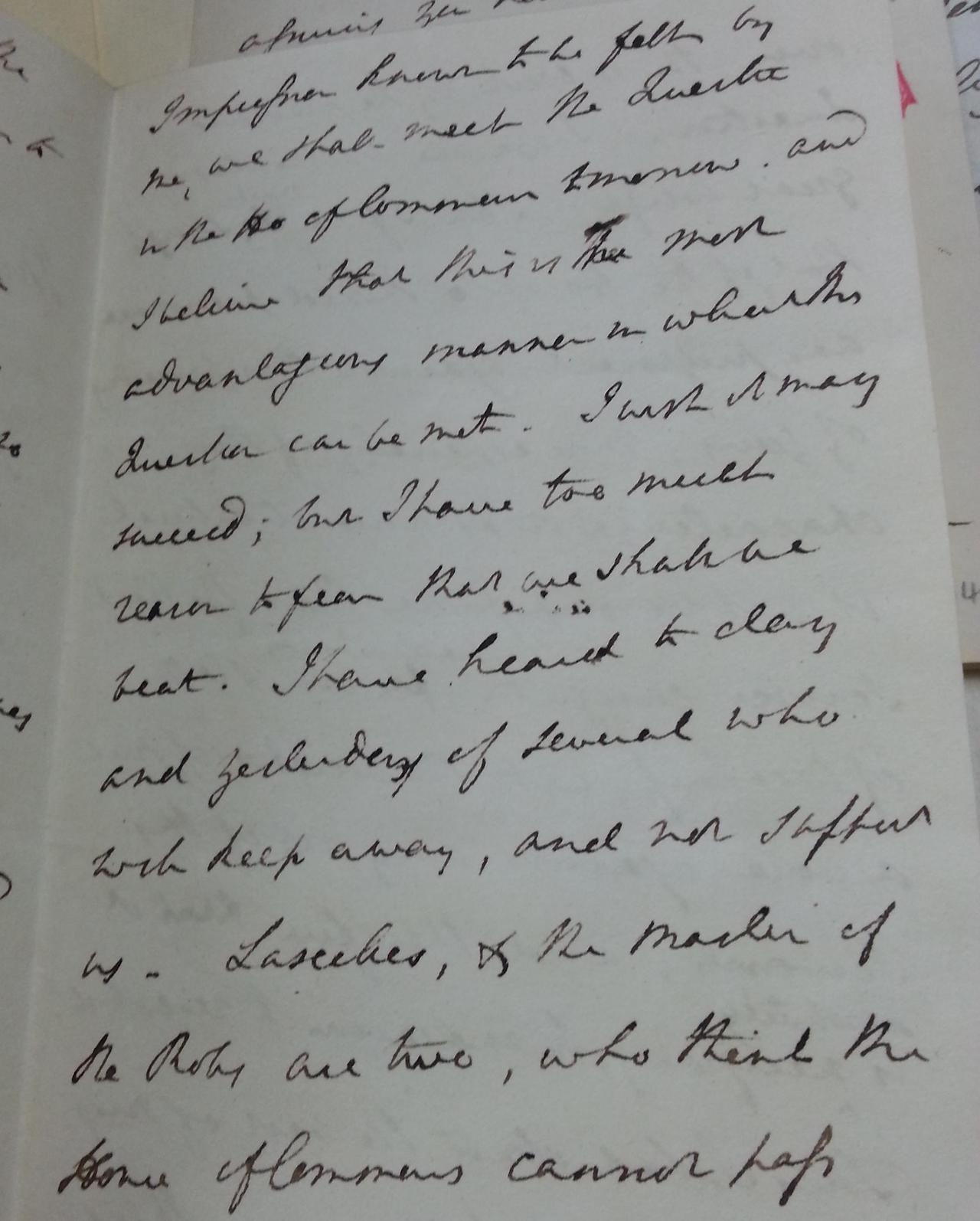
You are aware of the Line which I took in the Ho of Co on Friday last [the debate of the 2nd, in which Perceval labelled Chatham’s early submission of his memorandum to the King an “error” and postponed the vote]; it succeeded to the extent of putting off the discussion, and gave me the opportunity of making known to our Friends, that while on the one hand I did not mean to Satisfy you in delivering your Narrative to the King with the request that it should not be communicated for the present, so on the other I could not consent to ascribe to that delivery any of that Motive or Character which our adversaries endeavour to impute to it [ie, that it was unconstitutional]; and therefore that I should recommend it to the House to pass it by with the previous Question. With this Impression known to be felt by me, we shall meet the Question in the Ho of Commons tomorrow, and I believe that this is the most advantageous manner in which this Question can be met.

I wish it may succeed; but I have too much reason to fear that we shall be beat [in fact Whitbread’s motion was not passed, but only by a slim margin of 33 votes]. I have heard to day and yesterday of several who will keep away, and not suffer us. Lascelles, & the Master of the Robes are two, who think the House of Commons cannot pass over the subject by the previous Question. These are authorities of great weight. Still I feel most strongly that, if the Ho of Co should pronounce any judgment against this proceeding of yours [note: “of yours” ~ If John didn’t feel his hair standing on end at that phrase then he was excessively dim], more especially if they characterize it as unconstitutional, it will be impossible that the King’s Service can go on, particularly in our State of Weakness, with the Weight of such a vote against any one of His Servants; and therefore it is absolutely necessary to endeavour to resist it.

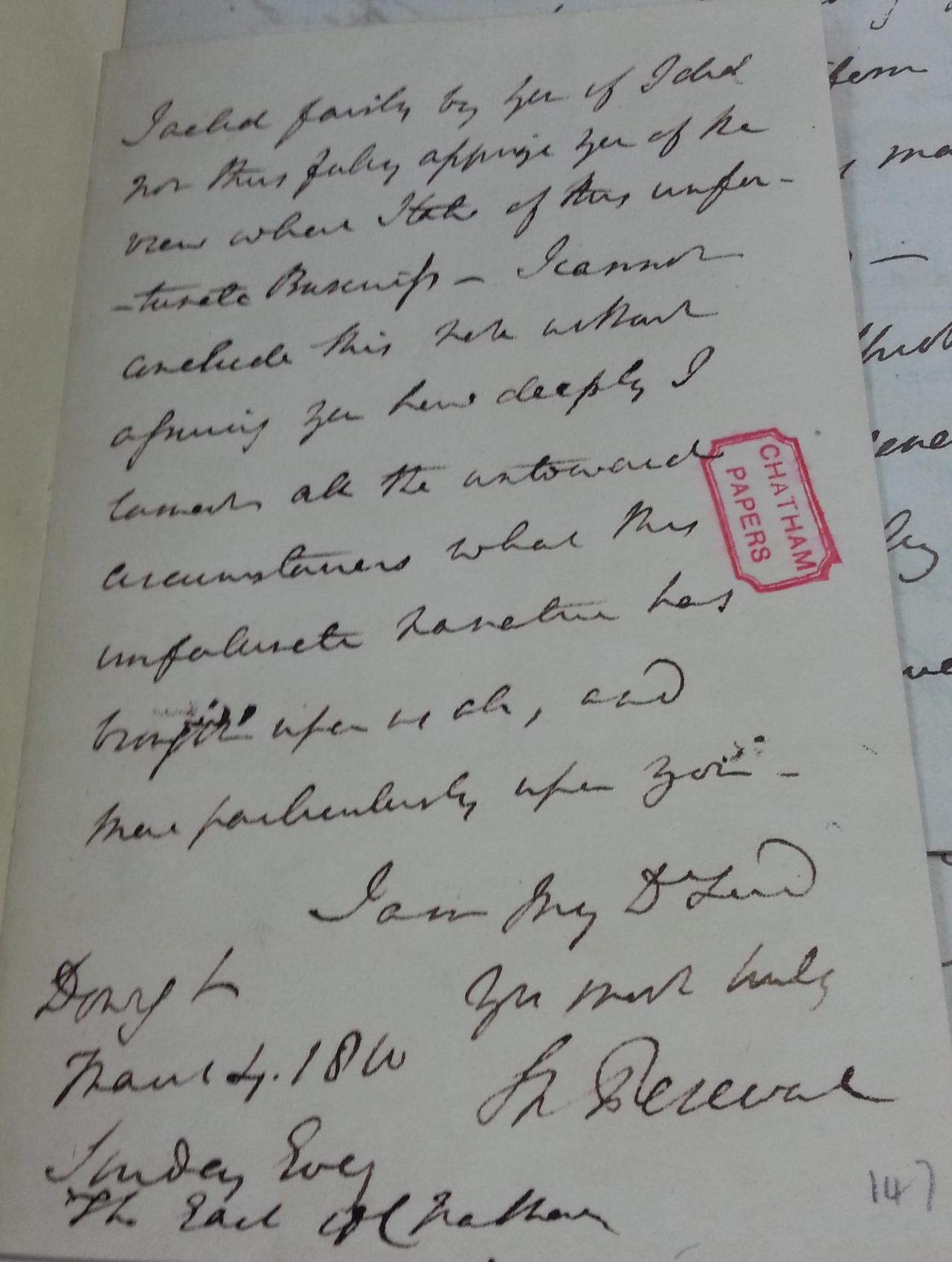
This I shall do to the best of my power. But I should not think I acted fairly by you if I did not thus fully apprize you of the view which I take of this unfortunate Business [John’s hair, already standing on end, probably started to turn white at this point].

[And then the last paragraph, in which Spencer Perceval, deeply religious as he is, doesn’t swear but clearly wants to say something stronger than “unfortunate”:]

I cannot conclude this note without assuring you how deeply I lament all the untoward circumstances which this unfortunate narrative has brought upon us all, and more particularly upon you.

[Ouch!]

I am My Dr Lord

Yrs most truly

Sp Perceval”

Oh dear John, part the zillionth

“There is to be a meeting at my house tomorrow Evening at 9 OClock precisely, and I hope your Lordship will be able to attend it”

(Spencer Perceval to John, Earl of Chatham, undated [January 1810], PRO 30/8/368 f 137)

From the emphasis on “precisely” I draw further confirmation that John’s reputation as the “Late” Lord Chatham was not entirely undeserved. 😉

Tumblr historical figures meme: John, 2nd Earl of Chatham

A while ago a questionnaire was doing the rounds on Tumblr. Followers were supposed to submit the name of a historical figure, and the blogger would answer the questions on the questionnaire with that figure in mind. I did a few of these, but my favourite was obviously my response to the name of John, 2nd Earl of Chatham (no prizes for guessing why). My response is below.

So this one is a bit of a gift 😀 (and I imagine ardentpittite knew that). I could let the blog speak for itself but that would pass up an opportunity to gush about John— so buckle up folks, ‘cause I can’t stop myself. 😉

Why I like him

John and I are accidental buddies. Like most people I encountered him through his brother, and it was only after I started researching him in his own right that I realised he was actually pretty cool too. He could have been so jealous of his younger brother, but he wasn’t. His was a supporting role and he accepted it entirely. It probably suited his character but it still takes strength.

He was terribly maligned and it didn’t help that every time he tried to distinguish himself he got slapped down because of who he was (sent to Quebec, then called back because his father disagreed with the American war — check. Called to the Cabinet, then demoted because his brother wanted to keep the other departments sweet — check. Prevented again and again from actually doing anything remotely dangerous with the army because his brother was his heir and didn’t fancy going to the House of Lords — check, check, check, check, check…)

He was also (sorry anoondayeclipse) by far the most handsome member of the family. *wipes brow*

Why I don’t

Let’s face it, the “Late Lord Chatham” sobriquet was not entirely undeserved. He was addicted to his lie-ins, he hardly ever turned up anywhere on time and I get the impression he was a rubbish correspondent. He could also be petty and snide. And his political opinions … ! I know I shouldn’t let it bother me— he was a man of his time and all that— but he was much more conservative than his brother. Anti abolition of the slave trade, anti parliamentary reform, anti Catholic emancipation, anti, well, everything. And his opinions on how to deal with insurrectionary Ireland in 1798 frankly make my hair stand on end. But as with his brother, I don’t have to agree with him to like him.

Favourite anecdote

Probably the occasion I blogged about in the past when John turned up at half past four to an official Court function that started at noon, thus completely living up to his name and reputation 😉 . In his defence he wasn’t well at the time.

Favourite quotation

John had a noticeable lack of a sense of humour in contrast to his brother William, but when he did make jokes they were dry and rather sarcastic. My favourite is reported by his sister Harriot (it’s printed in her Letters, edited by Cuthbert Headlam): he referred to rumours of forthcoming society marriages and pairings as “Stock Jobbing Reports”. Love it.

The quotation that completely breaks my heart and then stamps on all the pieces, though, is the letter from John to Earl Camden, 7 August 1796 (Kent RO Camden MSS CKS-U840/254/4) in which John lets out his bitterness at being sacked from the Admiralty in 1794. It was the letter that first convinced me John’s side of the story might be worth telling: “The mischief done me, is irreparable, and tho my Brother, whenever he gives himself time to reflect, must (if he possesses any of the feelings wich I always believed him to have) regret the step into which he was surprised, he can never set it right”. *sobs*

BrOTP

John and the 4th Duke of Rutland. Well obviously.

OTP

John seems to have been one of those strange 18th century creatures: an aristocrat in love with his own wife. Lady Hester Stanhope’s memoirs may have made reference to a “mistress”, but I have never found evidence of one. I may be wrong but it seems to me John and his wife were rarely apart. So John-Mary. Works for me.

Oh-God-why-did-that-have-to-happen

Walcheren. I don’t think I need to elaborate. If I do … google it. I’m saying nothing.

And if Walcheren had to happen … WHY, WHY, WHY did John have to submit “that wretched memorandum” (Spencer Perceval’s words, I’d use stronger ones) to the King first? Really, John, you weren’t stupid, but I really wonder what you were thinking.

Unpopular opinion

I think pretty much everything I think about John goes against the grain. He was his own enemy 99% of the time, but he was so thoroughly shafted by everyone he stood no chance. Yes, I realise some would say (and some have said… David Andress I’m looking at you) he had a pretty cushy time coasting on his brother’s influence. They are not entirely wrong of course, but I reckon John had enough pride to disagree.

It doesn’t help that his executors possibly went through his papers and kept the most random bits and bobs imaginable from them; either that or John sorted through them himself. John’s portion of the National Archives Chatham Papers is, basically: loads of household bills from 1834-5 that his heirs needed to settle his outstanding accounts after his death; several huge folios full of correspondence, notes and memoranda on Walcheren and the aftermath; lots of stuff from the Admiralty from 1793-4, which I have a hunch John kept for a reason that I won’t go into here; and uhm, a scattering of letters from friends and family, mainly 1780s-1790s. That is literally it.

What I am saying here is that my “unpopular opinion” is that he is actually worth anyone’s time of day.

A wish

That he and Mary had managed to sprog. There were miscarriages. *sobs anew*

My nickname for him

I have called him “John” throughout and have no intention of stopping. Anyone who has a problem with this can get stuffed.

Five words that best describe him

Clever, lazy, elegant, serious, maligned.

If I could say one thing to him

Should Castlereagh ever suggest the command of an amphibious expedition to Antwerp … just say no.

Favourite portrayal

George Romney’s portrait of John will for ever give me naughty thoughts. I don’t seem to be able to add photos to this, nor can I in any case for copyright reasons. Second place belongs to my avatar, the detail of John’s face from Sir George Hayter’s Trial of Queen Caroline (1823):

Yes, John is in his mid to late 60s in that painting. He aged well.

Least favourite portrayal

Sir Tresham Lever, The House of Pitt (1947). “Stupid” and “useless”?! Please.

Eleanor Eden by John Hoppner (ca 1800)

And of course the lady most famous for nearly-but-not-quite becoming Mrs William Pitt the Younger.

Interestingly Pitt’s brother John, Earl of Chatham was totally dismissive of the frenzied rumours surrounding his brother’s courtship of Miss Eden in December 1796: “I can not conceive what cou’d induce Bathurst, to write you word, seriously, that my Brother was to marry Miss Eden. I do not believe a word of it, tho he has certainly often been there this year, but I rather fancy the inducement was to talk over the finances with my Lord. Mrs Bankes, who is intimate with the Aucklands assures me there is nothing at all in it, and that Lady Auckland [Eleanor’s mother] amuses herself very much with the report (which is very current) and at the alarm it gives certain Persons, who are afraid, they will not engross the whole of his time as they have been in the habit of doing” (Chatham to Lord Camden, 23 December 1796, Kent RO U840/C254/6)

Perhaps a little bitchy (and one must remember John was not on the best of terms with his brother in December 1796), but interesting nonetheless. I daresay John was one of the least surprised people in England when Pitt decided not to marry Eleanor Eden after all just a month later.

Ruminations on Mortality

More happy thoughts for a (sort of) sunny Wednesday afternoon, but yesterday (24 September, that is) was the 178th anniversary of John, 2nd Earl of Chatham’s death. I suspect I was the only one who noticed— that is until I posted about it on Facebook, when roughly 200 of my friends were given the chance to be thoroughly uninterested about it— but I thought it might be an appropriate time to write this post.

John, as I have mentioned before, had no children. The heir to the Chatham title was, therefore, his brother William, who would have been mightily brassed off to be swept away to the House of Lords as Third Earl of Chatham. (Not to mention how annoyed John would have been to have his candle snuffed out well before time… although I suppose he wouldn’t have cared much.) The fate of Pitt the Younger’s government pretty much rode on John’s shoulders, and everyone knew it. Under the circumstances John’s career in the army was rather unfortunate. He didn’t serve abroad much during the wars with France but when he participated in the Helder expedition to Holland in 1799 he was whapped in the shoulder by a spent ball. It was deflected by his epaulette and he survived more or less unscathed (although his coat and waistcoat, reportedly, did not). I don’t suppose he would have been very pleased to  know that his risking his life for his country called forth the typical following encomiums from his cousin the Marquis of Buckingham:

“Lord Chatham’s escape has, I trust, decided you [his brother Lord Grenville] and others to whom the public have a right to look, not to suffer yourselves to forego for his very proper feelings as a soldier the dearest interests of the public; and that, in one word, his further service on the Continent will be negatived; a sacrifice which, I must say, he owes to the public.” (Buckingham to Grenville, 15 October 1799, Dropmore MSS V, 473)

Even a number of Pitt’s earlier biographers had a bit of fun with poor John’s narrow squeak. P.W. Wilson, for example, joked that “Pitt’s career was safeguarded  by the fraternal gold lace” (William Pitt, the Younger (1933), p. 278). Forgive me if I remain straight-faced.

It wasn’t just John’s career that put him at risk, of course. Like all the Pitt children his health was delicate, and any prolonged periods of ill health always got the London newspapers into a state of excitement. Lord Rosebery tells the story of how, “while London was illuminating for the King’s recovery [after the Regency Crisis in 1789], Lord Chatham lay mortally ill. So grave was his malady that the hunters after Providence had fixed on Grenville as the new minister” (Pitt (1891), p. 93). I haven’t found any evidence of this actually happening, but it certainly could have done, although not in the spring or summer of 1789 when John’s movements were thoroughly accounted for. What Rosebery is probably referring to (and somewhat inflating) is the accident that happened to John in the summer of 1788 which I have decided to refer to as the Septic Shoebuckle Incident. From the London Chronicle, 14-16 June 1788:

“The Earl of Chatham has been confined to his room these two months, owing to the kicking of his buckle against his ancle [sic] bone, which, though apparently a trifling accident, has hitherto baffled the efforts of his surgeon to effect a cure.”

So apparently John injured his leg on his shoebuckle (how? ……… no idea: answers on a postcard please). Apart from the fact that the above sounds fairly painful (it almost sounds like the buckle got lodged in his leg, although I think that’s unlikely), the wound obviously went septic and in the absence of antibiotics, kept John under the weather for a good long while. Family and friends were also anxious about it, and apparently with good reason because John’s leg injury kept him unwell for months. “I think my brother is now really at the eve of being able to move again,” William wrote to his mother on 29 August (Stanhope I, 382), three days after the World reported John “nearly recovered” from “a very serious confinement”. By September John was recovering at Henry Dundas’s house in Wimbledon, although it was not until 25 October that the Public Advertiser announced that he was “perfectly recovered from his tedious lameness, occasioned by a wound on the shin from his buckles”. Even that wasn’t the last word: as late as 22 March 1789 the former Pitt family tutor Edward Wilson referred to the injury in a letter to John’s mother (PRO 30/8/67 f 115): “I am truly sorry to hear that anything is the matter with my Lord Chatham’s leg again, but I have rested my hope in your Ladyship’s account of it, as I am now unwilling to trouble his Lordship with enquiries”.

The newspapers were agog. (Had John succumbed, a modern newspaper would almost certainly have run the headline: “Ministry scuppered by a shoebuckle!”) I guess it wasn’t unreasonable to suppose that four to six months was a long time to take to recover from an injury. One can only imagine John’s feelings when he openedthe Morning Herald on 2 October 1788 and discovered that at least one journalist had written him off already:

“If the Earl of Chatham, whose health is much impaired, should die, Mr Pitt will succeed [to the Earldom], and of consequence go up to the House of Peers.”

In 1791 almost exactly the same thing happened (no, not his shoebuckle — that sort of injury surely only happens once in a lifetime). This time, apparently, John fell out of his carriage and broke his leg (according to the Geneve Post on 28 July 1791, anyway). Ouchies for sure, but once again it took months for him to recover, and the length of his recovery possibly owed something to another unspecified underlying illness as Reverend Wilson referred to “the palid [sic] hues that were really alarming” (18 November 1791, PRO 30/8/67 f 53). Either way, the newspapers ran amok again. “The Earl of Chatham was prevented from making his return of the navy, on account of his Lordship’s being confined to his room with a wound in his leg, which he received in stepping to his coach,” reported the London Chronicle on 2 July. Three days later the Star reported him “much recovered”, but on 14 July wrote that he continued “much indisposed at his house in the Admiralty”. On the 19th the Geneve Post announced that he was “so very ill, that is is prevented from leaving his room”. They refrained from printing the running odds on Pitt’s succeeding to the earldom within the month, but someone must have been calculating them by then. On the 21st the Morning Herald dashed the hopes of the gambling men by deeming John “so well recovered … as to be able to resume his Presidency at the Board of Admiralty”, but the account was premature. Pitt wrote to his mother on the same day (PRO 30/8/12 f 436) “My Brother as you probably know, is not yet released from his provoking Confinement; but he certainly mends, tho slowly”. Reverend Wilson also hastened to reassure Lady Chatham: “We receive frequent & undoubted assurances that there is no ground of danger or alarm” (22 July 1791, PRO 30/8/67 f 195).

If Lady Chatham had been following the newspapers she would have needed the reassurance. The Star reopened the odds on the succession of a third Earl of Chatham on 23 July with the news that “The Earl of Chatham continues much indisposed … His Lordship has not attended the Admiralty Board this fortnight”. Not until 12 August did the Evening Mail report that Chatham had gone “out in his carriage, for the first time these six weeks”, and it was not till the end of the month that he resumed his official duties. Probably John’s health was followed so closely because he was a member of the cabinet, but some of it almost certainly had to do with curiosity as to what would happen if he keeled over.

Of course after Pitt died in 1806 nobody cared quite so much whether John lived or died, but as he got older the vultures began to cluster around the various honorary positions and emoluments he held for life in the hopes of inheriting them in due course. In 1831 John’s health collapsed and he thought himself close to death. He wasn’t the only one: the Duke of Wellington received a letter, dated 15 March 1831, from General Sir William Clinton, asking for one of John’s official posts since there was a rumour he had died. The Duke had to write back to tell Clinton he had been misinformed. (University of Southampton Wellington Papers, WP1/1178/26)

Poor John, but it does rather put me in mind of Spamalot’s “Not Dead Yet” song… (…..which probably makes me just as bad as all those sniggering historians to be honest)

“A felicity inexpressible”: The Chatham Vase

The “Chatham Vase” is a sculpture commissioned by Hester, Dowager Countess of Chatham, in 1780-1 to commemorate her husband William Pitt the Elder, First Earl of Chatham. It was sculpted in the shape of a Grecian urn by John Bacon, the same man who designed Chatham’s monument in Westminster Abbey. The urn was erected at Burton Pynsent, Somerset, which Lady Chatham used as her dower house until her death.

The lines on the pedestal (largely weathered away now, but still just about legible) read:

“Sacred to pure affection, this simple urn stands a witness of unceasing grief for him who, excelling in whatever is so admirable, and adding to the exercise of the sublimest virtues the sweet charm of refined sentiment and polished wit, by gay social commerce rendered beyond comparison happy the course of domestic life and bestowed a felicity inexpressible on her whose faithful love was blessed in a pure return that raised her above every other joy but the parental one, and that still shared with him. His generous country with public monuments has eternised his fame. This humble tribute is but to soothe the sorrowing breast of private woe.”

This tribute was apparently written by Lady Chatham herself, with a little assistance from her son William Pitt the Younger. Pitt wrote to his mother on the subject on 20 April 1780 (Stanhope I, 39):

“All my feelings with regard to the paper enclosed I need not express. I am sure I should be far indeed from wishing to suggest a syllable of alteration. The language of the heart, of such a heart especially, can never require or admit of correction. May it remain as it deserves, a lasting monument of both the subject and the author.”

After Lady Chatham died in April 1803, her son John, second Earl of Chatham, was forced to sell Burton Pynsent for financial reasons. He made sure, however, to take the Vase away before selling the property. Where it went after Burton I do not know—I have found no record of John having access to any country property between 1805 and 1815, or from 1820 onwards. Presumably the Vase spent the time packed away in John’s attic. It was not forgotten, though. Richard, Duke of Buckingham and Chandos, the son of John’s cousin the Marquis of Buckingham and Hester Chatham’s great-nephew, wrote to John in March 1831:

“My Lord,

I feel that I am taking a great liberty in entering into the subject of this letter and must appeal to your kindness to excuse me for doing so. My veneration for the memory of the great men of the family from which I am descended, must plead my pardon, and I am sure that to no-one can that appeal be more forciby made than to the Son of the grand Earl of Chatham.

The monument erected by your Mother to her lamented Lord at Burton Pynsent has now no resting place where it can stand a memorial to her Piety and of your Father’s greatness. The want of a male heir should any thing happen to you in the uncertainty of human life, will, unless you will that monument away, leave it—or its value—to be divided amongst Co-Heiresses [presumably a reference to John’s then heirs, Lady Harriot Hester Pringle and Lady Lucy Taylor]. It ought to stand in some Scene which your Father visited and took interest in, during his life time. Will you allow me to put it up at Stowe? … Allow me to press the request upon you, and to express my hope that you will prove that you forgive me by coming this next Summer at Stowe, and then view with your own eyes the Urn placed amidst the Scenes in which your Father past so many of his days” [PRO 30/8/365 f 243, 3 March 1831]

I personally found that letter astoundingly cheeky—“You’re old and about to peg it, and have no children, so can I have your urn?”—and I don’t know how much eye-rolling John must have done on reading it, but he agreed:

“I beg that you will accept my very warmest thanks for the kind manner in which you have acquiesced in my request … With your permission I shall put an Inscription upon a side of the Pedestal different from that on which your Mother’s inscription is engraved, stating how it came to be placed at Stowe, and probably you will not be displeased if I request Lord Grenville to write the Inscription for me” [23 March 1831, PRO 30/8/365 f 241]

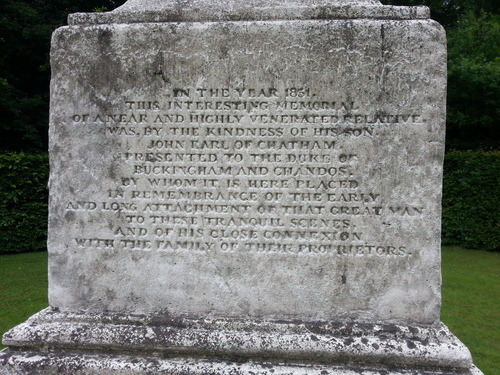
Lord Grenville’s inscription reads: “In the year 1831, this interesting memorial of a near and highly venerated relative was, by the kindness of his son John Earl of Chatham, presented to the Duke of Buckingham and Chandos by whom it is here placed in remembrance of the early and long attachment of that great man to these tranquil scenes, and of his close connexion with the family of their proprietors.”

The Vase, however, did not long remain at Stowe. It was sold at auction in 1848, and where it was between 1848 and 1857 I do not know. In 1857 it was sold again and purchased by James Banks Stanhope, son of James Hamilton Stanhope, who through various very complicated relationships was related to both the Grenvilles and the Pitts, and placed at Revesby Hall in Lincolnshire:

The Vase moved on one more time, when it was bought by the 7th Earl Stanhope in 1934:

The Vase is now at Chevening (and hopefully won’t go anywhere else as there are no more sides to engrave……). This is as appropriate a place as any given that the Stanhope family was closely bound to the Pitts by blood and marriage, and the first Lord Chatham lived there for a while in 1769 and helped lay out the grounds (nobody ever managed to stop him “improving” any house he stayed in). There is still a copy at Stowe, but the original can still be seen at Chevening, which holds annual garden Open Days if anybody is curious enough to want to see it.