“Name that Member!”: weird (but wonderful) British parliamentary customs

Today, something a little different, to celebrate the 4th anniversary of the English Historical Fiction Authors blog and the publication of their second anthology of articles: Castles, Customs, and Kings: True Tales by English Historical Fiction Authors, volume II. For further information and links, including how to link to other posts in the CCK Blog Hop, see the bottom of this post!

My background is in political history. I love British politics, current and not so current. I wrote my high school dissertation on an the 1784 general election (think “Blackadder the Third” … startlingly accurate), chose political options as an undergraduate whenever possible, and studied 18th century political discourse for my PhD. Unsurprisingly, my career path has also taken me close to politics. Although I am a librarian by training, I spent a year working in a government department, and one of my duties was to compile daily lists of parliamentary debates.

ImageVaultHandler.aspx

Hansard, from here

Ah, Hansard… Hansard, since 1803(ish) the official record of British parliamentary goings-on. If it’s not in Hansard, it didn’t happen. Modern Hansard comes in densely-typed A4 packets, sewn together to form a booklet from about a centimetre to a centimetre and a half in thickness (depending on how verbose members are feeling on any particular day). Dull, you say? Anything but. My Hansard perusals were the highlight of my day.

You see, Britain’s Parliament has been around for a good long while — its history goes all the way back to Magna Carta (if you’ve been living in a cave for the past year of 800th-anniversary celebrations, that was signed in 1215) and the 13th century. Simon de Montfort summoned the first “proper” parliament in 1265, incuding representatives from all around England. That’s 750 years of (sort of) regular parliaments, and 750 years’ worth of weird and wonderful customs and traditions. Because if there’s one thing we Brits love, it’s a weird and wonderful custom.

So, ever wondered why poor old Black Rod gets a door slammed in his face every time Parliament is opened? Or why the Lord Chancellor sits on a woolsack? Or all this fancy politeness of only referring to other members as “the honourable Member for [insert random constituency here]”? Wonder no more….

1. That Black Rod thing

… is really quite simple. It’s a statement of the Commons’ independence from the Crown. It goes back to the 17th century, when Charles I came into the House of Commons in 1642 to arrest five MPs. They had been forewarned and escaped, but it was the last time a monarch was allowed to enter the Lower Chamber. After all, if the Civil War proved one thing, it was that even the monarch was not above British law.

Nowadays Black Rod (the person in charge of Westminster security — so named because he carries a black staff as a symbol of his office) summons the House of Commons to come to the House of Lords to hear the Queen’s speech whenever she opens Parliament. Because he represents the royal authority, the door of the House of Commons is slammed in his face as he arrives, and he has to knock three times to gain admittance.

Yes, that is the political equivalent of “We’re the kings of the castle, and you’re the dirty rascal”.[1]

https://www.youtube.com/embed/9o65Ap7nC8w“>http://

2. Why does the Lord Chancellor sit on a Woolsack?

This one is also quite simple: because wool was one of England’s most important products and exports. Edward III made it compulsory for his Lord Chancellor to preside over the Grand Council on a bale of wool. The current Woolsack is stuffed with wool from around the Commonwealth.[2]

The Woolsack, from here

The Woolsack, from here

3. “Naming” a member

I’ve actually come across a few examples of this occurring in my research. “Naming a Member” is a disciplinary procedure in the House of Commons. Using an MP’s name is forbidden: only the Speaker can do it, when he /she calls on a member to speak in debate. Otherwise, it’s all “the honourable Member for” whichever borough elected them in the first place. Thus David Cameron (if he weren’t prime minister) would be “The honourable member for Witney”, and George Osborne (if he weren’t Chancellor of the Exchequer) “the honourable member for Tatton”, etc.

However, if an MP is especially naughty — maybe they might accuse another member of telling a direct lie[*] — the Speaker might “name” them, by saying “I name the Honourable Member for Mouldy-in-the-Hills, Ms Winterbottle, for disregarding the authority of the Chair”. Big deal? Maybe, but the named MP is then suspended for five days. If Ms Winterbottle is named again during the same session, she is suspended for twenty days. If she does it a third time, she might not sit again for the remainder of the session.[3]

[*] See below

4. … Speaking of lying in the House…

Accusing another MP of lying is an example of “unparliamentary language”. (Euphemisms are allowed: Winston Churchill once accused another member of “terminological inexactitude”). Swearing and general insults are also not allowed. According to a House of Commons Factsheet on traditions of the House, “Among the words to which Speakers have objected over the years have been blackguard, coward, git, guttersnipe, hoolian, rat, swine, stoolpigeon and traitor”.[4]

MPs can apologise for unparliamentary language by “withdrawing” it. Otherwise, if the language is not withdrawn, then the Speaker may order the MP to withdraw instead.

Occasionally, refusals to withdraw “unparliamentary language” have led to arguments been taken, as it were, outside. In 1798, the prime minister, Pitt the Younger, accused an opponent, George Tierney, of deliberately obstructing a government measure. When Pitt refused to withdraw his comments, Tierney challenged him to a duel. Both escaped unhurt.

5. Dragging the Speaker

The Speaker [or chairperson] of the House of Commons is elected each session by the MPs. Traditionally, the Speaker Elect is not supposed to be happy at all with the honour. On the contrary, they should be physically dragged to the chair. (Extra points are, presumably, given for kicking and screaming on the way.)

Why? Because in centuries past, the Speaker would lay the advice of the Commons before the monarch. If the monarch didn’t like it… the Speaker could be imprisoned, or even executed. It doesn’t happen any more, of course, but still![5]

https://www.youtube.com/embed/jS-BWqI5nI4“>http://

6. … And some other examples of weird and wonderful customs

  • The Mace: sits on a table in front of the Speaker in the House of Commons, and is carried in and out in procession each day. It represents the Royal authority and, unless it is present, Commons decisions are not binding. It is occasionally a focus for parliamentary protests, therefore: any MPs who so much as touch it are “named” and suspended for five days. John McDonnell, MP for Hayes and Harlington, was suspended in January 2009 for trying to carry it off in protest during a debate on Heathrow Airport.[6]

https://www.youtube.com/embed/CpDyW-p_KWs“>http://

  • Hats: MPs used to be required to wear them, unless speaking in debate. Until 1998 they were still required to wear one while raising a Point of Order (i.e., challenging whether a breach of House rules has occurred). Two top hats were kept in the Commons for precisely this purpose (although some MPs, to save time, put their copies of Hansard on their heads instead). The rule was (unfortunately) abolished in 1998. Male MPs are still forbidden from addressing the House in a hat. (Women are allowed.)
  • Swords: MPs used to wear them, and in the 18th century government members were still required to wear Court dress — which included a dress sword. Nowadays, as a Commons Factsheet puts it, “It is not now permitted to carry arms of any kind into debate”. There are still sword hangers in the cloakroom, though, and the Treasury and Opposition benches are still two sword lengths apart …… just in case.
  • Armour: Also not allowed: since 30 October 1313, it seems. If you were wondering, yes, it’s specifically forbidden.
  • Snuff: Smoking, obviously, is forbidden, and has been since 1693. Snuff on the other hand, would you believe, is provided at public expense for MPs, and still kept in the doorkeepers’ box. “Very few Members take snuff nowadays,” reports a Commons factsheet. Which implies that some do……[4]

There are, of course, many more British parliamentary customs: this is but a flavour. It’s worth checking out the House of Commons factsheet on the subject, and also the following sources:

  • An article from the Daily Telegraph on the subject
  • A Listverse article entitled “10 Oddities of the British Parliament”
  • The UK Parliament website page on traditions
  • A History Today article on the 750th anniversary of Parliament

References

[1] For more on Black Rod’s duties, see this site

[2] For the Woolsack, see the online UK Parliament glossary

[3] See here

[4] UK Parliament guidance on unparliamentary language; House of Commons Information Office Factsheet G7, “Some Traditions and Customs of the House”: found here

[5] See here

[6] BBC article on McDonnell’s suspension

~~~~~~~~~~~~~

New Release!

CC&KII Cover

Castles, Customs, and Kings: True Tales by English Historical Fiction Authors, Volume 2
Edited by Debra Brown and Sue Millard

An anthology of essays from the second year of the English Historical Fiction Authors blog, this book transports the reader across the centuries from prehistoric to twentieth century Britain. Nearly fifty different authors share the stories, incidents, and insights discovered while doing research for their own historical novels.

From medieval law and literature to Tudor queens and courtiers, from Stuart royals and rebels to Regency soldiers and social calls, experience the panorama of Britain’s yesteryear. Explore the history behind the fiction, and discover the true tales surrounding Britain’s castles, customs, and kings.

Purchase links:

Amazon US http://www.amazon.com/Castles-Customs-Kings-English-Historical/dp/0996264817
Amazon UK http://www.amazon.co.uk/Castles-Customs-Kings-English-Historical/dp/0996264817

~~~~~~~~~~~~~

Powered by Linky Tools

Click here to view the other posts in the CC&K Volume II Blog Hop!

Lord Chatham’s aides-de-camp at Walcheren, 1809

I’ve been reading the Monthly Army Lists recently. I know, I know… as a friend already told me, “Who reads the Army Lists, other than officers keen on getting promoted?” The answer is, “Historians who want to find out what district their subject was attached to during the Napoleonic Wars, and who their staff were”.

armylist2

I will give out no prizes for anyone who guesses which army officer I’ve been tracking through the army lists. In the 1790s Britain and Ireland were partitioned up into military districts, and each appointed a commander-in-chief with his own staff. Lord Chatham (YES! you guessed it!) spent most of his time attached to the Southern District, where he served under Sir David Dundas, before being promoted in 1806 to the command of the Eastern District.

His aides-de-camp have awfully familiar names:

  • Captain Bradford (October 1806 – December 1808)
  • Captain Hon. W. Gardner (as of June 1807)
  • Captain Hadden (as of January 1809)
  • Captain Falla (as of January 1809)

armylist

Another familiar name that crops up is that of Lt. Col. Cary, who appears for the first time as Assistant Adjutant General in June 1807.

Why do I say “familiar”? Because check out this list, printed in The Scots Magazine and Edinburgh Literary Miscellany (71), 623, of Chatham’s aides-de-camp at Walcheren:

  • Major Bradford (11th Foot)
  • Hon. Captain Gardner, RA
  • Captain Haddon [sic], 6th Dragoons
  • Major Linsingen, 1st Light Dragoons, KGL
  • Captain Felix, 36th Foot
  • Major Lord Charles Manners and Captain Lord Robert Manners, extra ADCs
  • Lt-Col. Carey, 3rd Foot Guards, Military Secretary

“Captain Felix” of the 36th is something of a mystery, not appearing in the Monthly Army List for 1809 or 1810 in that regiment. But note that the Tradesman, or Commercial Magazine (vol 3, 1809), 168 leaves Felix out and in his place is a certain “Capt. Falla, 25th Foot”.

Leaving out Major Linsingen, and the Manners brothers (both of them sons of Charles, 4th Duke of Rutland, Chatham’s old buddy), who were these men? Chatham would have known them well from the Eastern District, and was obviously inclined to trust them. Conversely, they would have known Chatham well and, presumably, been accustomed to his way of doing business (by which I mean his habit of getting up about 12 o’clock noon).

Below is some of the information I’ve managed to find on Chatham’s chosen men. They were not, after all, merely names in the Army Gazette, but real men with their own lives and stories to tell.

1. Sir Henry Hollis Bradford (1781-1816)

Bradford (with the 11th Foot in 1809) was the youngest son of Thomas Bradford of Ashdown Park, Sussex. He was born on 25 June 1781. He was Chatham’s longest-serving ADC in the Eastern District, although also the first to leave him, at the end of 1808, when he was sent out with Sir John Moore to Corunna. He had already previously served at Copenhagen in 1807.

He survived the retreat, and Chatham remembered him fondly enough to appoint him First Aide-de-Camp at Walcheren. Bradford was tasked with bringing home Chatham’s official dispatch reporting the fall of Flushing in August 1809, and received a reward of £500 for the job. After Walcheren he went back to the Peninsula, where he saw action as Assistant Adjutant-General at Salamanca and Vittoria, and Nivelles and Toulouse, among others. As a result he was created a Knight of the Bath in January 1815.

33483823_123360040074

Monument to Sir Henry Hollis Bradford, from here

He fought at Waterloo, but was badly wounded during the course of the battle. Unfortunately he never recovered, and died on 17 December 1816 at Lilliers, in France, as a result of the wound he had received over a year earlier. He reached the rank of Lieutenant-Colonel.[1]

2. Hon. William Henry Gardner (1774 – 1856)

Gardner was the son of Admiral Alan, Lord Gardner, who had been Lord Chatham’s friend and colleague on the Board of Admiralty during Chatham’s tenure as First Lord. William Henry was thus also the brother of Alan Hyde, Lord Gardner, who commanded one of the naval divisions during the expedition to Walcheren. His connections to the Walcheren high command did not end there: in 1805 he had married Elizabeth Lydia Fyers, the daughter of William Fyers, who had served as Chief Engineer during the expedition.

He was born on 6 October 1774 and died 15 December 1856. He reached the rank of General.[2]

3. William Frederick Hadden (1789 – 1821)

Hadden was the son of James Murray Hadden, Chatham’s Surveyor-General of the Ordnance (and close friend). Hadden was in the 6th (Inniskilling) Dragoons in 1809, as a Captain: interestingly, he appears in May 1814 as a Lieutenant in the 4th.

One reason for this demotion may have been his odd behaviour. According to anecdote, he was drummed out of the army for asking Queen Adelaide to dance without an introduction, but this doesn’t match up with his lifespan and I have not found any evidence of it. According to a website on the history of Harpenden in Hertfordshire, where his family had a house, Hadden threatened to muder his friend the Dean of Liverpool as a result of a vision and was subsequently locked away in a lunatic asylum. Whether the story is true or not is unclear, but like Bradford he certainly died young.[3]

4. Daniel Falla (1778 – 1851)

Falla came from an established Jersey family. His brother, Thomas, was also in the army, but killed at the siege of Seringapatam in 1799. He was in Egypt in 1801 before joining Chatham’s staff, and would follow Chatham to Gibraltar, where Chatham had him appointed Town Major in 1822.

Falla remained Town Major for twenty-five years: he retired in 1847, twelve years after Chatham himself had died. Falla then returned to his native Jersey, where he died at St Helier, on 14 March 1851. He reached the rank of Colonel.[4]

5. Thomas Carey (1778 – 1825)

Like Falla, Carey was a native of the Channel Islands — of Guernsey, to be precise. He was by far the most active of all the aides, and thus the easiest one to track in the records. He was the sixth son of a local magnate, and entered the army as an ensign in the 3rd Foot Guards (Chatham’s old regiment) in January 1794. He participated in the disastrous Flanders campaign of 1794-5. He was at the Helder in 1799, where he served as Adjutant for his regiment. Carey earned himself a reputation for hard work: a Horseguards official said, “Carey is one of the most zealous and efficient adjutants I ever knew: there is no nonsense about him; however irksome may be the orders he receives, he sets to work, and executes them on the instant with cheerfulness and alacrity, never starting or thinking of a difficulty”.

He was in Egypt in 1801, where he contracted the eye disease opthalmia and nearly lost his sight. Following his recovery, he accompanied the abortive British expedition to North Germany in 1805 as assistant adjutant general to the forces. He was also at Copenhagen in 1807.

Like Bradford, he served in the Peninsula in 1808 and 1809, and was present at both Vimeiro (where he was wounded) and Corunna. Although he joined Chatham’s staff on the Eastern District officially in 1807, he claimed to have been familiar with him since 1804, although in what capacity I have not been able to identify. By 1809, however, when Carey went with Chatham to Walcheren, the two men were close: as a short biography of Carey in the History of Guernsey put it, he and Chatham “enjoyed the most intimate and lasting friendship”. Carey was certainly devoted to Chatham: “The more I see of him, the more I am convinced that in understanding few equal him, & in Honor or Integrity He cannot be excelled”.[5]

Carey was militant in the defence of his commander after the end of the Walcheren campaign. He interceded on Chatham’s behalf with various political and military figures, but to no avail. Carey remained, apparently by choice, with Chatham in the Eastern District until 1814, when he was promoted to the rank of Major-General. Unfortunately at this time an old illness recurred (malaria, perhaps, from Walcheren?) and he was forced to leave the army. He was not, therefore, able to participate in the Waterloo campaign.

His health gradually failed until he died in London on 9 November 1825. I would very much like to know what Chatham’s reaction was to his death, for of all his aides Carey had been the most faithful.[6]

References

[1] Henry Hollis Bradford: London Gazette, 4 January 1815; Journals of the House of Commons LXV, 558; www.geni.com page on H.H. Bradford; Burke and Burke, The Knightage of Great Britain and Ireland (London 1841), 217; The New Monthly Magazine, VII (1817), 69; http://glosters.tripod.com/WInf.htm

[2] William Henry Gardner: J. Burke, A General and Heraldic Dictionary of the Peerage and Baronetage of the British Empire (London, 1832), I, 505-6; geni.com page on William Henry Gardner; genealogical page on the Gardner family

[3] William Frederick Hadden: article on the Haddens of Harpenden

[4] Daniel Falla: Gentleman’s Magazine, July 1851, 328; page on the Falla family monument; Annual Register (1851), 271

[5] Thomas Carey to William Huskisson, 3 May 1810, British Library Huskisson MSS BL Add MSS 38738 f 26

[6] Thomas Carey: Gentleman’s Magazine, vol XIX (July 1824), 563; Jonathan Duncan, The History of Guernsey, with occasional notices of Jersey, Alderney, and Sark (London, 1841), pp. 613-15

Guest Posts for Other Blogs

I regularly post for the English Historical Fiction Authors blog, and have also posted for Madame Gilflurt and others. A list of my guest posts can be found below:

For English Historical Fiction Authors:

And a joint post with Stephenie Woolterton of The Private Life of Pitt fame:

For Madame Gilflurt:

For Mariana Gabrielle:

And a quick post for the Bluestocking Belles’ Teatime Tattler:

  • A fictionalised look at the interruption by “Mad Jack” Fuller of the Walcheren inquiry

“As honorable to the Commander, as advantageous to the Country”: the Walcheren command

In mid-May 1809, the British government was pretty sure it was going to be sending a sizeable expedition to the Scheldt basin to reduce the island of Walcheren and destroy the dockyards of Antwerp. Horseguards was busily preparing a force of thirty thousand men (the number would later rise to nearly 40,000); the Admiralty was putting together a flotilla of over six hundred vessels, from the 80-gun HMS Caesar to a vast fleet of transports and flatboats. At this point, however, the military and naval commanders had not yet been appointed.

Lord Castlereagh, by Sir Thomas Lawrence

Lord Castlereagh, by Sir Thomas Lawrence

Lord Castlereagh, the Secretary of State for War, had been thinking about an expedition to the Scheldt for months. When he had first considered it, he had intended the command to go to Sir John Moore, but Moore had been killed at Coruña in January. For a while there was a rumour that Sir John Hope would take the command, as he was one of the more senior generals attached to the expedition, and there were other rumours that Sir Harry Burrard and even the Duke of York were considered,[1] In fact the job went to John Pitt, 2nd Earl of Chatham, then a cabinet member as Master-General of the Ordnance.

Lord Chatham, engraved by Charles Turner, after  John Hoppner

Lord Chatham, engraved by Charles Turner, after John Hoppner

Why Chatham was chosen mystified contemporaries, and historians since. Chatham had joined the army in 1773, but, although a reasonably senior Lieutenant-General by 1809, had not served abroad since 1799. He had in fact not been militarily active at all between 1784 and 1798. There were the usual conspiracy theories – the King had nominated him; George Canning wanted Chatham to succeed so he could prop him up as a figurehead Prime Minister; Chatham needed the cash – and of course after the whole deal went wrong everyone at Horseguards and the War Office was busily accusing everyone else for the appointment.

From the evidence that wasn’t drawn from gossip, however, Chatham seems to have been Castlereagh’s own choice. Maybe Castlereagh remembered how Chatham had been leapfrogged for the Peninsular command the previous year. Maybe Castlereagh thought that, since the expedition was sure to succeed, a Cabinet member in command could only reflect glory on the rest of the government. Who knows? But on 18 May 1809 Castlereagh wrote the following letter to Chatham, who was ill at the time:

“Private & Confidential

Downing Street

18 May 1809

My Dear Lord

I am anxious to have the great Question on which we conversed yesterday put in a course of proper Investigation. The Admiralty are naturally pressing upon it, and Commodore Owen is come to Town for the purpose of giving his Assistance.

I do not conceive, that any Effectual progress can be made, till we have come to a decision, Who is to be Entrusted with the Execution of the Operation, if it should be determin’d on, nor indeed till this is fixed, can any of the Departamental [sic] Arrangements be satisfactorily proceded [sic] on.

Under these Impressions, and in the hope that the result may prove as honorable to the Commander, as advantageous to the Country, allow me to propose it for your acceptance. In Expressing my own wishes, that it may be confided to you, I am authorized to add the Duke of Portland’s, and I have no doubt those of all our Colleagues.

Until I am possess’d of your Sentiments, I shall not feel myself authoriz’d to mention the Subject to His Majesty, nor indeed can I well take any measures at the Horseguards in furtherance of our purpose.

Believe me my Dear Lord

Very Truly Yours

Castlereagh”[2]

Chatham’s response to Castlereagh’s offer didn’t exactly burn with enthusiasm:

“Private

Hill Street

May 18 1809

My Dear Lord,

I received your letter of this morning, and feel sensibly the kind manner, in which you have proposed to me, the command of the Expedition, now under consideration, and I am much gratified by the concurrence in your sentiments, expressed by the Duke of Portland. Of course, I shou’d be at all times, ready when called upon to obey His Majesty’s Commands, but considering this proposal, as an Option given to me, confidentially on your part, I can only say, that I shou’d be very anxious to have some further conversation with you on this subject, before I venture to give any decided answer to it. I am better, but still confined. I shou’d therefore be happy if you wou’d have the goodness to call here at any time most convenient to you.

Believe me,

My Dear Lord,

Yours Most Truly

Chatham”

Perhaps Chatham already had a premonition of what was to come. If so, I imagine both he and Castlereagh had reason to rue the day he overcame his reluctance and accepted the command of the Walcheren expedition.

References

[1] Henry Brougham to Lord Grey, 30 June 1809, from The Life and Times of Henry, Lord Brougham I, 439-40 (London, 1872)

[2] National Archives Chatham MSS PRO 30/8/366 ff 58-9

[3] PRONI, Castlereagh MSS D3030/3087

Lord Chatham’s “unfortunate Narrative”

AN00078897_001_l

“Secret Influence, or a Peep Behind the Screen” (Charles Williams, March 1810) (from here)

In July 1809 nearly 40,000 troops and 200 sail were sent out under the joint commands of Lieutenant-General the Earl of Chatham and Admiral Sir Richard Strachan. Their ultimate object was to destroy the French navy and dockyards at Antwerp, but first they had to secure the entrance to the Scheldt River. For this purpose the British forces occupied the islands of Walcheren and South Beveland, but this process took nearly a month, by which time the French had brought in considerable reinforcements, strengthened the defences of Antwerp, and withdrawn their fleet upriver. Meanwhile, the British Army had begun succumbing to an illness that swept through the ranks at an alarming, and thoroughly devastating, pace. On 27 August 1809 Chatham, in accordance with his lieutenant-generals, agreed to call off the campaign.

Fast-forward six months to Friday, 16 February 1810. The House of Commons was in the midst of a full House Committee appointed to look into the planning, execution and outcome of the Walcheren expedition. Admiral Sir Richard Strachan had been called up the previous day to give his evidence to the Committee, and George Tierney moved to call Lord Chatham to the Bar on Thursday the 22nd. When Tierney sat down, General William Loftus rose to move: “That an humble Address be presented to HM, that he be graciously pleased to order to be laid before the House a Copy of the Memorial presented to HM by Earl Chatham, explaining the proceedings of the late Expedition to the Scheldt”.

This innocuous motion, which was not even significant enough to warrant a mention in the official Parliamentary Debates, sparked off a massive political and constitutional controversy which came perilously close to bringing down Spencer Perceval’s new and tottering ministry. For there were several very irregular features to Chatham’s Narrative. The contents were bad enough: Chatham laid the blame for the delays in undertaking the expedition squarely at Strachan’s door. But this assault on the nation’s darling, the Royal Navy, paled before the way in which the Narrative had found its way to the public. Written on 15 October 1809, Chatham had not submitted it until 14 February: and instead of submitting his explanatory narrative to the Secretary of State for War, Chatham had submitted it directly to the King, without communicating it either to the Cabinet or to Sir Richard Strachan himself.

The opposition, already scenting Perceval’s blood, fell on Chatham’s memorandum with glee. Lord Folkestone led the attack on the 19th February. The Narrative “was such a document as that House ought not to receive or allow to remain on the table”: it was a potentially unconstitutional document, since it purported to be an official document submitted without the seal of ministerial responsibility. Within minutes the word “impeachment” was being flung about the House with much enthusiasm. Folkestone spoke of the Narrative as though it were something dirty that needed to be pushed out of the Commons on the end of a stick: “He really did not know how the House should proceed to get rid of such a paper; but it seemed highly desirable that it should do so”.[1]

Worse was to come. When Chatham was cross-examined on the 22nd, the Narrative inevitably came up. Chatham was asked if he had drawn it up on 15 October, which he confirmed: in answering the question of why he had not submitted the paper prior to the 14 February, however, Chatham — who was ill the day of his examination — let slip with “I thought it was better to presere the date at which it was in fact drawn up; there were after that time none but verbal or critical alterations”.[2]

“Is this the only Narrative or Memorial, or paper of any description, which has been delivered to His Majesty by your lordship on the subject of the Expedition?” was the obvious immediate response, which Chatham refused to answer — five times. When pressed as to whether he refused on the grounds of being a Privy Counsellor, he replied brusquely, “I refuse generally. I decline answering the question.”[3]

The fuss that greeted Chatham’s paper was immense. The Times (an oppositionist paper) considered that the Narrative “will be read, under all its circumstances, with more astonishment and suspicion than any thing that we ever recollect to have come before the public as an authentic document”.[4] According to the Morning Chronicle, the Narrative gave “rise to reflections by no means favourable to his Lordship”.[5] Even the Morning Post, a government paper, believed that “certainly nothing could be more irregular or improper” than the way in which Chatham had submitted his Narrative. “His Lordship cannot otherwise be considered than as standing convicted of a serious constitutional offence”.[6]

Clearly Chatham had had no idea what reaction his paper would provoke when he had requested Loftus to submit it to the Commons. These newspaper snippets, however, particularly that from the government paper, would have given him a good idea of the way the wind was blowing. The sequel was inevitable. On 23 February Samuel Whitbread — ominously, the man who had led the campaign to impeach Henry Dundas, Viscount Melville, the First Lord of the Admiralty, in 1805 — passed a motion requesting the King to lay before the House “copies of all reports, memoranda, narratives or papers submitted at any time to his Majesty by the Earl of Chatham, relative to the late Expedition”. There followed what was probably the most awkward cabinet meeting ever, in which Chatham (who was, after all, still Master General of the Ordnance) was pressed by his disgruntled colleagues to explain himself.

Chatham’s reasoning was that he had in fact submitted the same memorandum to the King prior to 14 February, on 15 January: he had then requested it to be returned on the 10th, to remove a few passages, and had resubmitted it on the 14th. The King corroborated this fact, and Perceval was able to use it to stave off an immediate assault on 2 March by Whitbread, who moved two Resolutions, one of which stated

that the Earl of Chatham … did unconstitutionally abuse the privilege of access to his Sovereign, and thereby afford an example most pernicious in its tendency to his Majesty’s service, and to the general service of the State.[7]

Perceval had given Chatham the weekend to resign and save his colleagues. There are a number of reasons why Chatham did not do so, which I will discuss at greater length in the biography, but on Sunday 4th March Perceval wrote a long, cold letter to Chatham pretty much informing him that if he did not resign, the government would likely fall with him.He finished on an ominous note, in which he made it quite clear that as far as the Narrative was concerned, Chatham was on his own: “I cannot conclude this note without assuring you how deeply I lament all the untoward circumstances which this unfortunate narrative has brought upon us all, and more particularly upon you.”[8]

Chatham ignored the letter. The next day, 5th March, George Canning saved the situation by proposing an amendment to Whitbread’s original motion, removing any imputation of unconstitutionality and dropping the buck squarely into Chatham’s lap as opposed to that of his colleagues:

That the House saw, with regret, that any such communication as the Narrative of lord Chatham should have been made to His Majesty, without any knowledge of the other ministers; that such conduct is highly reprehensible, and deserves the censure of this House.[9]

One by one Chatham’s colleagues got up to disassociate themselves from him. They had not known of the memorandum; they considered it a grave error; they could not defend him.  The ministry could not make its disinclination to defend Chatham any clearer. Chatham had been a liability to the government ever since he had returned from Walcheren: his colleagues were not prepared to defend him now he had attracted even more criticism. With the Walcheren inquiry still proceeding, Chatham had no choice but to resign. He did so at the King’s levee on 7 March.

Perceval wrote to him immediately:

I do most sincerely regret that any Circumstances should have occurred, what should have rendered this Step expedient either with a view to Yourself or to His Majesty’s Service … I am sensible that his Maj[esty]’s Service will experience great loss by your retirement; but in the temper of the House, upon the Subject of the late discussions, nothing could be well more embarrassing than the repeated revival of them with which we should unquestionably have been harassed.[10]

Chatham was not deceived by Perceval’s expressions of regret, which, after all the peremptory letters that had been written over the past fortnight designed to force Chatham to resign, did not ring true.

So ended the affair of Chatham’s Narrative. Obviously Chatham had had no idea it would cause such a stink or he would never have made it public. Why did he do it? Why did he draw up the memorandum in the first place? Both seem such a crassly stupid decisions for Chatham to have made, and contemporaries were shocked. “I confess, of all men alive, I shoud not have suspected Lord C of such a treacherous conduct,” the Duke of Northumberland wrote.[11]

Chatham did, of course, have his reasons for acting the way he did. Certainly there was a healthy dose of panic and short-sightedness in the way he submitted his Memorandum, and human nature needs to be factored into the equation. Still, Chatham had a justification to make for his actions. What that justification was, and why it was never made more public, will be examined in my forthcoming biography. For now, it’s perhaps enough to note how easily Perceval’s government was nearly overturned by what was, essentially, a question of formal cabinet procedure.

References

[1] Parliamentary Debates XV,482, 485

[2] Parliamentary Debates XV, Appendix, ccclxvii

[3] Parliamentary Debates XV, Appendix, ccclxxiii

[4] Times, 21 February 1810

[5] Morning Chronicle, 22 February 1810

[6] Morning Post, 6 March 1810, 8 March 1810

[7] Parliamentary Debates XVI, 7*

[8] Spencer Perceval to Lord Chatham, 4 March 1810, National Archives Chatham MSS PRO 30/8/368 f 145

[9] Parliamentary Debates XVI, 16

[10] Spencer Perceval to Lord Chatham, 7 March 1810, National Archives Hoare MSS PRO 30/70/283

[11] Duke of Northumberland to Colonel McMahon, 26 February 1810, quoted in A. Aspinall (ed), Correspondence of George, Prince of Wales, 1770-1812 (London, 1970), VII, 13-4

Lord Chatham in Gibraltar — the FIRST time

Still in Gibraltar. This morning I went up the Rock in a cable car (expensive but worth it) and sat on a bench overlooking the bay to write my chapter dealing with the 2nd Earl of Chatham’s active Governorship here, 1821-5. It was bliss, and I was completely untroubled by monkeys, lizards, seagulls, &c &c, which was a small mercy as I was surrounded by all the above. Nope, it was just me, my laptop, and John Chatham for three amazing hours.

10930895_10101325764873730_3044804752120700857_n

On my way down (clutching my laptop) I spotted an offroad track which was advertised as a walking route. In a moment of utter lunacy, I decided to take it. For a while, it was pretty nice, if narrow and with a deceptively deep drop on my right:

11390268_10101325764958560_6356821700362694301_n

About half an hour after I took this shot, however, the path took me round private property (steep uphill climb across limestone shards? Why not!) and then back down again (steep downhill across limestone shards? Even better!). At this stage the path just came to a . Thankfully I could see the paved road about ten metres below me, but somehow I had to get down to it. So I climbed. Well, you know, I had no alternative (other than walking back the way I came for 45 minutes … er no, thank you, and yes, I still had my laptop with me).

So there I was sliding down the side of the Rock, totally channelling my inner James Bond (well, I wasn’t sure whether or not I was trespassing on MoD property…) and it occurred to me to wonder whether the 2nd Earl of Chatham ever did anything like this while he was in Gibraltar. But no, of course not. He was in his late 60s.

Which was the inconvenient moment at which it hit me. He was in Gibraltar in the 1770s too. As aide-de-camp to General Robert Boyd, Sir George Elliott’s Lieutenant Governor.

How the heck could I have forgotten that?!

And, while I was clinging to the side of the rockface by my fingernails (OK yes, that’s a slight exaggeration … but not much), I had a flashback of walking past a shelf at the Gibraltar National Archives on Tuesday full of volumes of official Diaries kept by the Governor’s secretary from the early 1770s to about 1810. I’d passed it by thinking “Ooh how nice, too early”, but … what if John was mentioned?

I survived my descent, of course (I did say I exaggerated a bit) and, as it was only three o’clock, repaired as fast as I could to the Archives. I’m not 100% sure what they thought when I turned up all dusty, disshevelled and slightly sunburnt, but within a few minutes I had the 1778 and 1779 diaries open before me on the table.

Within about ten minutes I startled everyone in the room with my cry of triumph.

governors_diary_1778_chatham_arrives_snippet

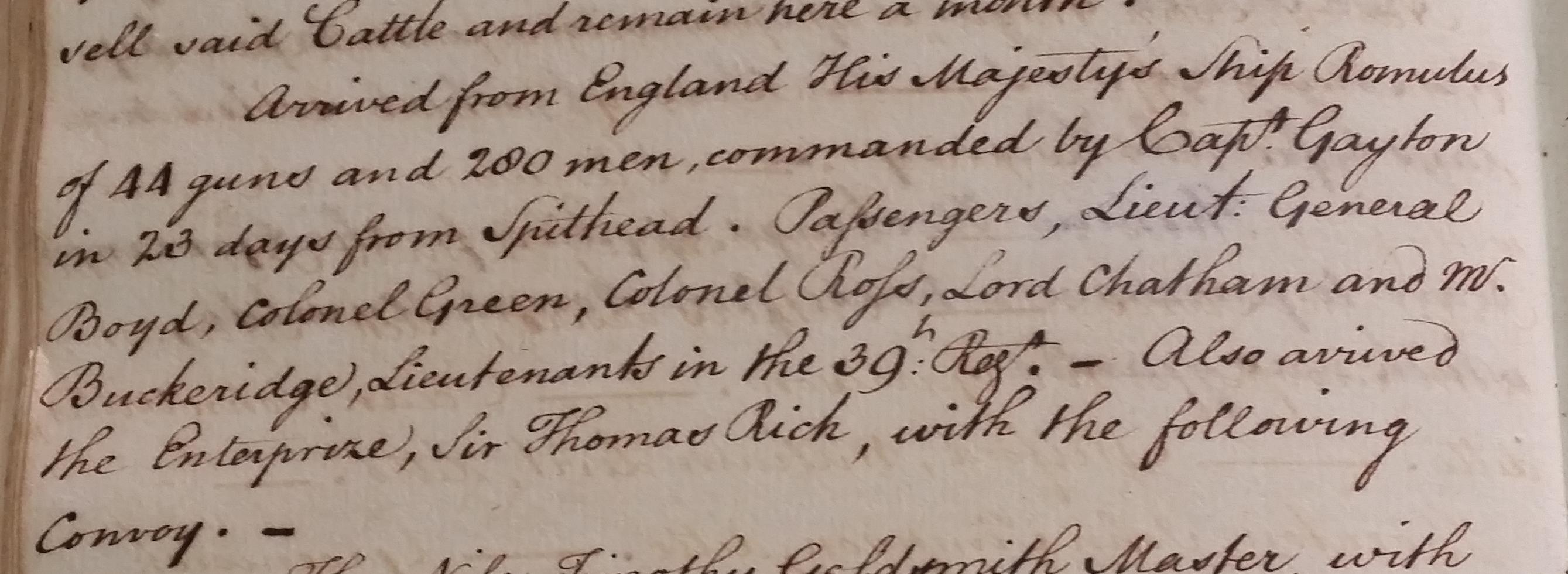
Do you see what I see? (This is the entry for 7 July 1778). The entry goes on to list the accompanying convoy for about three pages, in some serious detail. But the relevant bit is this: “Arrived from England His Majesty’s Ship Romulus of 44 guns and 280 men, commanded by Capn. Gayton in 23 days from Spithead. Passengers, Lieut: General Boyd, Colonel Green, Colonel Ross, Lord Chatham and Mr Buckeridge, Lieutenants in the 39th Regt.”

William Buckeridge, incidentally, was Boyd’s other ADC.

I knew Chatham had arrived in Gibraltar early July 1778, but now I had a date — and also a ship, a departure point, and a journey length. 😀 But this is the mysterious bit. 23 days’ journey means the Romulus left Spithead on or about the 15 June 1778. So why did Chatham not attend his father’s funeral on the 8th? He must have had a cast-iron reason, otherwise people would have talked, but why not? I know the convoy was all embarked and ready to leave by mid-May: perhaps the ships were delayed by adverse winds? I find it hard to believe Chatham would have been refused permission to attend the funeral if it had been possible for him to go. And I find it even harder to believe he would not have wanted to go. Pageantry was John’s forté, and he did it very well.

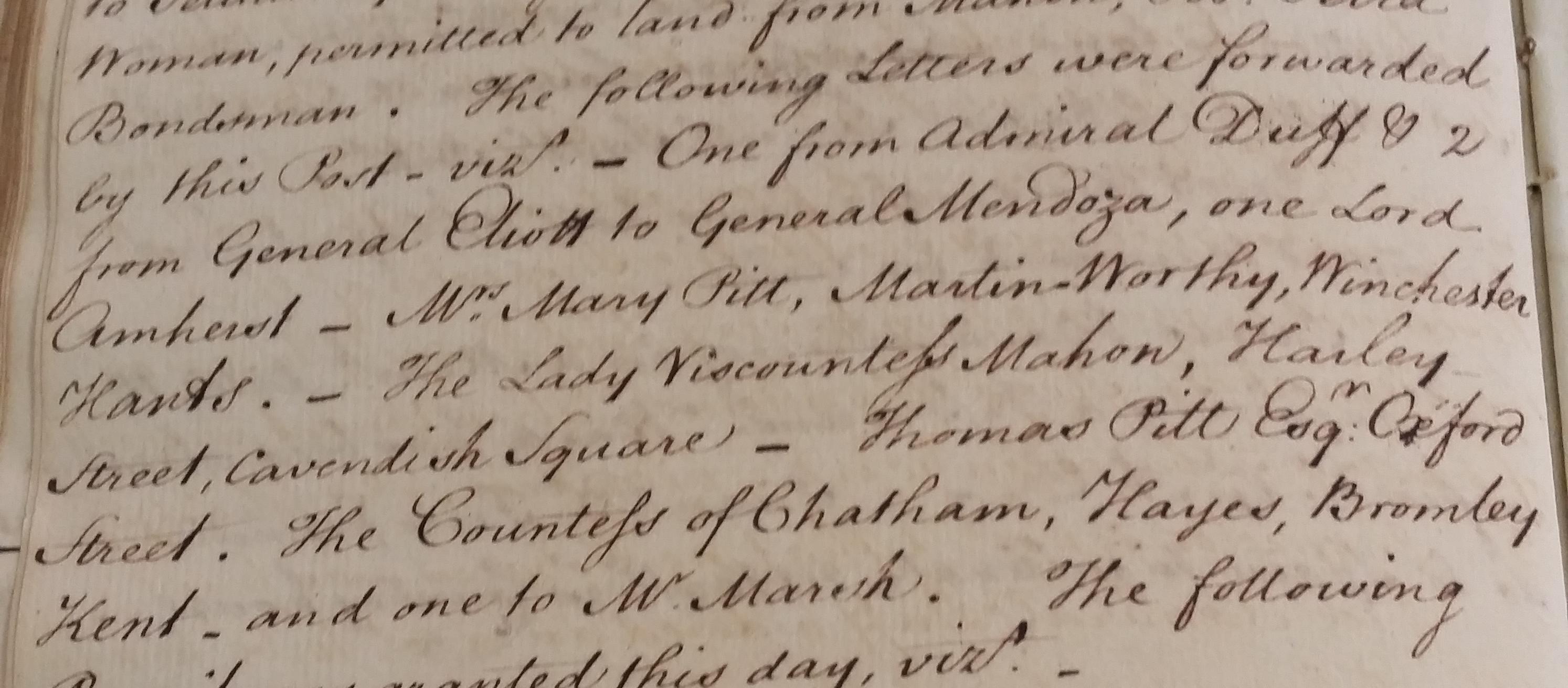
Be that as it may, there was more. All letters sent from the garrison with the official Governor’s packet were recorded, and their recipients. So I know Chatham was writing home on 16 and 20 July, and also on 8 and 12 October:

governors_diary_1778_chatham_sends_letters_02_detailgovernors_diary_1778_chatham_sends_letters_03

On the left: letters listed to Mrs Mary Pitt, Lady Mahon (Chatham’s eldest sister), Thomas Pitt, and the Countess of Chatham; on the right, letters to the Hon. Mr Pitt, Pembroke Hall, the Marquis of Granby (later the 4th Duke of Rutland, Chatham’s best bud), and Lady Harriot Pitt, Chatham’s younger sister.

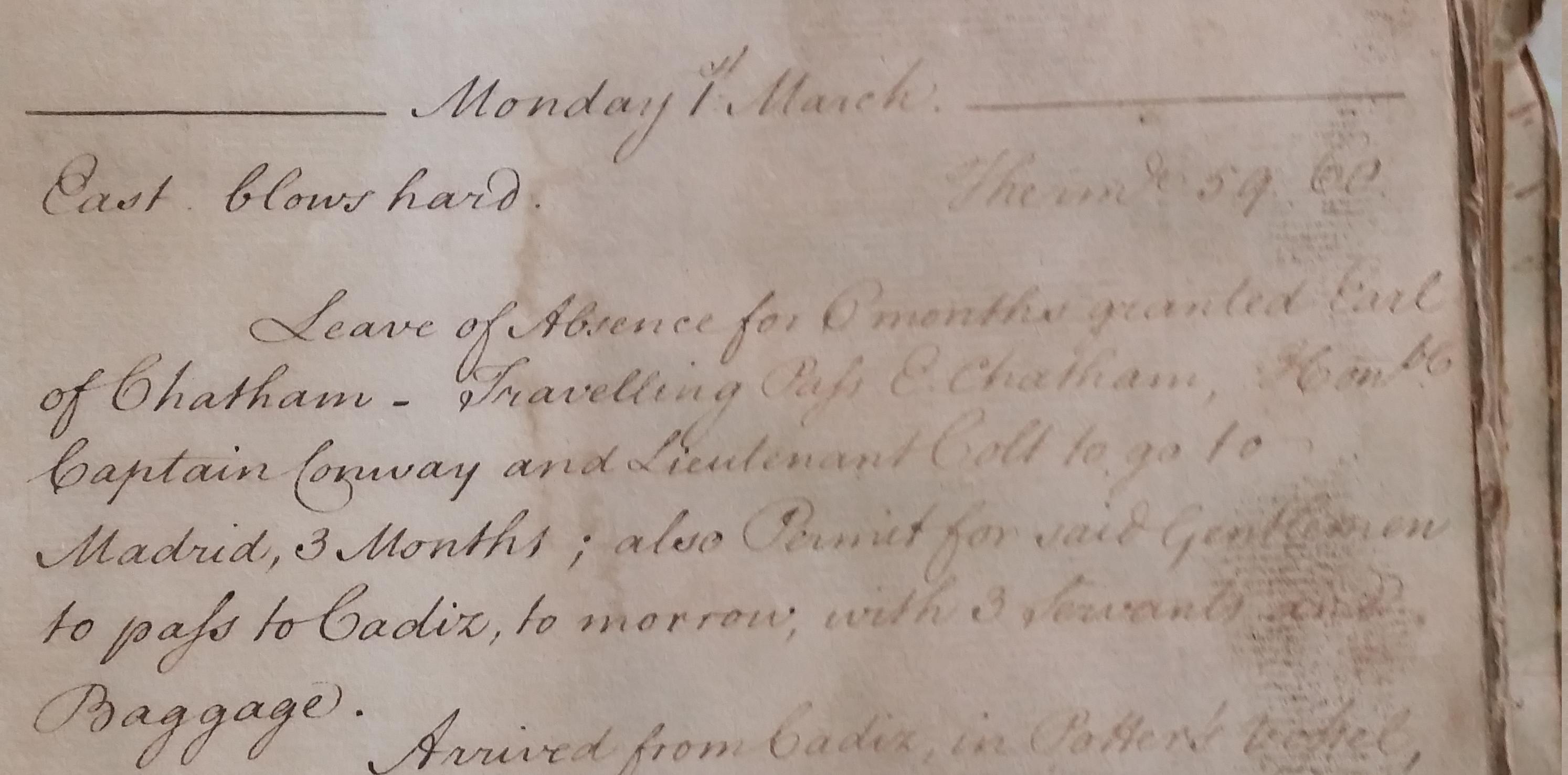
As you will know from previous posts, Chatham left Gibraltar in early 1779 to go back to Britain. I was a bit unsure about whether he left in February or March, and how much leave he was granted, but now I know the answer: he left on 2 March, and his leave was six months. (Within that period the siege had started, and he transferred to another regiment, so the next time he returned to Gibraltar was as Governor in 1821.)

governors_diary_1778_chatham_leave_detail

Apologies for the quality of the above photo — the 1779 Diary is in pretty darn poor nick — but it reads “Leave of Absence for 6 months granted Earl of Chatham. Travelling Pass E. Chatham, Honble. Captain Conway and Lieutenant Colt to go to Madrid, 3 Months; also Permit for said Gentlemen to pass to Cadiz, to morrow, with 3 Servants and Baggage.” It was issued on 1 March 1779.

I am so, so chuffed by this, you have no idea. It was totally worth nearly falling down the Rock for.

__________

References

All material from the Governor’s Diaries, March – November 1778 and 1778 – 1782, Gibraltar National Archives

190 years ago yesterday: Lord Chatham leaves Gibraltar

I am currently in Gibraltar, having the time of my life visiting the archives and chasing monkeys. I was wandering about the Upper Rock, taking in the Straits and very much enjoying the sun and the sights, when something struck me. It has been almost exactly 190 years since the 2nd Earl of Chatham — the man I am here to research — left Gibraltar.

Streets of Gibraltar

Chatham succeeded the Duke of Kent as Governor of Gibraltar in January 1820. I suspect he at first had very little intention of ever coming out (the Duke of Kent, after all, had been an absentee governor since his disastrous attempt to serve in person resulted in several mutinies) but was only forced into it by the fact the House of Commons started discussing expensive sinecures, and Chatham’s governorship came up. Ministers were all “Oh yes, Chatham has every intention of going out there”, probably all while wrestling Chatham bodily onto the boat.

Chatham was meant to have gone out in May 1821, but was held up by three things: 1) his wife’s death on 21 May; 2) King George IV’s visit to Ireland, which snarled up all available frigates; and 3) his own reluctance. He really did not want to go, and it did not help that he suffered from profound depression for months after his wife’s death. Nevertheless, as soon as all ships had returned from Ireland and he had run out of excuses, Chatham boarded the Active frigate at the end of October 1821 and arrived in Gibraltar on 15 November. I can’t imagine it was a pleasant trip, although, at 19 days, it was relatively short.

Having spent the day perusing the Gibraltar Chronicle with great care, I can now say a little bit more about what Chatham did in Gibraltar, but for the details you’ll have to wait till my book comes out next September. Suffice to say he never warmed to the place, possibly not helped by the fact Lord Maryborough, who had taken over Chatham’s old rented house of Abington, kept writing to tell Chatham about the abundance of game on the estate and what wonderful hunts he was missing. Chatham’s weak health did not get on with the climate, and by early 1825 his health was pretty much shattered.

He wrote for permission to return to England, which was granted. He stayed long enough to lay the foundation stone of the church that would become the Cathedral of the Holy Trinity on 1 June, then high-tailed it with all the speed his weakened frame could muster.

Cathedral of the Holy Trinity, Gibraltar

Cathedral of the Holy Trinity, Gibraltar

The Gibraltar Chronicle recorded Chatham’s departure in its 8 June edition. Chatham’s last day was a sunny, clear 23 degree day:

“Yesterday, at 12 o’clock, His Excellency General the Earl of Chatham, Governor of this Fortress, embarked on board HM Frigate Tribune, Capt. Guion, returning to England on leave of absence.

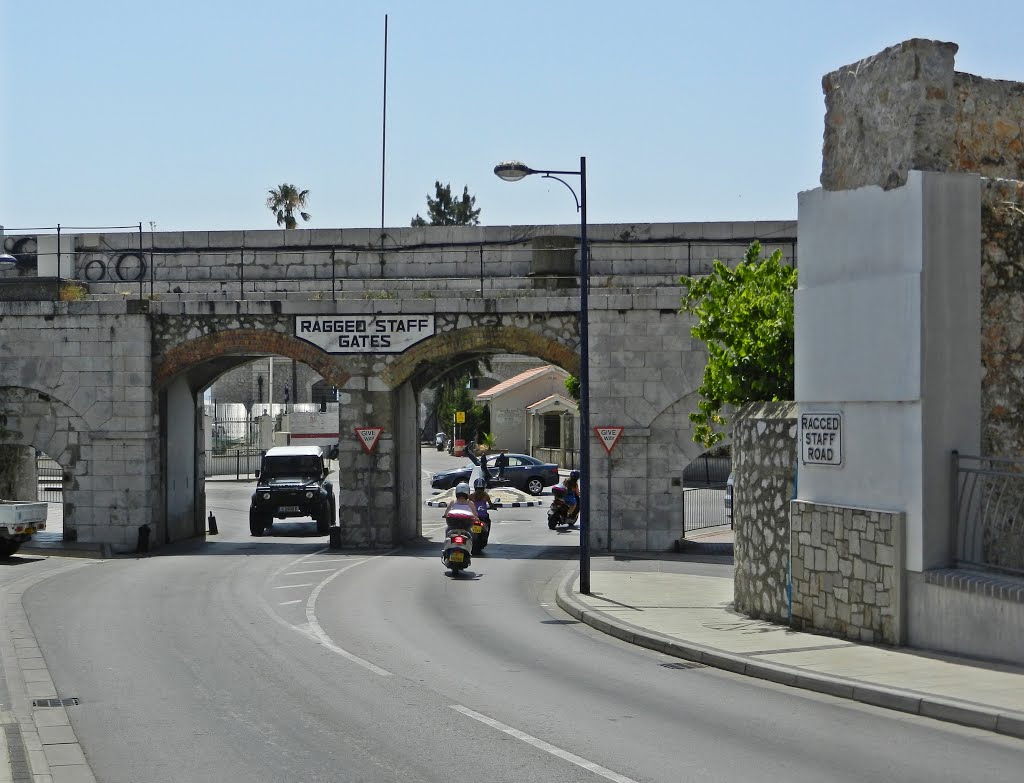
The streets from the Convent to Ragged-Staff [Wharf] were lined by the Troops composing the Garrison; and His Excellency, being received at the Convent Gate by a Guard of Honor from the 43rd Light Infantry, proceeded, accompanied by the Lieutenant Governor, General Sir George Don, and the Officers of the Military and Civil Departments. On arriving at Ragged-Staff, His Excellency was received by another Guard of Honor furnished by the 94th Regiment, and, at the moment of stepping into the Barge, was saluted with 19 Guns from the Garrison, which were repeated by the Frigate on His Excellency’s arrival on board.

The Tribune shortly after got under weigh, and sailed into the Straits with a light breeze at East.”[1]

Ragged Staff Gates, Gibraltar (Wikimedia Commons)

Ragged Staff Gates, Gibraltar (Wikimedia Commons)

In fact Chatham’s “leave of absence” was permanent, and he never returned. As late as 1829 there was talk that he might well come back, but, although Chatham recovered to a degree after returning to England, his health had been permanently damaged. He was, after all, nearly 69 in June 1825. He was seriously ill in 1829, and nearly died in 1831. Even so, when the Reform Bill came before Parliament in 1831, Chatham was terrified that he — as an opponent of reform — might be sent off to Gibraltar to prevent him causing trouble in the Lords: “Lord Chatham has the fear before his eyes of being ordered off to reside upon his government”.[2]

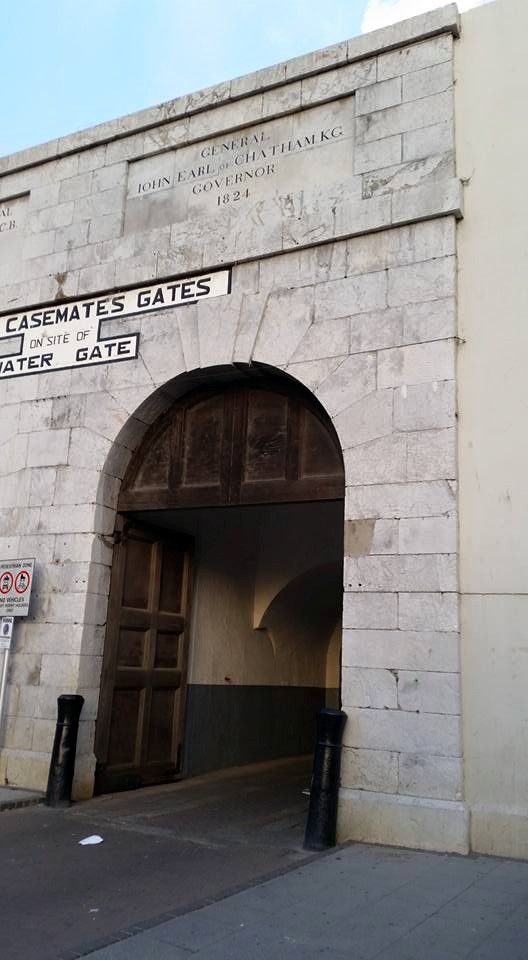
Grand Casemates Gate, 1824

Grand Casemates Gate, 1824

So it was that when Chatham died on 24 September 1835, he had been Governor of Gibraltar for fifteen and a half years, but only served there for four. Still, he did rather better than a number of Gibraltar histories imply (one I’ve seen flat out denied he ever went out there) and better than the Duke of Kent. At least there were no mutinies!

References

[1] Gibraltar Chronicle, 8 June 1825

[2] Duke of Buckingham to the Duke of Wellington, 27 September 1831, Southampton University Wellington MSS WP1/1196/18

“A true representative of myself”: Georgiana Townshend’s letters

Mary, Countess of Chatham was, as I have mentioned before, one of a large family. She was very close to at least three of her surviving six siblings, but the one she was arguably closest to was her unmarried elder sister Georgiana.

Georgiana Townshend was born on 1 June 1761. She seems to have been plainer than her younger sisters, at least two of whom (Mary and Katherine, who later became Duchess of Buccleugh) were described as beauties. Although she seems not to have given up hope of marriage until she was in her forties, Georgiana seems never to have caught the eye of a suitable husband. She eventually became Housekeeper of the Royal Apartments at Windsor Castle, with an apartment of her own on the premises, but apart from this seems to have spent her time either living with the Chathams or with her brother the 2nd Lord Sydney, for whom she seems to have been a live-in babysitter.

Part of the reason for her remaining a spinster was, no doubt, her plainness. (If the one portrait I have seen of her is a good likeness, she was not ugly but also far from beautiful.) Georgiana’s personality is best described as “sunny disposition”. And to judge from her correspondence, my God that girl could talk. I have absolutely no doubt of why the taciturn 2nd Lord Chatham chose to marry Mary Townshend rather than Georgiana: he and the quiet, reserved Mary were much better suited. Had he married Georgiana, I suspect his brain would have been oozing out of his ears within months.

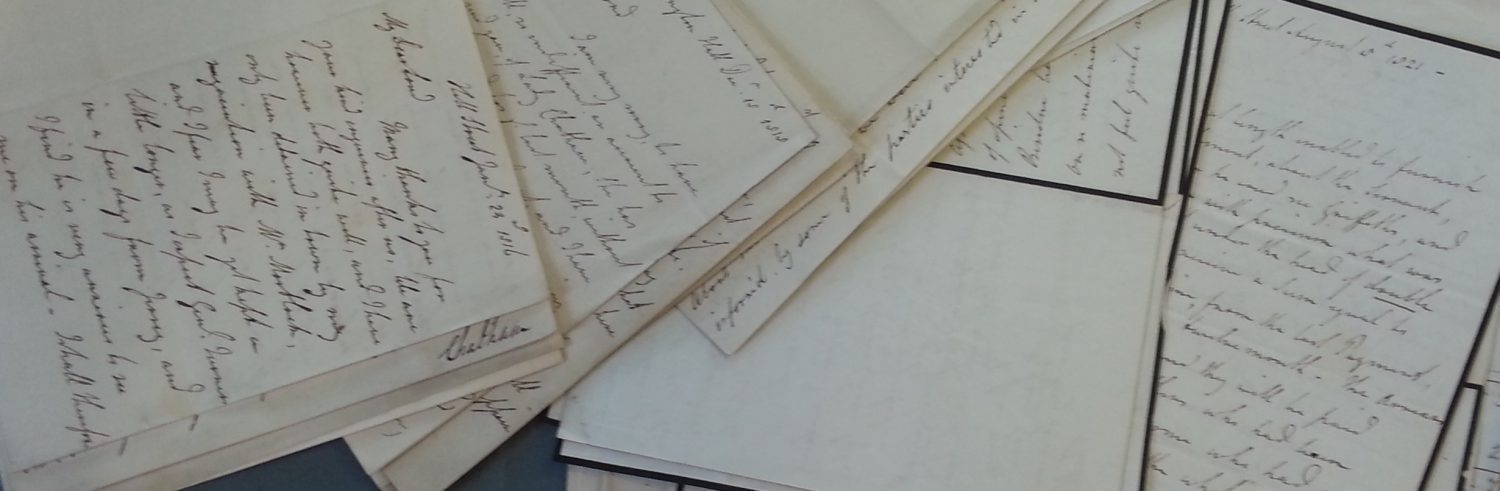
Georgiana wrote copious letters on a daily basis to family and friends. Regrettably, many of them survive. No doubt she had nothing much better to do, and since she lived at Windsor many of her letters are full of interesting vignettes about the Royal Family. Just as often, however, she was clearly writing because it was an expected social duty. Generous, well-meaning, adorable, and guileless are all words that could be used to describe Georgiana’s style. She was clearly a lovely person, but I suspect her friends could occasionally have used a pause button. Perhaps she was physically unable to use her brain while her hand was moving, I don’t know, but the result is a stream-of-consciousness mess that, presumably, reflected Georgiana’s personality like a well-polished mirror. She was endearingly aware of it herself: “I am sure you must be tired of my Stupid Letters,” she wrote to Mrs Stapleton, the Dowager Countess of Chatham’s companion, “but they are a true representative of myself, stupid & newsless, therefore you will know what to expect when you see one.”[1]

So what did Georgiana write in her letters? Well … she wrote about fashion.

“Now you will expect to hear if I was well dressed at the birth day therefore I will indulge you, with telling you that I was vdeery well dressed, my train was brown sattin & my petticoat yellow crape with silver spangles, & decorated about very well, with yellow, & brown Roses.”

A lot.

“She [Lady Harriot Pitt] was very well dressed her Jacque became her very much, to be sure she was lucky as to the colour, only think of her having chosen a buff & blue Sattin to go to the Queen’s House in, but it was vastly pretty, she looks vastly well this Evening…”[2]

No, really. A LOT.

“It is to be the fashion to wear the hair down the back this Winter, I would not have believed it, if I had not seen it, I really saw Lady Duncannon the night before last, with her hair all down her back & curled at the ends, her hair was dressed very full before, and a good many little curls upon the Topp [sic], she had two curls of each side, the upper ones were pinned up, the lower ones flowing & just curled at the ends, she had a very pretty hat a la figaro, her head was altogether too large, if it had been smaller I think it would have been very becoming, but it must be vastly uncomfortable, & very nasty to have all that powdered hair hanging about her, though there is not much powder…”

She wrote about being teased about being single (she seems to have been the butt of a number of jokes, poor girl, many of which I fear went right over her head):

“I do not know that I made any conquests though a L[ad]y attacked me rather violently to know if I was not going to be married, & though I said upon my honour not, I do not think she believed me, she took me quite by surprize, as I have very little acquaintance with her, but I … shall avoid her like the plague [at the drawing room] on Thursday”.

“The Duke of Cumberland says he has found [a husband] for me; he said he was sure I should not refuse him … therefore I only begged I might know not who it was … he told me he wished me married, as he was sure I should make a good Wife, I should like to know who he means”.

She wrote about the Royal Family:

“I was looking at some plants that the P[rincess] Augusta was shewing me, & to my astonishment I felt somebody whip me gently, I looked quiet [sic] round, & perceived that it was her Majesty who had done me that honor, she said I believe you never was whipped by a Queen before, which to be sure was pretty true. What a dear charming woman she is.”

“There were several men very drunk that made it very disagreable so we came away, there was one worse than all rest … he … was most beastly drunk indeed, you may guess who I mean ye first in company but quite otherwise in behaviour [the Prince of Wales] he was drinking with all the Regimental band that was there, & was at least carried out speachless [sic], one of our servants who was there said he never saw such a sight in his life, people were getting upon chairs & tables to look at him till they absolutely gave way, … I never heard anything like it, he sung & hallowed until he lost his voice.”

“The Royal Family have been by to the Cathedral [St George’s Chapel, Windsor] & returned of course. Dearest dear Pss Mary saw me, & kissed her hand to me. How often I wish more in the world were like her, she is such an Angel, that you will say, is no news for me, but is often the burthen of my song, & so it always must be, to those who sing of her.”

She talks of literature:

“I have been refreshing my memory since I have been confined, with to my mind a very pretty interesting book, which I had read so long ago, that it was quite new to me, who have a bad memory, the Vicar of Wakefield, I have jst finished it this Even, it has amused me very much, & there is plenty of good avice in it, if people woud follow it.”

And, er, not-quite-literature:

“I am afraid you will be disappointed in the book I promised to send you [Marcellus and Julia: a dialogue, a thinly-veiled satire on the Prince of Wales and Mrs Fitzherbert], I cannot imagine how any body ould say it was very clever, it is very plain who Marcellus & Julia are meant for, and I have heard that they had a great quarrell last year … I really am quite ashamed of sending you such nonsense as the book you will receive with this, I should not have thought of sending it you if I had read it first”.

Sometimes, ill-advisedly, she talks politics:

“I am sure you must rejoice in all the wicked people being taken up, I hope, as I am afraid there is no doubt of their guilt, that some of them will be made an example of, what a mercy it is, that the wretches were discovered in time. I am afraid they have poisoned the minds of many weak people, but I suppose it was best to wait till they had strong proof against them, before they were taken hold of.”

“We are just come home from the second day of Mr Burkes speech [at Warren Hastings’ trial in 1788], he would have ended to day, if he had not been taken ill with a violent Cramp, it is no wonder he excites himself, he is so very violent. … Besides his great abuse, he has entertained us with the accounts of the most horrid torments, & not all the most decent, inflicted upon a number of poor creatures. I think he mght as well have contended himself without describing the tortures, it really made one quite sick.”

And often she talks of, well, absolutely nothing at all:

“Now I hope the weather is growing fine, I shall have a great many walks with them. How has your Farm & Plantation borne this Winter? Have the Farmeresses been successfull? & how does your new Cow succeed?”

Lastly, her life was occasionally enlivened by the possibility of having her purse relieved by a highwayman:

“We [Georgiana and her mother] were followed by two Highwaymen; as we have every reason to believe, they were very near stopping us when we discovered them, upon which we made the Coachman drive home as fast as he possibly could, & made the footman who was on horseback … keep close behind, the Phateon, & the lanes were as narrow that they could not pass us, but they were in sight till we got very near home [Frognal in Kent], I never was more rejoiced in my life to find muself at home.”

I could go on, but my own head would probably explode.

I may be rather unfair on Georgiana. She wasn’t the sharpest knife in the drawer, but she loved her family. Her letters about her nieces, her sister Mary, whom she nursed tirelessly through her many illnesses, and her obvious concern for all the people she loved, mark her out as being a person I would very much like to have known. I suspect, however, that a little of Georgiana went an awful long way.

References

[1] Unless otherwise marked, all quotations come from National Army Museum Combermere MSS 8408-114

[2] Georgiana Townshend to the Dowager Countess of Chatham, 3 March 1785, PRO 30/8/364

Lord Chatham, Knight of the Garter

Yesterday I had the opportunity to visit St George’s Chapel Archives at Windsor Castle, where I spent an instructive morning perusing the Garter Registers and chasing Lord Chatham’s officially recorded movements as a Knight of the Garter.

Chatham was elected a Knight of the Garter in December 1790, as I explain in my guest post for English Historical Fiction Authors on the Order of the Garter during the reign of George III. The Garter should have gone to his brother Pitt the Younger, but Pitt wrote to persuade the King to give it to Chatham instead.

One of the most notable features of Chatham’s character was his love of pomp and status, so I can imagine he was thrilled to be admitted to Britain’s oldest and most prestigious Order. Although he was invested with the Garter in December 1790, he was not fully “installed” (for more on the distinction between the two ceremonies see my EHFA post) until May 1801, when the King dispensed with the full ceremonies for twenty-three uninstalled Knights.

Dispensation installing Chatham as a Knight Companion of the Garter (29 May 1801) (PRO 30/8/371)

Dispensation installing Chatham as a Knight Companion of the Garter (29 May 1801) (PRO 30/8/371)

After his “installation”, Chatham was finally permitted to enjoy the full privileges of the Order. Before, he had only been allowed to wear the ribbon and Lesser George: now he was allowed to wear the Star, or “Glory”, and surround his crest with the Garter insignia. He was allowed to attend Garter Chapters, and was allotted a stall in the quire of St George’s Chapel, although I am informed this would have changed according to Chatham’s seniority in the order (in other words, every time a senior knight died, Chatham’s stall would move one step closer to the Sovereign’s).

He was also allowed to affix a stall plate to the back of the stall, listing his “achievements”. I have been permitted to see Chatham’s plate, although not to photograph it, but it was put up shortly after his installation in May 1801 since it records him as being a Major-General and Lord President of the Council. The achievement is in French: “le noble et très puissant Jean, Comte de Chatham”.

A later Garter Stall Plate (1891); Chatham's was similar (Wikimedia Commons)

A later Garter Stall Plate (1891); Chatham’s was similar (Wikimedia Commons)

Many Knights of the Garter died without being installed, including Chatham’s good friend the Duke of Rutland, who was invested in 1783 and died in 1787. Rutland, though, was an exception to the rule: when he was made Lord Lieutenant of Ireland in 1784, the King gave him permission to use the Garter Insignia and wear the Star as though he had been fully installed.[1]

Plan of the stalls of the Knights of the Garter as they stood in 1828 , from "The Visitants' Guide to Windsor Castle" (thanks to regencyhistory.net for this)

Plan of the stalls of the Knights of the Garter as they stood in 1828 , from “The Visitants’ Guide to Windsor Castle” (thanks to regencyhistory.net for this)

My purpose in consulting the Garter Registers was to track Chatham’s attendance record as a KG at Chapters and official Dinners. By statute all Chapters were recorded in the official Registers, and all attendees’ names were noted down. I had been informed Chatham’s attendance was patchy: I wanted to see whether this was true. I must admit I was surprised to hear Chatham wasn’t a frequent attender. Despite his reputation for laziness, Chatham was very proud of his Garter.

I can now report that Chatham’s attendance was not as bad as it looks. He was elected to the Order at Chapter XV, held at St James’s Palace on Wednesday, 15 December 1790, at the same time as the Duke of Saxe-Gotha and the Duke of Leeds. Present at this Chapter were the King, the Prince of Wales, the Dukes of Gloucester and York, and the Marquis of Stafford, along with the Prelate, Chancellor, and Registrar of the Order (the Officers), and Garter King of Arms and Black Rod.[2] Members of the Royal Family seem to have been keen attenders of the Chapters, much as one would expect (and a Chapter could not be held without the Sovereign or his representative, so he is pretty much the only person with a 100% attendance record). But only fully installed members of the Order could attend Chapters, so Chatham’s name does not appear again until Chapter XXIII, the first Chapter after his installation, held on 25 November 1803 at St James’s Palace.

Up until then, Chapters had been thinly attended (remember, only fully installed members could attend), and often only members of the Royal Family turned up. But the 1803 Chapter was rather different. The King was present, and the Dukes of Gloucester, York, Clarence, Kent, and Cambridge, but nine Knights Companion turned up too: apart from Chatham, the Dukes of Richmond, Portland and Roxburgh were there, as well as Lords Cornwallis, Salisbury, Westmorland, Spencer, and Camden. Presumably they needed a rather bigger room than they had been accustomed to using.[3]

After that, Chatham attended quite regularly. He was at Chapters XXIV, XXV and XXVII (17 Jan 1805, 27 May 1805, and 18 July 1807), and the Installation of April 1805. He missed Chapter XXVI, but since that took place on 22 March 1806 I’ll give him a break: his brother hadn’t even been dead two months, and his wife was still extremely unwell. He was not at Chapter XXVIII, on 3 March 1810, but I rather think he was otherwise engaged appearing at parliamentary enquiries and trying not to be impeached after Walcheren. Interestingly, though, he did attend the St George’s Day Dinner at Carlton House in April 1810. Given his name was mud at this stage, I cannot help wondering if it was a bit of a defiant gesture at the government: “Yah, yah, yah, I still enjoy royal favour.” Of course, maybe he just needed a bit of fun.

He may have attended the 1811 St George’s Dinner as well, but the attendees are not separately listed so there’s no way of knowing. Only one other Dinner is recorded, for 1812, and Chatham was not present.

Returning to the Chapters, he missed Chapter XXIX in March 1812, but he was at Chapters XXX-XXXI and XXXIII-XXXVII (he missed XXXII, on 4 March 1813, for no obvious reason that I can think of). He was absent from Chapter XXXVIII, on 24 July 1817, but this was around the time that his wife fell victim to her second bout of mental illness, so it’s not much of a surprise to see him absent until Chapter I of the reign of George IV (7 June 1820).

After this Chatham disappears almost completely from the record, but then Chapter II of George IV was not held till 1822, when Chatham was in Gibraltar. After his return in 1825, however, he never attended another Chapter, and there were 13 more Chapters and 2 St George’s Day Dinners held before Chatham’s death. Most of them were held during the reign of William IV, though, when Chatham’s health was poor, and he was mostly in Brighton when the Chapters were held. Still, Camden and Westmorland, his contemporaries (and close friends), were still attending nearly every Chapter.

The final mention of Chatham records his passing:

“On the 24th September 1835, in Charles Street Berkeley Square, Died, General The Right Honourable John, Earl of Chatham, Knight Companion of this Most Noble Order.”[4]

One last interesting note: one of the Statutes of the Order stipulates that no member of the Order should go out of the country without getting prior permission of the King. I found a few examples of this in the Register, mostly for Knights wishing to go abroad for their health, but permission was not recorded for Chatham to go abroad with the army either in 1799 or 1809 (or, indeed, to Gibraltar in 1821). I suspect this is probably because permission was not required to go abroad on military service, but possibly any permission given was not recorded.

So, in sum, of 26 Chapters during the reign of George III, 8 Chapters during the reign of George IV, and 9 Chapters during the reign of William IV, Chatham attended:

— his investiture (1790)

— the installation of April 1805 (the only proper Installation during his time as Knight)

— 11 Chapters from 1803 – 1820

— 1 (possibly 2) St George’s Day Dinners (out of a total of 5 recorded)

So no, not a brilliant record, but then Chatham was actually unable to attend 10 of the Chapters due to being either ineligible or out of the country, and missed a further 5 due to circumstances out of his control (family illness or bereavement, or — say — political disgrace). As a result, I make out he attended 11 out of 26 possible Chapters.

____________

References

[1] St George’s Chapel Archives, Register of the Order of the Garter, SGC G.5 (1688-1804) f 155

[2] St George’s Chapel Archives, Register of the Order of the Garter, SGC G.5 (1688-1804) ff 159-60

[3] St George’s Chapel Archives, Register of the Order of the Garter, SGC G.5 (1688-1804) f 168

[4] St George’s Chapel Archives, Register of the Order of the Garter, SGC G.6 (1805-1861) f 79

Lord Chatham in Colchester

I’ve known for a good while that the 2nd Earl of Chatham had close connections with Colchester. He spent a great deal of time there, connected with the military garrison. I believe he was, for a long while, Commander in Chief of the Eastern District, with headquarters in the town.

Colchester Barracks in the mid 19th century, from http://www.british-history.ac.uk/vch/essex/vol9/pp251-255

Colchester Barracks in the mid 19th century, from http://www.british-history.ac.uk/vch/essex/vol9/pp251-255

He was, however, in Colchester as early as 1798. John had not left the army since rejoining it in 1778, but between 1788 and 1798 he put politics first. In the summer of 1798, however, he received the rank of Major-General and clearly made a choice to return to his military career, appearing at the King’s birthday levee in his regimentals and moving to the Colchester garrison.[1] On 13 September 1798 Pitt the Younger wrote to his sister-in-law, Mary, Countess of Chatham: “I rejoice that my Brothers Military Life agrees so well with him, and that you like your Quarters, which I shall be very glad if I can visit … I shall direct this to Colchester.”[2]

From 1806 onwards John spent a significant part of the second half of each year in Colchester. Sometimes he seems to have been running away from something else — I suspect he spent so much time in Colchester in 1807 and 1808 because of his wife Mary’s illness, and after 1810 I would guess he had little to keep him in London — and how much his attraction to Colchester had to do with the local hunting scene, I could not say. He was a visible enough public figure, however, and in October 1807 the town Assembly appointed him High Steward of Colchester and gave him the Freedom of the Borough as “a new proof of the popularity of the [Duke of Portland’s] present vigorous Administration”, of which John was a member as Master General of the Ordnance.[3]

Colchester today (Wikimedia Commons)

Colchester today (Wikimedia Commons)

The post of High Steward was largely ceremonial (salaried, of course, although its £10 a year was hardly going to make much of a difference to John’s considerable debts). The post had been established in 1635, with a fairly vague brief “to advise and direct” the mayor, the twelve aldermen, twelve assistants, and eighteen councilmen who made up the Assembly, “to elect officers, make bye-laws, &c”.[4]

I imagine John much enjoyed the ceremonial aspects of the post, although these sometimes entailed more prosaic elements. Goodness knows how often he did this, and presumably this reflected John’s personal religious preferences (of which I have found no other sign so far), but I have tracked John down at a meeting of the Colchester and East Essex Auxiliary Bible Society in Colchester on 7 December 1812. I can only imagine John struggling not to fall asleep while the Reverend W. Dealtry thus concluded a long speech with reflections on the “noble patronage” Chatham brought to the meeting: “It is a patronage, of which, I am well persuaded, your Lordship never can repent; and I will venture to add, that by giving lustre to this society your Lordship will reflect lustre even upon your own illustrious coronet.”[5]

John was High Steward until 1818, when he was succeeded by John Round, a local barrister and MP. By this time Chatham had moved on: he settled at Abington Hall in Cambridgeshire in 1816, and his wife’s ill-health would in any case have kept him away from Colchester. But until 1815 he was frequently in the town, as is clear from all the correspondence dated from Colchester, as well as newspaper snippets following his movements.

But where did John stay in Colchester? It was quite obvious to me he must have had a reasonably permanent residence. For months I have been searching for it. Yesterday, quite by chance, I stumbled across a reference in a local Colchester journal in 1872, reminiscing about when “Lord Chatham lived in Head-Street”.[6] Further investigation revealed the name of his house in Head Street: Headgate House.[7]

Headgate House today (from Google Street View)

Headgate House today (from Google Street View)

Headgate House is now part of a shopping centre (H&M has moved in), but the frontage remains essentially unchanged from the house John Chatham would have known. It was described in an article as “possibly the finest family house in the town”, and the photographs reproduced in the article certainly suggest a house which, while rather less grand than what Chatham would have been used to, was grand enough. (The article is reproduced online here.)

Presumably this was the house where the following (somewhat dubious) anecdote was set:

It was the custom of Lord Chatham, when he commanded at Colchester, to invite every officer belonging to the garrison, in rotation, to his hospitable and elegant table. It happened, one day, that a raw Scotch lad, from some fastness of the Highlands, who had joined his regiment but a day or two previous, was placed opposite Lady Chatham, about midway between the noble host and his aid-de-camp, who sat at the bottom of the table. … A batter pudding was placed before her ladyship, when the sweets were paraded, and, with her usual urbanity, she invited Mr MacNab to partake … MacNab loved batter pudding, and he thought it a fitting occasion, in asking for more, to pay such a compliment to the elegant woman opposite to him as would make ample amends for his silence during the repast; without waiting, therefore, for a servant’s assistance, he pushed the plate across the table in a manner to attract her ladyship’s eye, and, with a countenance lit up by the brilliancy of the compliment he was about to pay, said, ‘Your pudden is sae excellent, my leddy, I needna ask ye wha made it.'[8]

I am still on the lookout for anything to do with Lord Chatham and Colchester: he spent so long there, and seems to have been so closely connected to the town, that I can’t believe he left absolutely no evidence of his being there. If anyone knows of anything, I would be grateful if you would contact me and let me know!

______________

References

[1] Express and Evening Chronicle, 2 June 1798

[2] William Pitt to Mary, Countess of Chatham, 13 September 1798, National Archives Chatham MSS PRO 30/8/101 f 141

[3] Bury and Norwich Post, 7 October 1807; Morning Post, 9 October 1807

[4] The History and Antiquities of the Borough of Colchester, in the County of Essex (Colchester, 1810), p. 74; A History of the County of Essex IX, Victoria County History (London, 1994) 156

[5] The Proceedings of the Colchester and East Essex Auxiliary Bible Society … (Colchester, 1812), unpaginated

[6] The British Flag and Christian Sentinel, 1 February 1872

[7] Philip Crummy, “The House that Ann and Hugh built”, Catalogue: New of Archaeological Excavations in Colchester, 18 (Winter 1985/6), 6-11

[8] Benson Earle Hill, Recollections of an Artillery Officer … I (London, 1836), 276-7