Lord Grenville on parliamentary reporting

In 1818 George Pretyman-Tomline, Bishop of Lincoln, Pitt’s old friend and executor, was putting the finishing touches to the book that would later be published in part as the first official biography of Pitt the Younger. He sent his draft to various of Pitt’s friends and connections to read over. One of them was Lord Grenville, Pitt’s cousin and former Foreign Secretary.

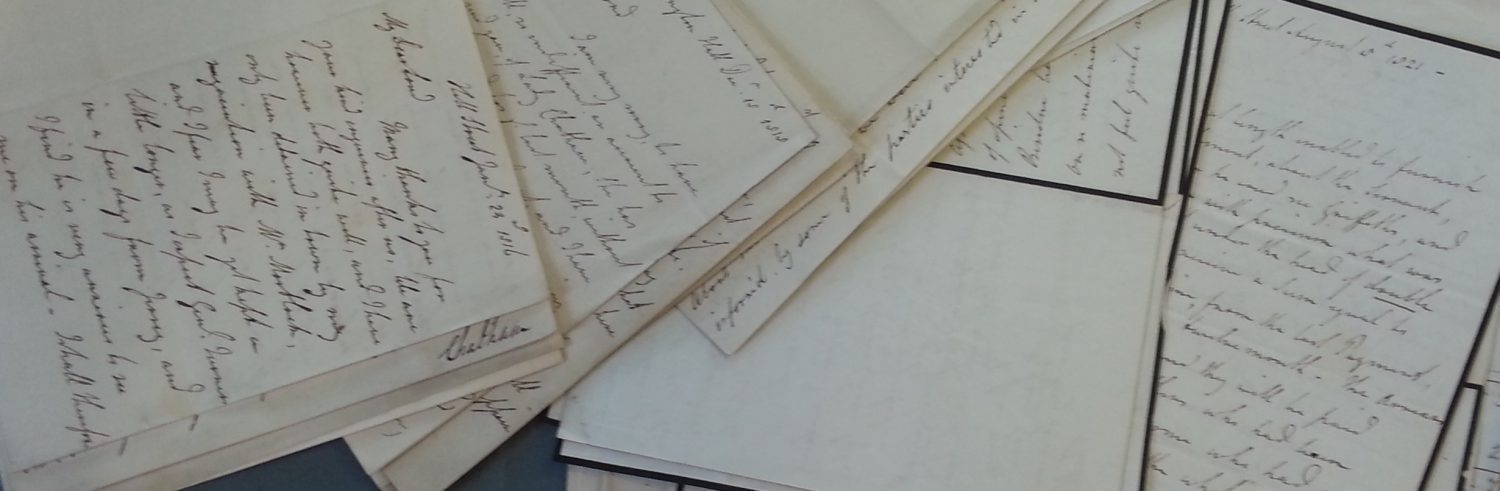
Grenville sent back a lengthy critique of the work. He included some interesting thoughts on the role of parliamentary reporting during Pitt’s time as prime minister. His fear (not entirely unreasonable) was that Tomline’s heavy reliance on official publications such as the Parliamentary Register would affect the public’s view of Pitt’s oratory, and consequently of his opinions. Grenville’s point, essentially, was that parliamentary debates were inaccurately reported. The following is from the Stanhope MSS in Kent RO, U1590/S5/O12.

“I lament to think how much your work will tend to accredit an error already much too prevalent. The practice of reporting the Parliamentary debates from day to day is as you know an innovation of our own times, & one of most extensive consequence both good & evil. At first it was pretty generally understood how very inaccurate such representations are, & must necessarily be. By degrees a contrary impression is taking possession of the public mind, & it is now commonly said, even by those who ought to know better, that these reports though not correctly accurate, are yet, substantially, fair representations of the opinions & arguments which they purport to convey. This opinion is in itself quite erroneous; it is destructive of the truth of history, highly injurious to all public men, &, as it happens, most paticularly so to Mr. Pitt, & those who acted with him in his first administration.

It is impossible that such reports can be even substantially accurate. What justice can a reporter, with the most upright intentions, do to the opinions or reasonings of statesmen on subjects which they have deeply studied, & of which he is often entirely & completely ignorant? What report could you or I make of a pleading in Chancery, a debate in the College of Physicians, or of the deliberations of a Council of War on the attack or defence of a place of which we never even saw a map? Just such are the reports of newspaper reporters, on Plans of Finance, on Measures of Revenue or Commerce, or foreign treaties of trade, alliance, or war, and on legal & constitutional questions of great intricacy, & deep research.

This is true, even if we admit on the part of the Reporter the impartiality of a Judge, & the attention of a sworn Juryman. But you surely must remember that, for reasons too long to be here detailed, there was a considerable period, during which no such impartiality existed towards Mr Pitt & his friends, in the Mass of those who were concerned in these reports. … Justice was rarely, if ever, done to him & to his cause.”

More on Pitt the Younger’s health

In September 1802 Pitt, while out of office, suffered one of his worst attacks of illness ever. It appears he almost died, and to judge from the following letter written by George Rose to the Bishop of Lincoln he gave his doctor, Sir Walter Farquhar, a good fright:

“What an Escape we have had! … Sir Walter Farquhar had the kind attention to write to me from Walmer the 17th Friday; you have probably heard the Particulars of the Attack, but take the Baronet’s own Words, ‘The bilious attack was violent at first, & on Tuesday at his own Request (a very uncommon Circumstance) I arriv’d at Walmer at Eleven o’Clock at night: that Night & Wednesday Matters went on very well; but Yesterday Morning the Symptoms were very unpleasant, & towards Night became much more so: I cannot express to you what I felt, but having a firm Mind to deal with I went on with the Remedies most likely to relieve, and at last by the Help of the warm Bath &c &c the alarming Ills gave way at Two o’Clock this Morning: at Eleven last night I sent an Express to Ramsgate for Doctor Reynolds, who was good enough to be here at Six to-day, & we have arranged future plans. I feel so satisfied that I go off for London at Four, & shall return to the Castle on Sunday, and the Day after I hope to be able to join my Family at Ramsgate … It is not easy to express what one feels on such an occasion … I hope I may never be in the same Situation again.’ You can judge my Dear Lord from this Account what the Danger must have been; when I left Mr Pitt a few weeks ago he was certainly better than I had seen him for some Years.”

After his September 1802 attack Pitt went to Bath, and actually listened to his doctor’s attempts to curb his drinking ……………………………. for a while anyway: Rose to Pretyman, 21 November 1802:

“Mr Pitt’s Health mends every Day; it is really better than it has been ever since I knew him: I am quite sure this Place agrees with him entirely; he eats a small Duck & a half for Breakfast, & more at Dinner than I ever saw him at 1/2 past 4, no Luncheon; two very small Glasses of Madeira at Dinner, & less than a Pint of Port after Dinner; at Night nothing but a Bason of Arrow Root; he is positively in the best possible Train of Management for his Health: But in his way here, at Wilderness, he drank very nearly three Bottles of Port to his own Share at Dinner & Supper; so Lord Camden told me.”

Whoops. 😉

(Ipswich RO Pretyman MSS HA 119/T108/44)

On Pitt the Younger’s health

I am going through all my MSS notes and trying to track down certain references. At the same time I have been finding all sorts of fun and interesting stuff. The following, for example, consists of snippets and summaries from the correspondence of George Rose, one of Pitt’s Secretaries to the Treasury and a close political associate, to George Pretyman, Bishop of Lincoln.

The subject of the correspondence was the death of Pitt’s brother-in-law Edward James Eliot at the age of 39. Eliot had married Pitt’s sister Harriot in 1785, but she died in childbirth in 1786. Eliot had known Pitt since they had been at Pembroke College together and was one of his oldest and closest friends. His death knocked Pitt for six at a time when he was already feeling the strain of the war with France: 1797 was not a good year for the British war effort.

Rose was with Pitt when he first heard the news of Eliot’s unexpected death. He detailed Pitt’s reaction in a letter to Pretyman, dated 20 September 1797:

“The Effect produced by the Event on him is not to be described; the suddenness of the Blow aggravated the Misfortune, he received the Account by the common Post in a Letter from Lord Eliot [Eliot’s father] not knowing the writing; no Circumstances whatever mention’d, but the Event must have been sudden as Mr Pitt told me last Night the latest Accounts were extremely favourable, & Mr Carthew [Pitt’s secretary] who returned to Town last night says our poor Friend had been remarkably well latterly.

I found Mr Pitt last Monday at Holwood with Lord & Lady Chatham, complaining of a Head Ach which had tormented him for a Fortnight, some Degree of Cold, & a Loss of Appetite; I therefore prevailed with him to see Sir Walter Farquhar [his physician] which I hope he will do this Evening. I suppress’d my own Feelings all I could to avoid working his, to say that I am griev’d to my Heart for the Loss we have sustain’d is an Expression far, very far, short of the real Impression made on me by it. I pity Mr Pitt with my whole soul & I lament most unaffectedly the loss of one of the very best Men I have met with in my Intercourse with Mankind”.

The next letter, 22 September 1797, continued to describe the effect of Eliot’s death on Pitt’s health:

“I was in so much real Agitation of Mind yesterday that I do not know whether I mentioned to you my having prevail’d with Mr Pitt the Day before to allow me to send for Sir Walter Farquhar in consequence of which I had appointed him to come last Night. Towards the Evening he grew Sick & reached [retched] violently, after which he was better; Sir Walter came to him about 9, he says he is quite clear about the Case & is sure he can do his Patient effectual Good, that there is much Gout in it [….sorry, but this is a typical Sir Walter diagnosis]. Mr Pitt could not of course go to St James’s yesterday & will therefore stay for the Levee on Wednesday next, after which I trust he will immediately go to Walmer … He feels anxious about the Removal of the little Girl [his niece, Eliot’s daughter Harriot Hester] to Burton, & yet the State of his Mother’s Health makes her being there at Present a Matter of Anxiety. … I did not leave Mr Pitt yesterday, & while I can afford him any Sort of Consolation I shall not think of going anywhere else. He is much better to-day.”

By 26 September Pitt was feeling much better, but was under a fair amount of anxiety over what to do with his orphaned niece Harriot Hester. According to Rose it looked like Eliot had not left a will, although this did turn up later. Pitt, as usual, turned to his usual method of burying pain:

“Mr Pitt continues much better than when I found him here a week ago; his Mind has been diverted from the melancholy Subject by an almost unremitting Attention to the imortant Business of providing the Means of carrying on the War”.

I do find it quite amazing that so many of his friends found it normal to see him dealing with grief and ill health by immersing himself in overwork. I suppose they were used to it by then and it represented a sign that Pitt had returned to normality. Also … probably better than drowning his sorrows in port. :-/

All quotations from Ipswich RO Pretyman Papers HA 119/T108/44

Add MS 41856 f 96: Dialogue between Mr. Addington & Bonaparte

I have been going through my old MSS notes in a bid to find all the relevant information I once collected for my novel in one place. In the process I found the following: a poem, possibly written by Lord Carlisle, either after the peace preliminaries that became the treaty of Amiens were signed in the autumn of 1801 or (more likely) early 1803 before war broke out between Britain and France again.

Carlisle was a member of Lord Grenville’s parliamentary faction. The Grenvilles considered the Peace of Amiens to be a disaster for Britain. Britain pledged to hand back all her wartime conquests except for Trinidad and Ceylon, to restore Egypt to the Ottoman Empire and to give Malta back to the Knights of St John. In return France was to evacuate Italy and her Portuguese territories, but the Grenvilles were unequivocal in their opinion that Britain had made all the sacrifices. The Prime Minister, Henry Addington, they considered to be foolish and inept. The poem has to be read with this in mind.

“Dialogue between Mr Addington and Bonaparte”

Mr. A—.

With a friendship most hearty

To you great Bonaparte

I open my pitiful case.

If by Peace you don’t aid me,

By the God who has made me,

I shan’t keep a moment my place.

Bona.

And wherefore thus sad in tone

My good Mr. Addington;

I wish you to govern yr. Nation.

I’ll do all that I can,

To preserve such a Man

As yourself, in that high situation.

Only Give me my share,

(What you’ll very well spare)

All Italy, Holland, & Spain.

With Switzerland too,[1]

Tis a trifle to you,

While you keep the rule of the Main.

Mr. A.

Lord for this my dear Chief,

I should hang like a thief:

O grant me an Island, or two!

A free port [2], that with ease,

You may shut when you please,

And something for Jenky [3] to chew.

Bona.

Well, I’ll give you Ceylon,

Tis a hundred to one

That this may prove dust for your rabble;

Trinidad may impose,

So dont turn up your nose,

I know you don’t venture to squabble. [4]

Did not Hawkesbury state,

(Many thanks to his prate),

How all nations refused you their aid.

Then to War if you’re led

Pitt jumps over your head:

And a fine piece of work you’ll have made.

But I smell all the trick,[5]

Pitt expects us to break:

And that he’ll have to manage the war.

But I know how to fit him; [6]

Take my Peace, and then quit him;

Let your place, not the terms be your care.[7]

[1] Over the course of 1802 and early 1803, Napoleon declared himself President of the Cisalpine Republic [Italy] and sent troops into Switzerland. He also remodelled the Dutch government. Much of this was in contravention to Amiens, and also to previous treaty engagements with Austria (Luneville, 1801)

[2] The Cape of Good Hope. Amiens made this into a free port

[3] Robert Bankes Jenkinson, Lord Hawkesbury, the Foreign Secretary. Later Lord Liverpool.

[4] Altered to “I well know that you don’t dare to squabble”

[5] Altered to “But beware of this trick”

[6] Altered to “But the best way to fit him”

[7] Altered to “Be your place, not your peace your first care”

Eleanor Eden by John Hoppner (ca 1800)

And of course the lady most famous for nearly-but-not-quite becoming Mrs William Pitt the Younger.

Interestingly Pitt’s brother John, Earl of Chatham was totally dismissive of the frenzied rumours surrounding his brother’s courtship of Miss Eden in December 1796: “I can not conceive what cou’d induce Bathurst, to write you word, seriously, that my Brother was to marry Miss Eden. I do not believe a word of it, tho he has certainly often been there this year, but I rather fancy the inducement was to talk over the finances with my Lord. Mrs Bankes, who is intimate with the Aucklands assures me there is nothing at all in it, and that Lady Auckland [Eleanor’s mother] amuses herself very much with the report (which is very current) and at the alarm it gives certain Persons, who are afraid, they will not engross the whole of his time as they have been in the habit of doing” (Chatham to Lord Camden, 23 December 1796, Kent RO U840/C254/6)

Perhaps a little bitchy (and one must remember John was not on the best of terms with his brother in December 1796), but interesting nonetheless. I daresay John was one of the least surprised people in England when Pitt decided not to marry Eleanor Eden after all just a month later.

Ruminations on Mortality

More happy thoughts for a (sort of) sunny Wednesday afternoon, but yesterday (24 September, that is) was the 178th anniversary of John, 2nd Earl of Chatham’s death. I suspect I was the only one who noticed— that is until I posted about it on Facebook, when roughly 200 of my friends were given the chance to be thoroughly uninterested about it— but I thought it might be an appropriate time to write this post.

John, as I have mentioned before, had no children. The heir to the Chatham title was, therefore, his brother William, who would have been mightily brassed off to be swept away to the House of Lords as Third Earl of Chatham. (Not to mention how annoyed John would have been to have his candle snuffed out well before time… although I suppose he wouldn’t have cared much.) The fate of Pitt the Younger’s government pretty much rode on John’s shoulders, and everyone knew it. Under the circumstances John’s career in the army was rather unfortunate. He didn’t serve abroad much during the wars with France but when he participated in the Helder expedition to Holland in 1799 he was whapped in the shoulder by a spent ball. It was deflected by his epaulette and he survived more or less unscathed (although his coat and waistcoat, reportedly, did not). I don’t suppose he would have been very pleased to  know that his risking his life for his country called forth the typical following encomiums from his cousin the Marquis of Buckingham:

“Lord Chatham’s escape has, I trust, decided you [his brother Lord Grenville] and others to whom the public have a right to look, not to suffer yourselves to forego for his very proper feelings as a soldier the dearest interests of the public; and that, in one word, his further service on the Continent will be negatived; a sacrifice which, I must say, he owes to the public.” (Buckingham to Grenville, 15 October 1799, Dropmore MSS V, 473)

Even a number of Pitt’s earlier biographers had a bit of fun with poor John’s narrow squeak. P.W. Wilson, for example, joked that “Pitt’s career was safeguarded  by the fraternal gold lace” (William Pitt, the Younger (1933), p. 278). Forgive me if I remain straight-faced.

It wasn’t just John’s career that put him at risk, of course. Like all the Pitt children his health was delicate, and any prolonged periods of ill health always got the London newspapers into a state of excitement. Lord Rosebery tells the story of how, “while London was illuminating for the King’s recovery [after the Regency Crisis in 1789], Lord Chatham lay mortally ill. So grave was his malady that the hunters after Providence had fixed on Grenville as the new minister” (Pitt (1891), p. 93). I haven’t found any evidence of this actually happening, but it certainly could have done, although not in the spring or summer of 1789 when John’s movements were thoroughly accounted for. What Rosebery is probably referring to (and somewhat inflating) is the accident that happened to John in the summer of 1788 which I have decided to refer to as the Septic Shoebuckle Incident. From the London Chronicle, 14-16 June 1788:

“The Earl of Chatham has been confined to his room these two months, owing to the kicking of his buckle against his ancle [sic] bone, which, though apparently a trifling accident, has hitherto baffled the efforts of his surgeon to effect a cure.”

So apparently John injured his leg on his shoebuckle (how? ……… no idea: answers on a postcard please). Apart from the fact that the above sounds fairly painful (it almost sounds like the buckle got lodged in his leg, although I think that’s unlikely), the wound obviously went septic and in the absence of antibiotics, kept John under the weather for a good long while. Family and friends were also anxious about it, and apparently with good reason because John’s leg injury kept him unwell for months. “I think my brother is now really at the eve of being able to move again,” William wrote to his mother on 29 August (Stanhope I, 382), three days after the World reported John “nearly recovered” from “a very serious confinement”. By September John was recovering at Henry Dundas’s house in Wimbledon, although it was not until 25 October that the Public Advertiser announced that he was “perfectly recovered from his tedious lameness, occasioned by a wound on the shin from his buckles”. Even that wasn’t the last word: as late as 22 March 1789 the former Pitt family tutor Edward Wilson referred to the injury in a letter to John’s mother (PRO 30/8/67 f 115): “I am truly sorry to hear that anything is the matter with my Lord Chatham’s leg again, but I have rested my hope in your Ladyship’s account of it, as I am now unwilling to trouble his Lordship with enquiries”.

The newspapers were agog. (Had John succumbed, a modern newspaper would almost certainly have run the headline: “Ministry scuppered by a shoebuckle!”) I guess it wasn’t unreasonable to suppose that four to six months was a long time to take to recover from an injury. One can only imagine John’s feelings when he openedthe Morning Herald on 2 October 1788 and discovered that at least one journalist had written him off already:

“If the Earl of Chatham, whose health is much impaired, should die, Mr Pitt will succeed [to the Earldom], and of consequence go up to the House of Peers.”

In 1791 almost exactly the same thing happened (no, not his shoebuckle — that sort of injury surely only happens once in a lifetime). This time, apparently, John fell out of his carriage and broke his leg (according to the Geneve Post on 28 July 1791, anyway). Ouchies for sure, but once again it took months for him to recover, and the length of his recovery possibly owed something to another unspecified underlying illness as Reverend Wilson referred to “the palid [sic] hues that were really alarming” (18 November 1791, PRO 30/8/67 f 53). Either way, the newspapers ran amok again. “The Earl of Chatham was prevented from making his return of the navy, on account of his Lordship’s being confined to his room with a wound in his leg, which he received in stepping to his coach,” reported the London Chronicle on 2 July. Three days later the Star reported him “much recovered”, but on 14 July wrote that he continued “much indisposed at his house in the Admiralty”. On the 19th the Geneve Post announced that he was “so very ill, that is is prevented from leaving his room”. They refrained from printing the running odds on Pitt’s succeeding to the earldom within the month, but someone must have been calculating them by then. On the 21st the Morning Herald dashed the hopes of the gambling men by deeming John “so well recovered … as to be able to resume his Presidency at the Board of Admiralty”, but the account was premature. Pitt wrote to his mother on the same day (PRO 30/8/12 f 436) “My Brother as you probably know, is not yet released from his provoking Confinement; but he certainly mends, tho slowly”. Reverend Wilson also hastened to reassure Lady Chatham: “We receive frequent & undoubted assurances that there is no ground of danger or alarm” (22 July 1791, PRO 30/8/67 f 195).

If Lady Chatham had been following the newspapers she would have needed the reassurance. The Star reopened the odds on the succession of a third Earl of Chatham on 23 July with the news that “The Earl of Chatham continues much indisposed … His Lordship has not attended the Admiralty Board this fortnight”. Not until 12 August did the Evening Mail report that Chatham had gone “out in his carriage, for the first time these six weeks”, and it was not till the end of the month that he resumed his official duties. Probably John’s health was followed so closely because he was a member of the cabinet, but some of it almost certainly had to do with curiosity as to what would happen if he keeled over.

Of course after Pitt died in 1806 nobody cared quite so much whether John lived or died, but as he got older the vultures began to cluster around the various honorary positions and emoluments he held for life in the hopes of inheriting them in due course. In 1831 John’s health collapsed and he thought himself close to death. He wasn’t the only one: the Duke of Wellington received a letter, dated 15 March 1831, from General Sir William Clinton, asking for one of John’s official posts since there was a rumour he had died. The Duke had to write back to tell Clinton he had been misinformed. (University of Southampton Wellington Papers, WP1/1178/26)

Poor John, but it does rather put me in mind of Spamalot’s “Not Dead Yet” song… (…..which probably makes me just as bad as all those sniggering historians to be honest)

“A felicity inexpressible”: The Chatham Vase

The “Chatham Vase” is a sculpture commissioned by Hester, Dowager Countess of Chatham, in 1780-1 to commemorate her husband William Pitt the Elder, First Earl of Chatham. It was sculpted in the shape of a Grecian urn by John Bacon, the same man who designed Chatham’s monument in Westminster Abbey. The urn was erected at Burton Pynsent, Somerset, which Lady Chatham used as her dower house until her death.

The lines on the pedestal (largely weathered away now, but still just about legible) read:

“Sacred to pure affection, this simple urn stands a witness of unceasing grief for him who, excelling in whatever is so admirable, and adding to the exercise of the sublimest virtues the sweet charm of refined sentiment and polished wit, by gay social commerce rendered beyond comparison happy the course of domestic life and bestowed a felicity inexpressible on her whose faithful love was blessed in a pure return that raised her above every other joy but the parental one, and that still shared with him. His generous country with public monuments has eternised his fame. This humble tribute is but to soothe the sorrowing breast of private woe.”

This tribute was apparently written by Lady Chatham herself, with a little assistance from her son William Pitt the Younger. Pitt wrote to his mother on the subject on 20 April 1780 (Stanhope I, 39):

“All my feelings with regard to the paper enclosed I need not express. I am sure I should be far indeed from wishing to suggest a syllable of alteration. The language of the heart, of such a heart especially, can never require or admit of correction. May it remain as it deserves, a lasting monument of both the subject and the author.”

After Lady Chatham died in April 1803, her son John, second Earl of Chatham, was forced to sell Burton Pynsent for financial reasons. He made sure, however, to take the Vase away before selling the property. Where it went after Burton I do not know—I have found no record of John having access to any country property between 1805 and 1815, or from 1820 onwards. Presumably the Vase spent the time packed away in John’s attic. It was not forgotten, though. Richard, Duke of Buckingham and Chandos, the son of John’s cousin the Marquis of Buckingham and Hester Chatham’s great-nephew, wrote to John in March 1831:

“My Lord,

I feel that I am taking a great liberty in entering into the subject of this letter and must appeal to your kindness to excuse me for doing so. My veneration for the memory of the great men of the family from which I am descended, must plead my pardon, and I am sure that to no-one can that appeal be more forciby made than to the Son of the grand Earl of Chatham.

The monument erected by your Mother to her lamented Lord at Burton Pynsent has now no resting place where it can stand a memorial to her Piety and of your Father’s greatness. The want of a male heir should any thing happen to you in the uncertainty of human life, will, unless you will that monument away, leave it—or its value—to be divided amongst Co-Heiresses [presumably a reference to John’s then heirs, Lady Harriot Hester Pringle and Lady Lucy Taylor]. It ought to stand in some Scene which your Father visited and took interest in, during his life time. Will you allow me to put it up at Stowe? … Allow me to press the request upon you, and to express my hope that you will prove that you forgive me by coming this next Summer at Stowe, and then view with your own eyes the Urn placed amidst the Scenes in which your Father past so many of his days” [PRO 30/8/365 f 243, 3 March 1831]

I personally found that letter astoundingly cheeky—“You’re old and about to peg it, and have no children, so can I have your urn?”—and I don’t know how much eye-rolling John must have done on reading it, but he agreed:

“I beg that you will accept my very warmest thanks for the kind manner in which you have acquiesced in my request … With your permission I shall put an Inscription upon a side of the Pedestal different from that on which your Mother’s inscription is engraved, stating how it came to be placed at Stowe, and probably you will not be displeased if I request Lord Grenville to write the Inscription for me” [23 March 1831, PRO 30/8/365 f 241]

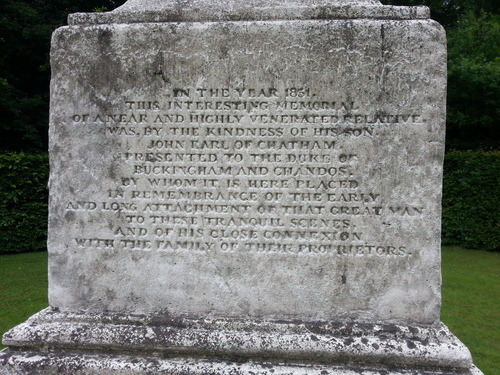
Lord Grenville’s inscription reads: “In the year 1831, this interesting memorial of a near and highly venerated relative was, by the kindness of his son John Earl of Chatham, presented to the Duke of Buckingham and Chandos by whom it is here placed in remembrance of the early and long attachment of that great man to these tranquil scenes, and of his close connexion with the family of their proprietors.”

The Vase, however, did not long remain at Stowe. It was sold at auction in 1848, and where it was between 1848 and 1857 I do not know. In 1857 it was sold again and purchased by James Banks Stanhope, son of James Hamilton Stanhope, who through various very complicated relationships was related to both the Grenvilles and the Pitts, and placed at Revesby Hall in Lincolnshire:

The Vase moved on one more time, when it was bought by the 7th Earl Stanhope in 1934:

The Vase is now at Chevening (and hopefully won’t go anywhere else as there are no more sides to engrave……). This is as appropriate a place as any given that the Stanhope family was closely bound to the Pitts by blood and marriage, and the first Lord Chatham lived there for a while in 1769 and helped lay out the grounds (nobody ever managed to stop him “improving” any house he stayed in). There is still a copy at Stowe, but the original can still be seen at Chevening, which holds annual garden Open Days if anybody is curious enough to want to see it.

The Cheveley mystery … solved!

Jan Siberechts:Cheveley Park, near Newmarket

(Cheveley Park in the 17th century by Jan Siberechts, from here)

image

(From Public Advertiser, 18 January 1790)

I have mentioned a few times on here the mystery that was John, Earl of Chatham’s “seat” of “Cheveley Park/Hall/House/Whatever”. This was first flagged up to me when searching for references to John in the Burney Newspaper Collection. From the summer of 1787 John and his wife could regularly be found at this “Cheveley” over the sporting season, up until John “disposed” of the estate in July of 1797 (Times, 2 July 1797, although the Morning Post recorded him as being at Cheveley as late as 6 October 1797). 

What confused me was this. The Cheveley in question (named “Hall” or “Park” interchangeably) was always stated to be “near Newmarket”, as in the snippet above; it was always mentioned as being John’s “seat”; it never seems to be mentioned in context with anybody else. Why would I be confused about this? Because Cheveley Park, Newmarket, was a hunting lodge belonging to the Duke of Rutland.

image

(From the Gazette and New Daily Advertiser, 22 January 1791)

So what was going on here? Did the Duke of Rutland rent out, or lend, his Cheveley Park, Newmarket, to the Earl of Chatham? They were after all very good friends— see my post on the subject the other day). Moreover, although John first started using Cheveley in the autumn of 1787, his bosom buddy the 4th Duke was at that point still alive and in Ireland, so no doubt might well have given John permission to use one of his estates for a bit. After the Duke died in October of that year, his son the 5th Duke was all of nine years old and, no doubt, a bit young to need a hunting lodge all to himself. It could very possibly have been the Cheveley Park, Newmarket.

But surely there would be some record of it? And I couldn’t find anything—nothing at all. A Google search for “Cheveley Hall” (on the supposition that the Hall and the Park were two different places) came up with nothing but a small half-timbered house in the centre of Cheveley village that John would have looked down his (very impressive and well-formed) nose at, and had no land attached whatsoever to hunt in. An email to the Newmarket Local History Society turned up nothing. ardentpittite very helpfully assisted me in finding some references to Cheveley Park in the Victoria County History of Cambridgeshire, but although the history stated that the house “stood empty” between 1784 and 1799 the evidence given for this statement was a couple of newspapers published over late 1786 and early 1787 (before John moved in) and a letter of 20 August 1799 from William Windham in the Dropmore MSS (after John moved out). By that reckoning John could certainly have been using Cheveley between 1787 and 1797—but I still had no proof.

My latest visit to the Archives made me more certain than ever that I was definitely looking at the Cheveley Park. Apart from John and Rutland’s gushy manlove letters, I found several references to John being at Cheveley Park, Newmarket:

image

image

Surely there being two Cheveley Parks in Newmarket would give rise to confusion at the Post Office? And let’s not forget this letter from Pitt the Younger to his mother, from PRO 30/8/12 f 389, dated 13 September 1787, as usual very modest about his abilities in the sporting field: “I returned yesterday from Chevely [sic] which I reached on the preceding Monday, and had the pleasure of finding my Brother and Lady Chatham established very much to their Satisfaction. My visit was not a long one but afforded me a good deal of Riding in the way there and back, and as good a Day’s Sport of Shooting as could be had without ever killing.” (Interestingly John Ehrman, who refers to this letter in The Younger Pitt: The Years of Acclaim p. 590, does not seem to have cottoned on to the fact that John was using Cheveley independently of Rutland.)

So was it the same Cheveley? “All I need,” I cried, “is a newspaper article saying something like “Lord Chatham has taken over the Duke of Rutland’s seat at Cheveley”. So a thousand thanks to my fellow Pittster and sister-in-research Steph, who within minutes came back with the following: “The Duke of Rutland’s house at Cheveley Park is taken by Lord Chatham during the sporting season” (From Norfolk Chronicle 7 July 1787).

Many, many thanks to Steph are due, therefore, for putting me out of my misery. And now I really must write a lengthy email to Newmarket Local History Society. 😉

“Ever unalterably yours”

image

I’ve long known that one of the second Earl of Chatham’s closest friends was Charles Manners, 4th Duke of Rutland (1754-1787). John seems to have made a habit of befriending Lords Lieutenant of Ireland: along with Rutland, who was in Ireland 1784-7, John was also close to Lord Westmorland (1789-94) and Lord Camden (1795-8). Rutland, however, seems to have been an especially close friend. Rutland was close to both Pitt brothers, but I definitely get the impression that John was the one Rutland felt closest to.

File:4th Duke Rutland.jpg

(The Duke of Rutland, from here)

Politically and personally, Rutland was strongly drawn to the Pitt family. His father, Lord Granby, had aligned himself with the Earl of Chatham and, although Rutland entered Parliament under the auspices of the Marquis of Rockingham, Rutland’s political position seems to have placed him quite firmly in the Chathamite camp. I am not sure how he initially came into contact with the Pitt brothers— perhaps he met William at Cambridge, but then again he and John might have met first in the salons and clubs of London.

However they met, by 1778 John and Rutland had hit it off big time. John spent a lot of time visiting Belvoir and Cheveley, Rutland’s country estates, and when he was sent abroad in 1778 Rutland (then still Marquis of Granby) sent him the following letter, dated 8 December (PRO 30/8/368 f 231):

“My dear Friend, I wrote you a Letter from Liverpool dated Oct 6th, but not choosing that it should be quite so publick as if it was stuck up at Charing Cross or Published in ye Morning Post which it probably would have been had it passed thro’ ye Channel of ye Post Office, I sent it to Mr Thoroton [?] desiring that he would find out some safe Conveyance [to Gibraltar, where John then was]: but none offering, I rather choose to run any risk than be deemed deficient in any one Point of Friendship or attention to a man for whom I profess & most sincerely do feel so much”.

John returned to England in the late spring of 1779, at which point Rutland had succeeded to the Dukedom. The two men decided to take their seats for the first time in the House of Lords on the same occasion, and I have reason to believe John spent nearly all his time in England staying either with the Duke in London or at Belvoir Castle. In the autumn of that year Rutland raised a new regiment of foot (the 86th) and gave John a captaincy in it. Unfortunately the minute the regiment was raised it was sent abroad to the West Indies. In January of 1780, shortly after John had left with his regiment, Rutland wrote the following (PRO 30/8/368, f 233):

“My dearest Friend, I am most miserable in the thoughts of not seeing you once again previously to your departure … Lord Amherst has consented to call the Regiment after my name, & has written to me a Polite Letter on the Occasion; as if all the disappointments which I have experienced in raising the Battallion [sic] were to be Entirely Cancelled & obliterated by the single act of Empty Civility.

But now my dear Lord, give me Leave to thank you in the Sincerest Manner for the Great Honor you have done me in trusting me with your Proxy [vote in the House of Lords]. Such an unequivocal testimony such a Publick distinguished Demonstration of Confidence from one whose Good Opinion & Friendship is the Pride & Pleasure of my Life is a Circumstance too affecting, for me to be able to Express the Satisfaction I feel upon it in terms adequate to my Sensations.

I will trouble you no longer but to offer to you every wish that Sincere Friendship can possibly suggest. … Believe me my Ever dear Friend to be unalterably yours, Rutland.”

Over the next few years the friendship seems to have taken root and flourished. From perusing the HMC Manuscripts of the Duke of Rutland, it looks like John was a (not always very effective) point of contact for guidance for the Duke of Rutland’s MPs in the House of Commons while Rutland was away in Ireland. The Rutland MSS are full of references to John and the occasional letter from him (John, it seems, was not always the best of correspondents). That didn’t stop Rutland from writing the following, quite astoundingly familiar letter of February 1785 (PRO 30/70/3 f 145):

“I am of Lord Lansdown’s mind in regard to Polliticks [sic], preferring Planting & retirement, I confess I begin to grow ennui’d; My Habits lead me to Indolence & to live [?] & [?] & I would rather be at Belvoir breaking my neck all morning, & Bottles & Glasses all ye Evening than Disposing of Bishopricks Peerages &c, However Pleasant Power & Patronage most certainly is. But yet the Little Ambition I have in my Composition & the great attachment which I bear to yourself & your family bind me to my present Situation[.] As long as I can render Service to our Country & Strengthen your Brother’s able and Honorable Government I shall never desert you. & by the Strict Union which subsists between us we shall ever mutually assist each other. God Bless you my dear Friend & love you as much as I do. I am ever unalterably yours, Rutland”.

John had planned to visit Rutland in Ireland in the summers of 1784 and 1785, but on both occasions had to put off his plans due to the bad health of his wife. He eventually managed, alone, in the summer of 1786, and spent three weeks in Dublin. It was not a wholly successful visit— political relations between Dublin and Westminster had been fraught since the Irish Commercial Propositions had failed in 1785, and the newspapers were agog with the possibilities offered by the Minister’s brother making a personal visit to the Lord Lieutenant— but it was the last time John and Rutland were to meet. Rutland died on 24 October 1787 of a disease of the liver, probably due to the “Bottles & Glasses all ye Evening” he had confessed to prefer to the ins and outs of political life. In a final testimony to friendship Rutland made provision in his will for John and William to become joint guardians to his children.

Thus passed a great friendship. John maintained ties to the Rutland family long after the Duke died; he remained good friends with the Dowager Duchess, rented the Duke’s hunting lodge of Cheveley (more on this later) for ten years from 1787 to 1797, and continued to visit the Rutland children at Belvoir on a reasonably regular basis. As late as 1825 (7 November, the Times) he was to be found hunting with the Duke of Rutland on his estates.

I must say that until yesterday I was not fully aware of the extent to which John and Rutland were good friends. “Ever unalterably yours” indeed: I can truly say I have never seen anyone else signing off to John in such a manner.