“A most precious Jewel”

Another super quick blog post, since I’ve finally received the last piece of a little puzzle that has been needling at me since I got hold of a batch of photocopied correspondence between Lord Grantham and his brother Frederick Robinson from Bedford & Luton Archives. I am still ever so slightly mystified, although I think I know what it means. If anyone else can help shed some light on the mystery, though, I’d be grateful.

The Robinson brothers were prominent movers in Whig political circles, and their letters are full of references to the big names of political life. One of the families they were close to was the Townshend family, including Thomas Townshend, the future Lord Sydney, his wife Elizabeth Powys, and their growing family. Frederick and Anne Robinson, Lord Grantham’s siblings, frequently dined and socialised with the Townshends. On 4 May 1778 Frederick Robinson wrote to Lord Grantham: “I was at the Opera at night & supped at Mrs Townshends[.] Georgiana [Thomas Townshend’s eldest daughter, born April 1761] is much grown though little alter’d[.] The second daughter [Mary Elizabeth, later Countess of Chatham, then fifteen] will be pretty”.[1]

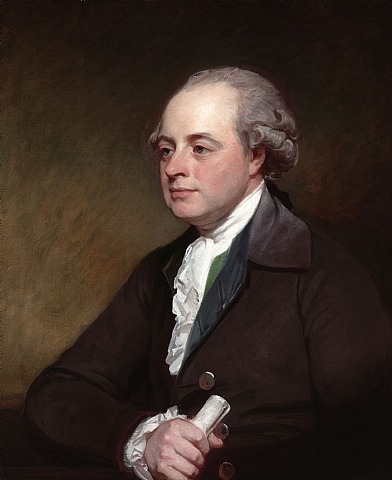
Mary, Countess of Chatham

Mary, Countess of Chatham

Almost exactly a year later, Mary’s future husband John, Earl of Chatham paid the visit to Grantham in Spain that I blogged about in a previous post. After John had left Madrid, Grantham wrote to Frederick Robinson with further thoughts about the three “English” who had been his guests for over a fortnight: “I believe he [Captain Colt] & Conway found out new Acquaintances at Madrid, but Lord Chatham never went with them, & I would not swear that he is not in possession of a most precious Jewel”.[2]

One thing is for sure about this curious turn of phrase: it was not meant literally. This “precious Jewel” was a euphemism for something, and something that made Chatham forego the pleasure of sharing Conway and Colt’s “new Acquaintances”. What was the nature of this jewel? Frederick Robinson’s response gives a clue:

I believe L[or]d Chatham is not in town, Nanny [Anne Robinson] met him at Tommy Townshend’s who gave him a dinner [upon Chatham’s return from abroad], I think it very probable that his Father recommended T[homas] T[ownshend] to him; if he has a mind to set that Jewel which you suppose him possess’d of very beautifully, he might consult Miss Mary Townshend.[3]

From which I gather that Lord Grantham guessed Chatham’s reluctance to visit Colt and Conway’s “Acquaintances” derived from some sort of attachment, and Robinson connected that attachment to Miss Mary Townshend, Tommy Townshend’s “pretty” second daughter. He certainly wasn’t wide of the mark, for four years later John and Mary were indeed married.

Could it be that John already had a thing for Mary in May 1779, when he was 22 and she was 16? Could it be that he had had a crush on her even before he left for Gibraltar, since Lord Grantham seems to have picked up on it even before John’s return to England? And if so, isn’t that kind of sweet?

Do you agree, or do you think Grantham was talking about something else?


References

[1] Frederick Robinson to Lord Grantham, 4 May 1778, Wrest Park (Lucas) MSS, Bedford and Luton Archives, L30/14/333/91

[2] Lord Grantham to Frederick Robinson, 2 May 1779, Wrest Park (Lucas) MSS, Bedford and Luton Archives, L30/15/54/139

[3] Frederick Robinson to Lord Grantham, 25 May 1779, Wrest Park (Lucas) MSS, Bedford and Luton Archives, L30/14/333/211

Lord Chatham’s seal

It’s rare to find any John-related artefacts out there, perhaps because people didn’t think his things worth keeping (the “wrong Lord Chatham”, as it were). A few months ago, however, I discovered something on the web that actually belonged to him.

johnseal

Amazingly, the above was John’s seal. I found it on the finds.org.uk site for the public to register finds of archaeological/historical interest. The website notes:

Part of a late eighteenth century gold fob seal set with a cornelian intaglio. The struts and suspension loop are missing. The fob seal is oval in shape and measures 33.81mm by 28.08mm by 5.24mm. It weighs 11.25g. The arms engraved on the intaglio are those of John Pitt, 2nd earl of Chatham (1756-1835), impalling those of his wife, Mary Elizabeth Townshend (1762-1821), daughter of Thomas Townshend, 1st Viscount Sydney. It encorporates the coronet, supporters and motto, BENIGNO NUMINE (‘by favour of the heavens’) of the earls of Chatham. The seal must date from between the marriage of John Pitt in 1783, and 1805, when the Pitt family sold their estate at Curry Rivel. (From here)

It was found on 1 February 2006, somewhere “in the Curry Rivel area” in Somerset, presumably on the Burton Pynsent estate, where the Pitt family had a house.

What remains of Burton Pynsent (from http://www.panoramio.com/photo/10263323)

What remains of Burton Pynsent (from http://www.panoramio.com/photo/10263323)

I’d guess John was out walking or riding around his estate and lost part of his seal. It’s just one of those reminders that the people I read and write about were actually human beings, who were liable to lose things (and probably quite annoyed about it afterwards).

I have not seen any manuscripts sealed with this particular design, although to be fair most MSS do not include the envelopes along with the letters (some do, particularly if the inside of the envelope formed part of the letter). I do wonder if it is a pre-1790 seal, since John was invested with the Garter in December of 1790 and was so proud of it he put his star/garter symbol on absolutely EVERYTHING. Without knowing more about heraldry, however, I could not say for sure.

As the find.org.uk website notes, the crest on the seal is composed of Chatham’s arms impaled with those of his wife, Mary Elizabeth Townshend. The Chatham arms are below:

pittcrest

And this is the crest of Lord Sydney, Mary’s father:

townshendcrest

I would very much like to see a colour version of the Pitt/Townshend crest. I may have to make one myself!

A “Not-So-Grand” Tour: Lord Chatham in Spain and France, March – May 1779

Madrid in the 18th century (from https://villajardines.wordpress.com/history/)

Madrid in the 18th century (from https://villajardines.wordpress.com/history/)


At the beginning of March 1779, the 2nd Earl of Chatham was serving as aide-de-camp to Colonel Robert Boyd in Gibraltar. Aware, no doubt, that hostilities were brewing between Britain and Spain, he received permission to return home, touring round Spain and France on his way. The inveterate gossip Sir Nathaniel Wraxall later recalled Chatham telling him “that he rode post the whole way from [Gibraltar] to Madrid”, a distance of  over 400 miles– although it appears he journeyed to Cadiz first.[1] Chatham spent a fortnight in Madrid, then travelled to Paris via Bordeaux. He arrived back in England at the beginning of May 1779, two months after leaving his garrison.

On 6 March 1779 Thomas Townshend wrote to Chatham’s mother that Lord Grantham, the British ambassador to Madrid, was in “daily expectation of seeing L[or]d Chatham. He says, that he knows L[or]d Chatham to be on the Road with one of L[or]d Hertford’s Sons & another Officer”.[2] Chatham was travelling with Hugh Conway (later Seymour-Conway, eventually known as Lord Hugh Seymour), a captain in the navy and later a notorious rake and close friend of the Prince of Wales. The third member of the group was Adam Colt, a captain in the 73rd Highlanders.[3] I haven’t yet managed to find much about him, but he was very much the junior member of the group in terms of rank and importance, and seems to have been treated as little more than a glorified servant.

Lord Hugh Seymour, by J. Hoppner (1799) (from http://en.wikipedia.org/wiki/Lord_Hugh_Seymour)

Lord Hugh Seymour, by J. Hoppner (1799) (from http://en.wikipedia.org/wiki/Lord_Hugh_Seymour)

Grantham did not have a definite arrival date for the three travellers in Madrid, but began preparing the ground diplomatically for their arrival around the first week of March. “I desired Floridablanca [the Spanish Prime Minister] to drop in Conversation … that I expected Lord Chatham &c in order that new faces & high names might create no Surprize”.[4] Grantham himself was curious about his forthcoming visitors: he had not yet met Chatham, but obviously remembered Chatham’s father and wondered, naturally enough, what the 2nd Earl of the name would be like.

They finally arrived on Thursday 25 March. “I walked out this Afternoon,” Grantham wrote to his brother Frederick Robinson, and “met three Gentlemen riding posts[.] [T]heir hats seemed to touch each other, & to make a Line across the Calle. I could not doubt their being my English & stopped them”. The young men’s enormous hats would make several reappearances in Grantham’s correspondence over the next fortnight, but for now Grantham was mainly concerned with acquainting himself at last with Conway, Colt (“young & Scottish”) and of course Chatham, whom he was surprised to find was not, in fact, Pitt the Elder in the flesh: “tall & thin, like his father but has not his Countenance”.[5]

The three young men (Chatham was twenty-one, Conway nineteen, and Colt probably about the same age as Conway) were not staying with Grantham, but the ambassador took on the responsibility of entertaining them. I’m not too sure he realised what he was letting himself in for, and certainly the youngsters do not seem to have spared much thought for Grantham’s official duties. The very first day they were “an hour and a half” late for breakfast, and Grantham soon discovered that if he wanted to get anything done he had to get up early and reserve “two hours in the Evenings to myself”.[6] His chaplain, Robert Waddilove, took the young men on a tour of some of the principal sites in Madrid, while Grantham set down his more considered impressions of his guests:

Lord Chatham is certainly handsome, like his father, but very gentle & modest. He has an exceeding good look of Carlito Pignatelli [presumably a member of the Spanish-Italian Pignatelli dynasty]; is very well behaved & seems as far as I can judge to think & speak very right. Conway has much more vivacity, has a remarkably open Appearance … [and] is exceeding tall & stout. … Cap[tai]n Colt, is a very Cream coloured Foal as ever I saw, a mere Recruit.

Grantham clearly enjoyed punning about the young Scotsman, whom he called “the Colt”: he “has never been out of the field, & is as rough as you can conceive”. Chatham seems to have been slow to open up. Grantham thought he was “rather prim”, although he “opens more than at first”, and was both “engaging & altogether interesting”. He and Conway had “inclinations to Virtue”, something Conway clearly outgrew later in his career, and both “wish to see & to learn”.[7]

Grantham felt Chatham’s reticence was largely due to his background: he “had a very private Education, & has some Timidity in Consequence of it”. He was clearly struck by Chatham’s generous nature, and related a story to his sister Anne:

He [Chatham] has donr at Gibraltar one of the handsomest & most generous Things a Man can do, he forgave a Man, who made rude Use of his Name, he paid his Debts to save him from Perdition, & took the most feeling part possible in a very delicate Situation.[8]

Chatham’s shyness (“he is reserved”) was a bit of a handicap, and Grantham was not surprised to find that he was not universally liked in the army. “It is singular what Accounts reach us from Gibraltar of L[or]d Ch[atham],” Grantham wrote cryptically to his brother.  At least one source suggested Chatham was “intemperate”, although, as Grantham observed, “he has disguised it if it so, as I have seen no marks whatever of such a Disposition … If he has been intemperate at Gibraltar, I will venture to say it was from not knowing how to resist ye. Tyranny of a Toastmaster”. By this time, Grantham had spent nearly two weeks in Chatham’s company and completely warmed to him: “I confess I am very partial to him”. He had no doubt most of the rumours were “formed upon some narrow principle of Regimental Party”: after all, Gibraltar “is divided into Parties, & … [Chatham’s] singular Education does not decently qualify him for a Garrison Life”.[9]

All in all Grantham seems to have found Conway the best company, Chatham the quietest and most mysterious, and Colt, well, “young and Scottish”.

Grantham presented the higher ranking two at the Spanish court (Colt, unfortunately, being only gentry, did not make the grade). Everywhere they went the young men attracted attention, partly, as Grantham noted, because of their “enormous hats”, but also because of who they were: “Ye. notice of Lord Chatham’s arrival, has everywhere excited much Curiosity”.[10] The noblemen received invitations to music parties, balls and dinners (incuding one of “one hundred &  three people”), and Grantham was rushed off his feet taking them here and there, plying them with “Cold Meat & liquor” in his carriage between engagements. The boys kept him on his toes, and on one occasion he nearly “lost” Colt, who left a party early and got snarled up in Madrid’s streets.[11] Despite this, Grantham seems to have managed to keep them largely out of trouble.

During the day Waddilove showed them the Escorial, the “Cabinet of Natural History”, and “the Academy”. The young men spent the Easter weekend in Madrid, and were therefore able to see the Maundy Thursday ritual of washing the feet of the poor.[12] Grantham took them to a concert given by a singer named “Madame Dos”: “Colt fancies himself in Love with her, Conway is in Raptures, & Lord Chatham capable of the most sentimental Admiration”. The three young men finally left on 7 April, leaving an exhausted Grantham suffering from a terrible cold but still mourning his guests, “as they have been exceeding good Company”.[13]

Conway and Colt went their own way, both returning eventually to service in Gibraltar. Chatham, however, went northwards, carrying despatches from Grantham detailing the collapse of diplomatic relations with Spain. Chatham passed through Bordeaux, where he arrived on 18 April and made contact with Grantham’s wine merchant, John Black. He left with £100 worth of wine on credit (……….. whether he actually ever paid for it seems unlikely, so poor John Black) and went on to Paris, which Black assumed he would have reached by the 25th.[14]
Chatham landed back in England at the beginning of May and reached London late in the evening of Friday the 7th. The next day he went to visit his mother, whom he had not seen for a year, but not before delivering his despatches to Grantham’s brother Frederick Robinson, who was very curious to meet him after all he had heard:  “From the little I could see of him in a short & first visit he seems to answer your  descriptions of him[.] I think in his person he is a very good likeness of Camerena’s Nephews in the Spanish Guards[.] He is darker than any of his family which I have seen.”[15] This comparison of John to dark Spaniards will surprise no-one who has seen J.S. Copley’s “Death of Lord Chatham” at the National Gallery: Copley has gone so far as to give John Chatham a noticeable five o’clock shadow.
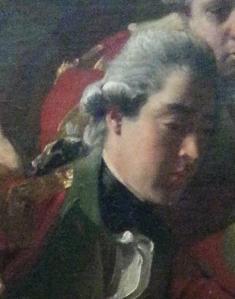
John, 2nd Earl of Chatham, in John Singleton Copley's "The Death of the Earl of Chatham" (1779)

John, 2nd Earl of Chatham, in John Singleton Copley’s “The Death of the Earl of Chatham” (1779)

This was the end of Chatham’s immediate adventures, at least for a while. There was, however, a sequel. In January 1780 Chatham, who had transferred to the 86th Foot, was sent with his regiment to the West Indies. Grantham was desperate to make contact before he left because Chatham still owed him £150 from his visit to Madrid. It seems Chatham did leave without paying, but when Grantham wrote “to wish him a good Journey & to desire his Directions about the Money” (a not-so-subtle hint) Chatham did, eventually, order his banker Coutts to pay up.[16]


Clearly Chatham was fond of Grantham, and grateful for his Spanish hospitality, because Chatham did not very often pay his debts!


References

[1] Wraxall, Posthumous Memoirs of my Own Time (London, 1836) III, 129; Lord Grantham to Frederick Robinson, 19 March 1779, Bedford Archives, Wrest Park (Lucas) MSS L30/15/54/125

[2] Thomas Townshend to Lady Chatham, 6 March 1779, National Archives PRO 30/8/60 f 176

[3] Army List for 1780, WO 65/30

[4] Lord Grantham to Frederick Robinson, 11 March 1779, Bedford Archives, Wrest Park (Lucas) MSS L30/15/54/124

[5] Lord Grantham to Frederick Robinson, 25 March 1779, Bedford Archives, Wrest Park (Lucas) MSS L30/15/54/126

[6] Lord Grantham to Frederick Robinson, 27 March 1779, Bedford Archives, Wrest Park (Lucas) MSS L30/15/54/127

[7] Lord Grantham to Frederick Robinson, 27 March 1779, Bedford Archives, Wrest Park (Lucas) MSS L30/15/54/127

[8] Lord Grantham to  Anne Robinson, 2 April 1779, Bedford Archives, Wrest Park (Lucas) MSS L30/17/4/245a

[9] Lord Grantham to Frederick Robinson, 5 April 1779, Bedford Archives, Wrest Park (Lucas) MSS L30/15/54/131; Lord Grantham to Frederick Robinson, 6 April 1779, Bedford Archives, Wrest Park (Lucas) MSS L30/15/54/132

[10] Lord Grantham to Frederick Robinson, 27 March 1779, Bedford Archives, Wrest Park (Lucas) MSS L30/15/54/127

[11] Lord Grantham to Frederick Robinson, 5 April 1779, Bedford Archives, Wrest Park (Lucas) MSS L30/15/54/131

[12] Lord Grantham to Frederick Robinson, 31 March 1779, Bedford Archives, Wrest Park (Lucas) MSS L30/15/54/129

[13] Lord Grantham to Frederick Robinson, 5 April 1779, Bedford Archives, Wrest Park (Lucas) MSS L30/15/54/131

[14] John Black to Lord Grantham, 28 April 1779, Bedford Archives, Wrest Park (Lucas) MSS L30/14/36/25

[15] Frederick Robinson to Lord Grantham, 11 May 1779, Bedford Archives, Wrest Park (Lucas) MSS L30/14/333/207

[16] Lord Grantham to Frederick Robinson, 17 January 1780, Bedford Archives, Wrest Park (Lucas) MSS L30/15/54/162; Lord Grantham to Frederick Robinson, 19 January 1780, Bedford Archives, Wrest Park (Lucas) MSS L30/15/54/163; Lord Grantham to Frederick Robinson, 9 February 1780, Bedford Archives, Wrest Park (Lucas) MSS L30/15/54/170
 

“A difficult part to act”

When I came to Parliament everyone knew who I was. Now they all look through me as though I’m not there … I have no presence, no role, nothing but a name, and even that is more William’s than mine now.

Thus speaks the 2nd Earl of Chatham, the main character of my novel The Long Shadow, shortly after his brother Pitt the Younger makes his maiden speech in the House of Commons. John’s words are, of course, my own, and they reflect one of the main themes of the novel, John’s search for his own identity beyond the long shadow of his father and brother. My theme, however, is well-grounded in fact. He was the eldest son, the head of the family, but heavily dependent on the patronage and favour of his younger brother. It was a complete inversion of the 18th century aristocratic norm. Not only that, but John possessed an impoverished and virtually landless title which was nonetheless closely associated with greatness and authority. How difficult must John’s position have been?

John, 2nd Earl of Chatham, in John Singleton Copley's "The Death of the Earl of Chatham" (1779)

John, 2nd Earl of Chatham, in John Singleton Copley’s “The Death of the Earl of Chatham” (1779)

With our 20/20 hindsight it is all too easy to forget that Pitt the Younger was not his father’s eldest son. When the first Earl of Chatham died in 1778 all eyes did not automatically turn to his second son, who was barely nineteen, still kept rooms at Cambridge, and was only just embarking on legal training at Lincoln’s Inn. William Pitt had not yet done anything to distinguish himself in the public, although his reputation for hard study and a defence of his father’s posthumous reputation published as an open letter to Lord Bute suggested he had inherited more than his fair share of the family brains. Quite reasonably, everyone turned their attention to the eldest son, John, now the 2nd Earl. “One looks upon him as the Child of the Publick,” Lord Grantham wrote, explaining his curiosity to meet the eldest son of the great Lord Chatham.[1]

At the time of his father’s death John was twenty-one and about to serve as aide-de-camp to General Boyd at Gibraltar. He does not seem to have been well known in political circles, but had clearly kept up social links with the effective head of the Chathamite political interest in Parliament, Lord Shelburne, and he had served on various occasions as a scribe for his gout-stricken father. John’s closest friend, the Duke of Rutland, might have formed a political group of his own — his father, the Marquis of Granby, was nearly as famous a political figure as Pitt the Elder, and Rutland’s rank, wealth and intelligence would have suited him to the task. Astonishingly, however, Rutland laid himself completely at the service of “a man for whom I profess & most sincerely do feel so much”[2]:

My dear Lord, give me Leave to thank you in the Sincerest Manner for the Great Honor you have done me in trusting me with your Proxy [while John was abroad in the West Indies]. Such an unequivocal testimony such a Publick distinguished Demonstration of Confidence from one whose Good opinion & Friendship is the Pride & Pleasure of my Life is a Circumstance too affecting, for me to be able to Express the Satisfaction I feel upon it in terms adequate to my Sensations.[3]

Charles, 4th Duke of Rutland (Wikimedia Commons) [a]

Charles, 4th Duke of Rutland (Wikimedia Commons) [a]

While Rutland was in Ireland, he left Chatham in charge of his parliamentary interest, instructing his agent Daniel Pulteney to apply to Chatham for advice on all political issues.

Had Chatham wanted to, he could have taken advantage of his name and parentage (as his brother William was later to do). His attitude to politics started out diligently enough. He was in Gibraltar from June 1778 until March 1779, so he could do nothing in that period, but one of the first things he did upon returning to England was to take his seat in the House of Lords. The reappearance of the Earl of Chatham in Parliament caused a frenzy of interest:

The young Earl of Chatham took the oaths and his seat in Parliament on Thursday last. His Lordship was dressed in his regimentals … and presented a very elegant, manly, and graceful figure. He is as tall as his late father, has the appearance of much mildness in his countenance, and is said to be a most exemplary young nobleman in his morals, and general good character.[4]

Chatham did not spend much time in England over the next two years, but he crops up regularly enough in the Journals of the House of Lords, and was one of nine opposition Lords who signed an official protest against the King’s elevating Lord George Germain to the peerage as Viscount Sackville.[5] As Rutland’s letter suggests, Chatham cared enough about political issues to make arrangements for his proxy vote to be deployed in his absence.

During a period  of leave in 1781 he spent some time at Lord Shelburne’s house at Bowood, where he was looked upon with great curiosity by the philosopher Jeremy Bentham:

Do you know Lord Chatham? … He has his father’s Roman nose, and, if events should concur to make him have a good opinion of himself, will soon, I dare say, acquire his commanding manner: at present, one sees little more than a kind of reserve, tempered with mildness, but clouded with a little dash of bashfulness.[6]

That “bashfulness”, however, was one of several reasons why John never did manage to find a political niche for himself. His “mildness” was remarked upon by many who met him, often in surprise. “Lord Chatham … has not his [father’s] Countenance,” Lord Grantham noted in astonishment when he met John in Madrid in 1779.[7] But Chatham was not his father, despite inheriting the title: he simply wasn’t cut out for politics. Much later in his life, during the Walcheren debacle, a military subordinate suggested “that he wants confidence in his own powers”, a remarkably incisive comment.[8] He had the intelligence to be interested, but neither the energy nor the drive to make his name. And in any case, by the time Bentham was writing in 1781, the rising star of the Pitt family was becoming clear… and it wasn’t John.

What sort of effect must all this have had on Chatham? He must have been aware that his father always expected great things of him. “The promise of our dear children does me more good than the purest of pure air,” Pitt the Elder once wrote to his wife, referring specifically to both John and William.[9] In the first few years after his father’s death he must have had a great burden on his shoulders, one he was not necessarily well-suited to carry, but he did his best.

William Pitt the Elder, 1st Earl of Chatham by William Hoare (Wikimedia Commons) [b]

William Pitt the Elder, 1st Earl of Chatham by William Hoare (Wikimedia Commons) [b]

As contemporaries realised, it was a difficult line to tread. When various rumours were circulated regarding his behaviour in Gibraltar, Lord Grantham and his brother Frederick Robinson immediately dismissed them as partisan talk. “I think much depends on ye. hands he will fall into,” Grantham concluded cautiously, but it was Robinson who put his finger on a deeper truth: “I think Ld. Chatham has a difficult part to act in this country, & do not wonder at his character being variously spoken of”.[10]


References

[1]Lord Grantham to Frederick Robinson, 27 March 1779, Wrest Park (Lucas) MSS, Bedford and Luton Archives, L30/15/54/127

[2] Rutland to Chatham, 8 December [1778], PRO 30/8/368 f 231

[3] Rutland to Chatham, 22 January 1780, PRO 30/8/368 f 233

[4] London Evening Post, 19 July 1779

[5] House of Lords Journal vol XXXVI, 18 February 1782

[6] Jeremy Bentham to George Wilson, 1781, Benthamiana, ed. J H Burton (London, 1843), p 333

[7] Lord Grantham to Frederick Robinson, 25 March 1779, Wrest Park (Lucas) MSS, Bedford and Luton Archives, L30/15/54/126

[8] Letters from Flushing by an officer of the 81st Regiment (London, 1809), p 126

[9] Lord Chatham to Lady Chatham, 8 June 1770, Chatham Correspondence IV, 267

[10] Lord Grantham to Frederick Robinson, 6 April 1779, Wrest Park (Lucas) MSS, Bedford and Luton Archives, L30/15/54/132; Frederick Robinson to Lord Grantham, 27 April 1779, Wrest Park (Lucas) MSS, Bedford and Luton Archives, L30/14/333/198

Image references

[a] http://commons.wikimedia.org/wiki/File%3A4th_Duke_of_Rutland.jpg

[b] http://commons.wikimedia.org/wiki/File%3AWilliamPittTheElder.jpg

“He has at least won all our hearts”: Letters from Flushing

No, I’m not ready to do that post just yet, but the Walcheren campaign of 1809 — and obviously the involvement of John, 2nd Earl of Chatham in that campaign — has been on my mind recently. I am aware that when I lay down my pen in a few months at the end of my novel, I am going to have to do some research on Walcheren: I feel I owe it to myself, and to my boy Chatham, to do it. I know it won’t be pleasant, but I can hardly call myself a Chatham expert until I have familiarised myself with every aspect of the campaign.

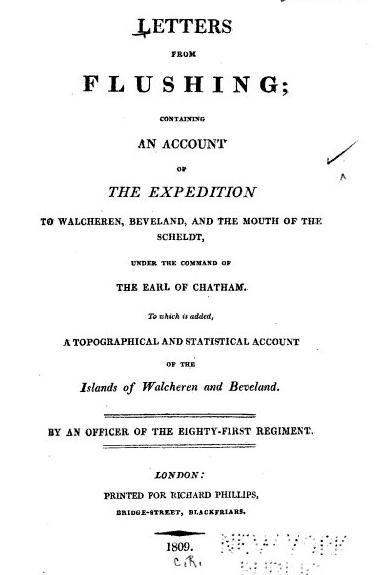
In due course, therefore, I will probably be writing a series of Walcheren-related posts. For now I’m thinking about it mainly because I have recently made contact with Dr Carl A. Christie, whose doctoral research was on the Walcheren campaign and who kindly sent me an article he wrote on the subject in 1981.[1] While reading the article one of the references caught my eye, so I chased it up:

flushing

I was expecting the book to be harsh on John, but while it is not exactly favourable,I was surprised at how positive it was about him. I freely admit I’m much more likely to blog about the nice stuff at this stage (cross my heart I will be fair to Chatham when I come to look at Walcheren properly) but after the bad press he has in the history books I really wasn’t expecting his subordinates to, well … like him. Although it must be noted that being a likeable chap does not necessarily make for a great military commander, and there’s plenty of censure here too.

George Cruikshank, "The Grand Expedition" -- a rather more critical *coughs* portrayal of Lord Chatham's inactivity than in "Letters from Flushing"

George Cruikshank, “The Grand Expedition” — a rather more critical *coughs* portrayal of Lord Chatham’s inactivity than in “Letters from Flushing” (Wikimedia Commons)

The anonymous officer of the 81st Regiment who wrote the letters printed in “Letters from Flushing” may have had a pro-Chatham agenda of some sort, I don’t know: I haven’t done enough research even to guess who he might have been. He certainly had an axe to grind against the navy, so would be expected to take the army’s side in a debate. Taking all that as given, he begins (pp. 3-5) with a lengthy description of Lord Chatham, and the way in which he was viewed at the beginning of the expedition at the end of July 1809. (The letter in question is dated from Ramsgate, 27 July 1809.)

There’s a fair amount of implied criticism in the account — the author is quite circumspect about his opinion: “there is an old proverb, that ‘walls have ears’, and perhaps there are some things which should not be committed to letters” — but the John I have come to know in my research is certainly recognisable here.

So much, however, I will say, that I could wish the Earl [of Chatham] would be more active in putting his talents forth. He is certainly a man of abilities, he thinks solidly, and writes extremely well; but it is not very easy to arouse him into exertion; he is indolent beyond any man I have ever seen. At the present moment he bustles about with some appearance of alacrity; but it is evidently only a fit and a start, and all of us begin to apprehend a relapse. If you pass his window in his hours of leisure, you will invariably see him yawning, or with a book, over which he is sleeping. To sum up all, however, and perhaps to compensate for all, he has the reputation of being as honest a man as Heaven ever formed; he is the perfect gentleman, moreover, in his manners and deportment, and, as I have said before, whatever he does, he does well. If his activity were but equal to his talents, he would be inferior to none of our most celebrated Generals.

The author goes on to hint at one possibility never mentioned by historians for why Chatham was chosen to lead the expedition: his name and heritage inspired loyalty in the troops under his command (pp 4-5).

As the brother of the immortal Pitt, his appointment has given universal satisfaction amongst all the officers; and I do really believe that, under this impelling principle, they would do more for him than for any General in the service. I can scarcely describe to you the enthusiasm with which the good people of Ramsgate flock around the brother of Pitt, and the son of Chatham.

Presumably the soldiery were at least expecting a man who would be at least half as brilliant as his father and brother, although as the account suggests Chatham’s reputation for indolence was well-known.

On pp 125-7, the author again speaks of Chatham’s popularity among the soldiers, something I found rather surprising: from a couple of sources quoted in Gordon Bond and Martin Howard’s accounts of Walcheren I had the impression he was viewed as a distant commander, rather out of touch with what was happening on the front lines. Still, John was always an affable chap, and well-mannered, as the author keeps mentioning (he’s not the only one to lay emphasis on John’s “manners”). There’s nevertheless a flavour of censure about his easy-goingness, and the author does attack his hesitation and inactivity:

As to our Commander in Chief, he spends the greater part of his time in Middleburg [the headquarters], and very freely and good-naturedly permits the officers to follow their own inclinations.

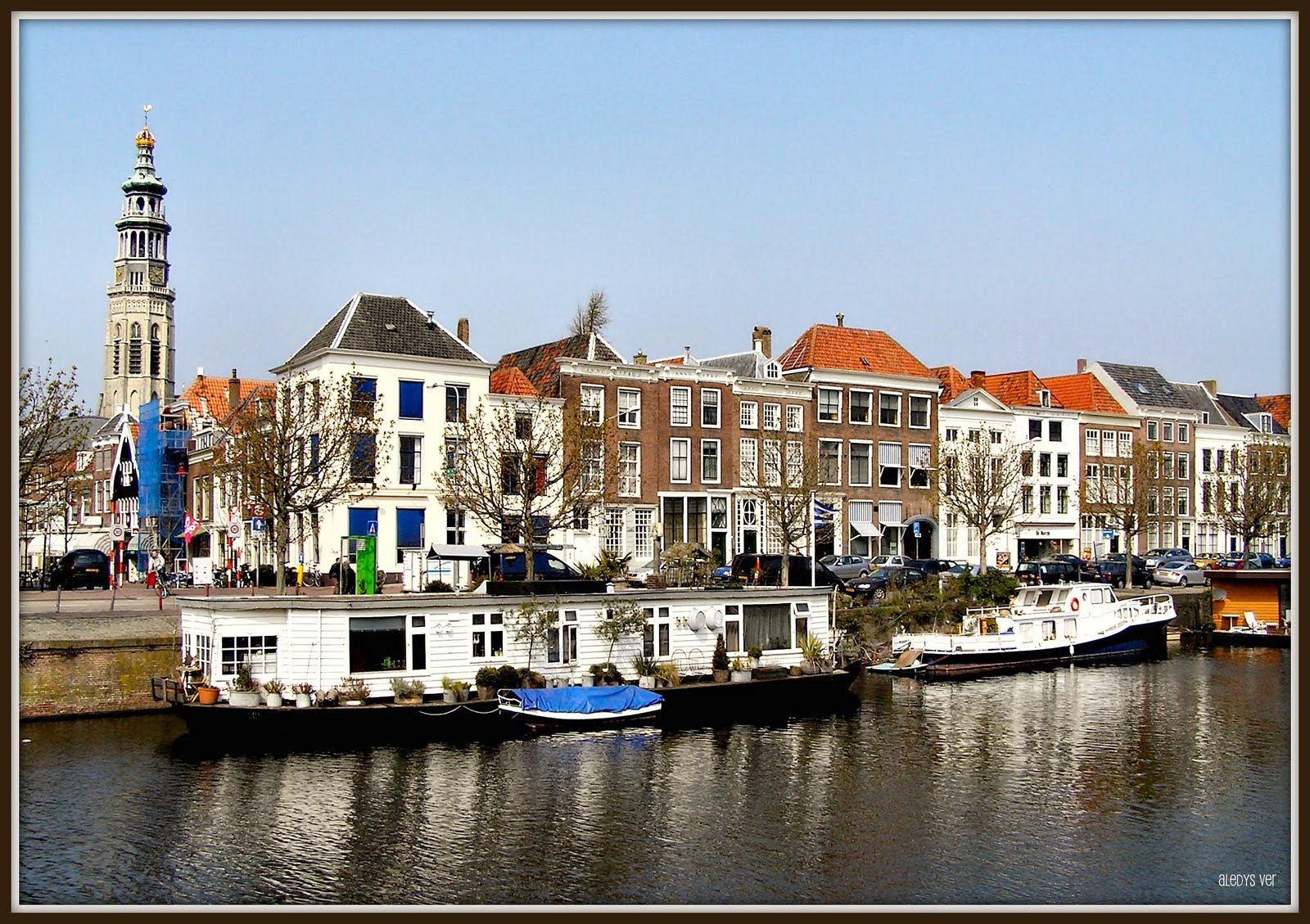
middelburg

Above: Middelburg, Walcheren Island

So much I must say of him, that every one seems to feel a lively regard for him; his manners are so gentlemanlike, and his temper so easy and affable, that he has at least won all our hearts. But there are certainly some murmurs that he is not sufficiently decisive, that he wants confidence in his own powers [I’d say this is a very incisive observation], that he is too fond of councils of war, and that he is deliberating, where the nature of the service requires that he should be acting. Be this as it may, he is the perfect gentleman [but of course]; and when he thinks proper to exert himself, an excellent officer. Every one acknowledges his abilities, whilst they lament that he does not sufficiently put them forth.

Even the author, however, seems to have fallen under the spell of John’s charm, since he can’t resist finishing off with a sweet story from John’s childhood. It’s almost certainly apocryphal, but having read a fair amount of Pitt family correspondence there is a flavour of truth about the tale:

I have heard that the late Lord Chatham, the great Chatham as he is deservedly called, entertained a very high opinion of our Commander’s abilities. The late Lord Clarendon being one day at his house, and Mr Pitt and Lord Chatham, at that time boys, happening to pass — ‘There, my Lord,’ said Lord Chatham, ‘are my best services to my country; there are two boy who will hereafter be most useful men. The one, Mr Pitt, is the readiest; he has a due confidence in himself. The other will be the most solid thinker.’

There, then, you have it: easy-going, lazy, difficult to rouse, diffident, a slavish follower of official military protocol: yes, that is definitely a Chatham I recognise. But popular, intelligent, full of ability, respected by the men under his command? Now that’s a John I have yet to see in any history books.

____________

Reference

All quotations from Letters from Flushing by an officer of the 81st Regiment (London, 1809)

[1] Carl A. Christie, “The Royal Navy and the Walcheren Expedition of 1809”, New Aspects of Naval History ed C. L. Symonds et al (Annapolis, 1981) 190-200

Happy 258th birthday John Pitt, 2nd Earl of Chatham

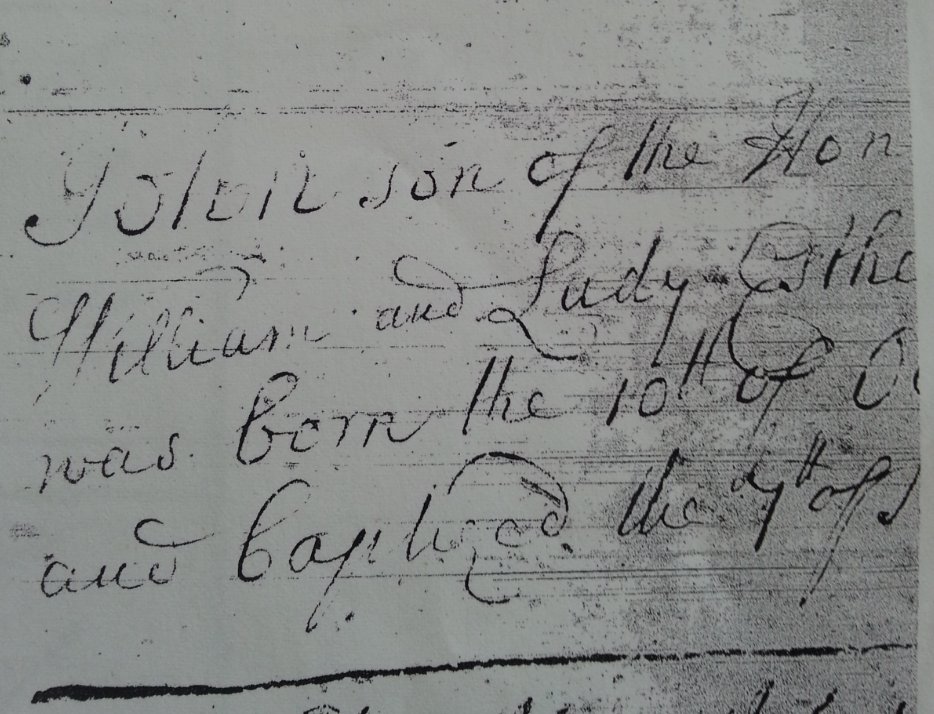
As those who have followed this blog since its beginning will know, I do not follow the majority view that John, 2nd Earl of Chatham was born on 9 October 1756. As far as I can see the only justification for this is that John’s father wrote a letter to William Pitt (John’s brother) on 9 October 1773 in which he talked of it being “the happy day that gave us your brother”.[1] Possibly it was John’s birthday, as certainly John read Tomline’s draft before the book was published and might have been expected to correct the error, but I tend to think Tomline mistranscribed.

This is why:

John, 2nd Earl of Chatham's baptismal record, Hayes, Kent

John, 2nd Earl of Chatham’s baptismal record, Hayes, Kent[2]

Even given this is a partial record, I think it’s fairly obvious that I have good grounds for commemorating John’s birthday on the 10th and not the 9th.

Anyway, moving on… in celebration of John’s 258th (he always looked younger than his years), today’s post is about his childhood. I’ve been posting a lot about his later years recently, so it seems fitting to go right back to the beginning for once.

John, 2nd Earl of Chatham, in John Singleton Copley's "The Death of the Earl of Chatham"

John, 2nd Earl of Chatham, aged 21/2, in John Singleton Copley’s “The Death of the Earl of Chatham”

John was, like his younger brother William, born at Hayes Place, his father’s country house in Kent. (The other three children were born in London.) “We are all well here … and intend that our little colony shall, God willing, receive its increase in the pure air of our village,” Pitt the Elder wrote to his brother-in-law George Grenville on 20 August 1756.[3]

In accordance with his later reputation, it seems John arrived a little later than expected, but when he did decide to make his appearance he was in a hurry.[4] It was probably the quickest entrance he made in his entire life. A delighted Pitt the Elder gushed to George Grenville on the morning of 10 October 1756 about John’s health and size:

Lady Hester is as well as can be in her situation, after being delivered of a son this morning, who is also well. She had a sharp time, but not longer than two hours and a half. There was enough notice to have [William] Hunter [the fashionable accoucheur] and all comforts about us. … Mrs Grenville, I am sure, and perhaps you, will excuse my talking nursery: the young man meets with general applause for stature and strength … He is, however, as they flatter me, without appearance of heaviness, notwithstanding his size.[5]

Pitt was evidently delighted to have a son at last. “[Lady Hester] and the child are as well as possible,” he reported to his nephew Thomas Pitt, “and the father in the joy of his heart”.[6]

William Pitt the Elder by William Hoare

William Pitt the Elder by William Hoare

Most books focus on the childhood of John’s brother William, but there are occasional glimpses of John in the family correspondence. The impression drawn from history is that Lord and Lady Chatham favoured their second son above all the other children, and there is probably some truth in this, but John, too, was much loved. In 1770 Lord Chatham spent some quality time at Burton Pynsent with John, who was going to travel on with his tutor Mr Wilson to Cornwall, while Lady Chatham remained with the four others at Hayes:

Pray tell all at Athens, professors, and scholars, how truly charmed I am with their performances [ie, as correspondents] … They may all rest satisfied that Pitt [John, whose courtesy title as heir was Viscount Pitt] is every thing that can please: he is a sweet, idle boy; he is a sensible, conversable, discreet man: sense or nonsense, verse or prose, Homer, mouse, taste, all shine alike, and draw perpetual applauses from papa and Mr Wilson.[7]

Along with his four siblings Hester, Harriot, William, and James Charles, John was educated at home by a tutor, Reverend Edward Wilson. There were some thoughts of sending him to Eton, where his father had gone, but apparently these came to nothing.[8] He seems to have been a bright boy: he often bested William in his studies, and their tutor Wilson’s comments on the subject can be followed in the Chatham MSS at the National Archives .[9] “John was distinguish’d first for his Mathematicks, and then for his Latin Lesson,” Lady Chatham wrote to her husband in July 1766. “… Mr Wilson imputed their success [John and Hester’s], to the subject, which he told me they took to, with a Taste and an ardour of Application that was quite fine. The subject, was an account of Aristides, and his great Virtues”.[10]

From W.A. Shuffrey, "Some Craven Worthies" (London, 1903)

Rev. Edward Wilson and his brother Thomas, From W.A. Shuffrey, “Some Craven Worthies” (London, 1903)

In terms of his likes and dislikes, John was pure boy. He was never happier than when out riding or shooting, two pastimes he kept up for the rest of his life. In 1777 his mother apologised to a correspondent for John’s not adding his good wishes to a letter, because he was “following the Fox Hounds, for the first day this season”.[11] It seems, however, that he was proficient at drawing, and his tutor Mr Wilson often referred to the vividness of his imagination.[12] Dancing was also a passion: he and his siblings were under the tutelage of the fashionable dancing master Giovanni Gallini, and there are frequent mentions in the correspondence of John staying out late dancing or accepting invitations to Pantheon balls.[13] On at least one occasion Lord Chatham referred to his eldest son as “the powdered beau”, suggesting an early inclination to dressing fashionably and well which he never entirely outgrew.

John was early destined for a career in the army (… which has always struck me as a little unusual as the destination for an older son, but there you go). His future was already determined before he was 14: Lord Chatham joked he was learning “how to live in a March, or bad quarters” when they made a bad journey from London to Somerset in July 1770.[15] John spent the summer of 1773 applying himself assiduously to his studies, Lord Chatham having procured him an ensigncy in the 47th Foot. John was due to go out with General Guy Carleton to Quebec the following year, but in the meantime the sixteen-year-old spent most of a holiday spent at Lyme in Dorset studying with a local military engineer.

Lord Chatham wrote to his wife referring to his eldest son as “young Vauban” and described how he was kept from joining his father and second brother on a ride because “he was generously occupied in learning to defend the happy land we were enjoying. Indeed, my life, the promise of our dear children does me more good than the purest of pure air”.[16] John’s brother James Charles was slightly less generous  when the travellers returned to Burton Pynsent, expressing astonishment “that Pitt has made so amazing a progress in the military art, in so short a time”– but that’s siblings for you.[17]

When he left England for Canada in June 1774 John, theoretically, stopped being a boy and became a man. He was still only 17, though, and he had spent all his childhood at home with his family. Travelling abroad must have been a big shock for a boy who had, essentially, rarely gone much further north than London. Apart from his brother James, he was by far the most well-travelled of the Pitts, travelling with the army to North America, Gibraltar, and the Leeward Islands, as well as in due course the Netherlands.

He was, also, and less positively, the man responsible for selling the house in which he had been born, Hayes Place, and the house in which he spent much of his childhood, Burton Pynsent. Hayes was sold in 1785, Burton Pynsent in 1805, after his mother’s death, both to settle John’s debts– although he had inherited both of them mortgaged to the hilt. John never had children of his own; nor would he, strictly speaking, fulfil the promise his father clearly felt he showed in his youth. But promise he had, and it is well worth remembering that the man who would, in later life and posthumously, be castigated as an idiot, once bested his brother in mathematics.


References

[1] Tomline, Life of Pitt I, 15

[2] Thanks to Stephenie Woolterton for the picture

[3] Grenville Papers I, 171

[4] Letters written by the late Earl of Chatham to his nephew Thomas Pitt… (London, 1804), p. 96

[5] Grenville Papers I, 173-4

[6] Letters of Lord Chatham to Thomas Pitt, p. 97

[7] Lord Chatham to Lady Chatham, 3 August 1770, Chatham Correspondence III, 470

[8] Lady Chatham to Lord Temple, 23 September 1769, Grenville Papers 5, 463

[9] PRO 30/8/67

[10] Lady Chatham to Lord Chatham, 11 July 1766, PRO 30/8/9

[11] Lady Chatham to Mrs Thomas Pitt, 25 October 1777, Dropmore Papers, British Library Add Ms 59490, ff 61-2. Thanks to Stephenie Woolterton for the reference

[12] James Charles Pitt to Lord Chatham, 21 June 1773, PRO 30/8/13; Edward Wilson to Lady Chatham, 23 August 1766, PRO 30/8/67

[13] Vere Birdwood, So dearly loved, so much admired (London, 1994), p. 9; Marie Peters, The Elder Pitt (London, 1998), pp. 211-2

[14] Ghita Stanhope and G.P. Gooch, Life of Charles, 3rd Earl Stanhope (London, 1914), p. 10

[15] Lord Chatham to Lady Chatham, 31 July 1770, PRO 30/8/9

[16] Quoted in Tresham Lever, The House of Pitt (London, 1947), pp. 192-3

[17] James Charles Pitt to Lord Chatham, 21 June 1773, PRO 30/8/13


The death and funeral of John, 2nd Earl of Chatham, September-October 1835

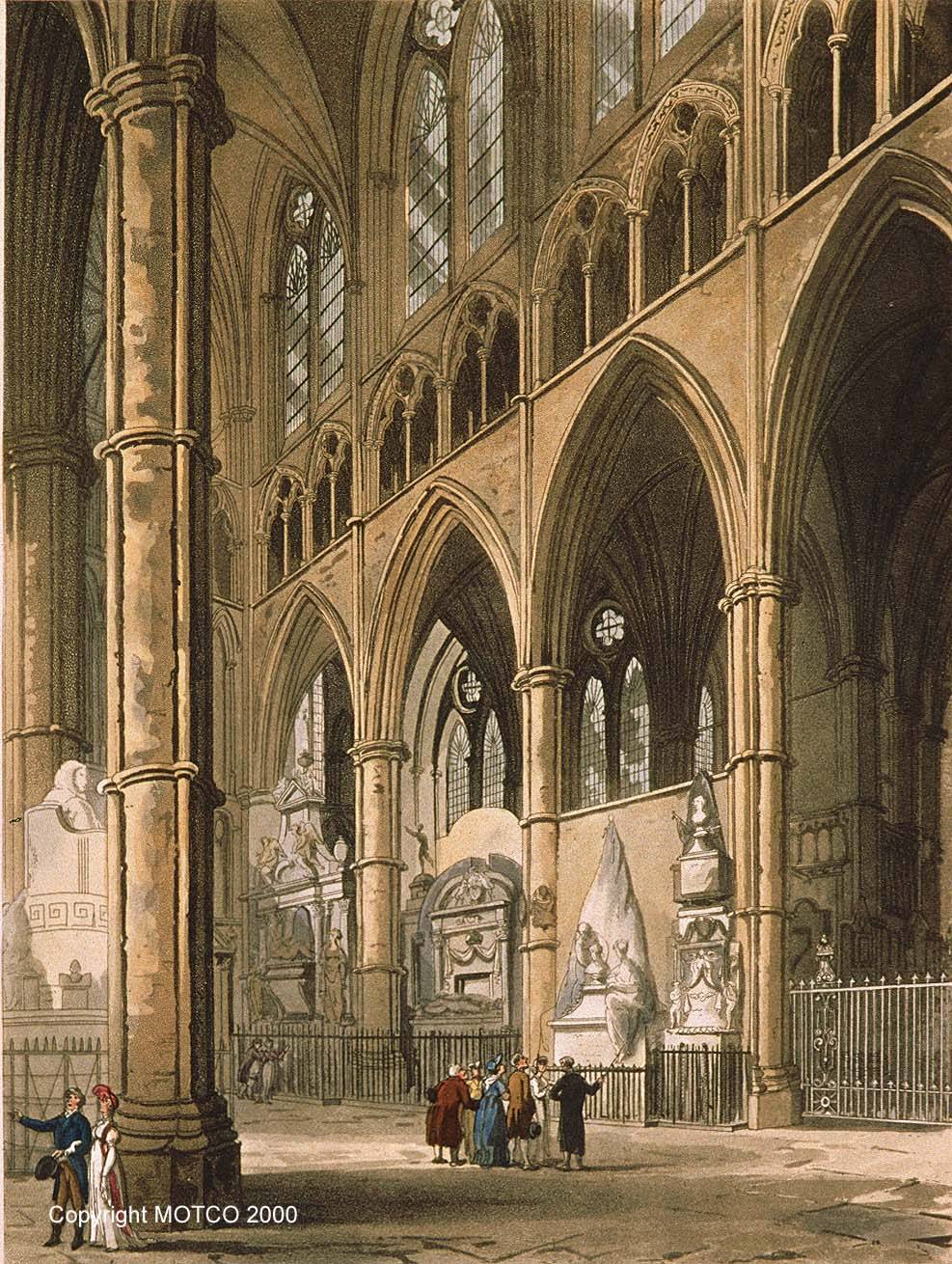
In the evening of 3 October 1835 George Bentinck, a relative of the Duke of Portland, wrote to his mother from Westminster Abbey. The weather, he complained, “has been far from good here. It has rained every day, [and] it was very lucky I brought my umbrella”. Appended to this fascinating catalogue of adventures was a piece of news: “Lord Chatham was buried here in the Abbey to day[.] [T]here was a very great funeral and the King sent his carriage[.] [H]e is buried in the North Transept between Lord Mansfield and Mr Pitt.” (Portland MSS, Nottingham University Archives, PwM 205)

R. Ackermann, North Transept of Westminster Abbey (1809), from http://www.motco.com/index-london/imageone-a.asp?Picno=9902095

R. Ackermann, North Transept of Westminster Abbey (1809), from http://www.motco.com/index-london/imageone-a.asp?Picno=9902095

In September 1835 John Pitt, 2nd Earl of Chatham was approaching his 79th birthday. He was the last remaining member of the Pitt family, and certainly one of the longest-lived (his mother got to 82 but neither his father nor his siblings even came close). In the summer of 1834 he had had a paralytic stroke but it seems made a reasonably full recovery. He was planning to spend the autumn, winter and spring in Brighton, as he had done nearly every year since returning from Gibraltar, and the newspapers reported in mid-September that his house was ready to receive him there.

John never made it. I’m not quite sure what happened to him exactly, but I would guess he suffered another, fatal stroke in the early hours of the morning of 24 September. His heirs, his great nephews William Stanhope Taylor and John Henry Pringle, were swiftly notified. One of the first things they had to do (apart from sort out the legal implications of John’s having completely forgotten Taylor’s name and got it wrong in his will) was to sort out John’s funeral.

John had not only been an Earl; he had also been a Knight of the Garter. As such, his rank entitled him to a grand funeral in the family vault in the north transept of Westminster Abbey. One day I will have to contact the Office of Heralds to see if they have any records on the subject, but according to precedent his funeral would have been held under the auspices of Garter King of Arms, who would have prescribed the precise order of the ceremony and also what sort of heraldic devices could be used.

The heraldic precedent for an earl’s funeral was that of the Earl of Derby in 1574. Reading over the account of the ceremony, I’m guessing John’s could theoretically have been as impressive as his heirs wanted it to be. John in life had always been very proud of his status and of his knighthood: he would, no doubt, have wanted the whole hog with the black velvet pall embroidered in escutcheons, the helmet (silver with five gold bars for an earl), crest, sword and target (crested shield), the great banner (the crest of the deceased), and the bannerolls (a square crest particularly designed for use in funerals).

Presumably he got at least some of these things, and the attendance of Garter King of Arms himself to preside. The fee to the Office of Heraldry for using all the heraldic devices required in an Earl’s funeral was £35, a not inconsiderable sum, but John’s heirs had to stump up a fair amount otherwise, as the bill for the funeral in the National Archives makes clear (PRO 30/8/370 f 152).

The bill was issued by Thomas Dowbiggin & Co (a company that made furniture for high society, with an undertaking business on the side) on 24 September 1835, so presumably Taylor and Pringle wasted no time in getting down to business. While John was not going to be buried in the same lavish fashion as his father and brother, who both received public funerals, he would be laid to rest in fine style.

The arrangements for the coffin alone were as follows:

A strong elm Coffin lined, and ruffled with rich White Satin – £7 7s 0d

A rich satin Winding Sheet – £4 18s 6d

A rich thick tufted Mattress and pillow – £2 12s 6d

A pair of silk gloves – £0 4s 0d

A strong outside leaden coffin soldered all round – £7 17s 6d

A Metal Plate of Inscription soldered on ditto – £0 7s 0d

Putting John into the coffin and soldering it closed cost just over a pound in total. Once he was in, the coffin was encased in another elm case, this time covered in crimson velvet attached with three rows of brass nails. Four pairs of “solid brass Handles with Octagon Rests” were attached to the side, and the whole was studded with “brass Coronets .., [and] Star to the order of the garter all richly gilt and burnished” [GARTER BLING!]. The decoration alone cost nearly thirty pounds. Unsurprisingly, it cost 15s just to carry the coffin downstairs.

Once the coffin was sorted, the accoutrements now had to be sorted out. At the head of the procession was a “Male Horse” (nice and specific there), covered in a velvet caparison and dressed with black ostrich feathers, and led by two grooms. John’s executors hired a velvet pall for 10s 6d, as well as more ostrich feathers (and a man to carry them, supported by two men in mourning with wands). The hearse was drawn by six horses, all also covered in velvet and ostrich feathers and attended by ten men in mourning carrying “truncheons”.

Behind the coffin was a “Velvet Chased Earl’s Coronet gilt and jewelled” with an ermine border carried on a velvet cushion, both of these presumably also hired as they only cost a total of £3 13s 6d. Of banners, bannerolls, targets etc etc there is no sign, so presumably these were skimped, but eleven official “mourners” were hired, each dressed in “ducasse” (? no idea: anyone know?) scarves and hatbands and wearing black silk gloves.

After this the list is mostly about kitting out the various officials, clergymen and porters who attended, and there must have been quite a procession. The provision of “rich silk pole covers” suggests that someone walked under a canopy, probably the Dean of Westminster, his Sub Dean, the Preceptor, the Clerk of Works, and “Mr Vincent & Mr Hayes” (I have no idea who these men were, alas). All of these men were also kitted out with “ducasse Scarves”, hatbands and gloves at the executors’ expense, as were the Chief Mourner (presumably the eldest heir, William Stanhope Taylor), “two vergers and a Beadle”. Some of the servants driving the mourning carriages in the procession also had to be kitted out, and no fewer than twenty grooms accompanied the “Royal Carriages”, presumably that of the King (William IV) mentioned by G.F. Bentinck and whatever other royals graced John’s funeral with their symbolic presence.

Behind the royal carriages were at least three empty “mourning coaches”, each drawn by four horses, also bedecked with the usual velvet and ostrich-feather combination. Two men in mourning walked beside each empty coach, carrying wands. The accompanying assemblage of porters, hearse pages, coach pages, foot pages, footmen, grooms, coachmen and postillions, all of them had to be kitted out in hatbands and gloves at the executors’ expense.

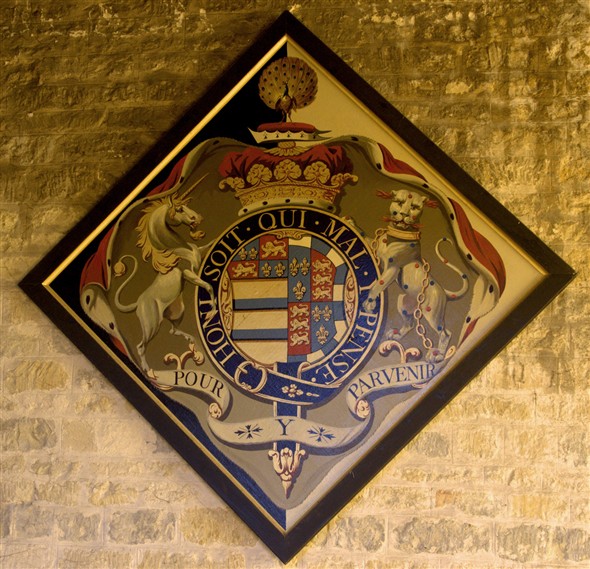
Finally came the “achievement”, in other words a hatchment designed to be attached above the door of John’s house in Charles Street (or perhaps attached over the grave in the Abbey: I’m not quite clear on where it ended up, but it could have been either of those places). I do not know where this has ended up, but it is described in the undertakers’ bill as “a Yard and half” in size, which seems to have been standard, “in double Shields supporters, Garter &c painted in Oil with Frame covered with fine black Cloth”. This, along with the “Wall Gooks, Nails &c” cost £8 8s 0d, not counting 7s for two men to fix it up.

John’s achievement would have been similar to the above, with his arms impaled with those of his wife Mary. Because Mary had died in 1821, however, both sides of the achievement would have been painted black.

Hatchment for the 4th Duke of Rutland (from http://www.bottesfordhistory.org.uk/page_id__796_path__0p1p30p45p.aspx). Like Rutland, John would have been entitled to surround his arms with a Garter. Unlike Rutland, his would have been completely black due to the fact he was a widower

Hatchment for the 4th Duke of Rutland (from http://www.bottesfordhistory.org.uk/page_id__796_path__0p1p30p45p.aspx). Like Rutland, John would have been entitled to surround his arms with a Garter. Unlike Rutland, his would have been completely black due to the fact he was a widower

After this the estate had to cover a number of additional expenses. “Fees to the Abbey” (presumably to all the officials, and for closing off the whole building and Abbey yard) came in at a whopping £130 17s 2d, nearly as much as the procession by itself. Masons were paid £4 13s 5d, and the royal servants received a tip of £3, while other servants received 9s. Carriage duty and “expenses for Men &c”, as well as a mysterious “Searcher”, made up the remainder. No fees were paid to any heralds or heraldry officers, so I am guessing Garter King of Arms did not directly attend.

The grand total for the whole funeral was £348 19s 7d, not counting £2 13s 5d for “removing [the] Marble Ledger … &c from the Family Vault”, relaying it, repairing the vault and “making good paving” (bill dated 3 October 1825, PRO 30/8/370 f 156).

I think John would have approved … although I also think he might have liked a surcoat or two. 😉


For further reading, you could do worse than to visit my friend Stephenie Woolterton’s webpage, where she discusses the funerals of John, Lord Chatham’s father and younger sister Harriot. (Please have a snoop at the rest of her excellent site, of course!)

Some sources used in putting up this blog post:

Chatham Papers, National Archives PRO 30/8/370 ff 152, 156

Portland MSS, Nottingham University Archives, PwM 205

William Berry, Encyclopaedia heraldica; or, a complete dictionary of heraldry (London, 1828)

James Parker, A glossary of terms used in heraldry (London, 1894)

The Earl of Chatham’s weight

johnsweight

A year or so ago, my good friend A Noon-Day Eclipse and I visited Berry Brothers & Rudd in London. BB&R (as I shall henceforth call them) obviously sell wine, but they also have ledger books dating back to the 18th century recording the weights of various patrons who visited over the years. BB&R, then Clarke’s, sold coffee as well as wine, and had an enormous pair of coffee weighing scales. Wealthy patrons frequently came to Clarke’s to be weighed. Pitt the Younger was weighed numerous times in the 1780s. What we wanted to see, however, was the weight of his brother, John, 2nd Lord Chatham.

John was weighed eight times over the course of ten years. I’ve attached a photograph of the relevant ledger at the top of this post, but his weights were as follows:

1816 June 20 – 11st 13lb in boots

1818 July 17 – 11st 1lb in boots

1821 Sept 29 – 11st 13 1/2lb in boots

1825 Aug 3 – 9st 10 1/4lb in boots

1825 Nov 8 – 10st 13 1/2lb in boots and greatcoat

1825 Nov 25 – 10st 12lb in boots and greatcoat

1825 Dec 16 – 10st 12lb in boots and greatcoat

1826 Jan 20 – 11st 3 1/2lb in boots and greatcoat

From this I deduce that John was rather a spare man. I don’t know how tall he was exactly, but he was described physically as “tall”, so I think it’s fair to say he was above average height: maybe 5’11” or so (possibly taller). According to the NHS BMI calculator, in September 1821 John had a BMI of 23.4, comfortably on the upper range of healthy for a man of his age (of course he would have been fully clothed with boots when he was weighed, which I cannot correct for, but it’s an accurate enough guess). At his lowest weight in August 1825, however, he had a BMI of 18.9, which is right on the cusp of underweight.

Why the fluctuation? I can hazard some guesses. John’s “normal” weight was obviously about 11st 13lb or thereabouts. The dates above are suggestive. At the start of the records, in 1816, John was a couple of months shy of his 60th birthday, presumably in good health, happy enough. He had few official responsibilities as he had been out of office for six years, and I’m guessing his military duties were not especially onerous.

Two years later, however, he’s dropped nearly a stone in weight. This is perhaps not surprising: his wife Mary’s mental issues had begun, and John had been nursing her for some months. This was to carry on over the next few years with very little intermission, and from his letters (I’ve blogged about them in the past) it’s clear it took a toll on his health.

Three years later, in September 1821, John was a widower and about to leave for Gibraltar. He had some issues with depression after his wife’s death, but that doesn’t seem to have affected his weight: this is his heaviest ever, just shy of 12 stone.

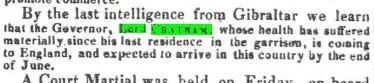
It’s a different story in August of 1825. John left for Gibraltar in November 1821. He left there in May 1825. I have not yet managed to work out exactly why he left when he did, but there’s a hint in the newspapers of the time:

Morning Post, 20 May 1825

Morning Post, 20 May 1825

The fact that John’s “health [had] suffered materially” is reflected in August’s weight record: 9st 10 1/4lb fully dressed in boots. Clearly he was not a well man even after returning to England. He arrived in London on 1 July 1825. A friend who had not seen him for four years was shocked:

Years have bent him much. Time has made him, who was once a very fine-looking man in face and person, no longer, as to the latter, upright and straight as an arrow, and in countenance it has left him certainly fine remains of what he was, but only remains. (Lord Eldon to his son, 24 July 1825, H. Twiss, Life of Lord Eldon II, 559-60)

John obviously kept an eye on his weight for some time afterwards, and he was weighed four times between November 1825 and January 1826. His weight had clearly recovered to a certain extent, although he never seems to have gone beyond 11st 3lb in full winter greatcoat and boots. Still, I think it’s fair to say he went from “too thin” to “about OK”.

I have a feeling there are a few more John records at BB&R, which we did not find on the day we visited. Perhaps one day I will find them. It would be interesting to see how heavy John was in his younger days, although I suspect (like his brother, who was about 12st in his late 20s) he was never overweight.

Happy 252nd birthday Mary, Countess of Chatham

Mary, Countess of Chatham

Mary, Countess of Chatham [1]

Today (2 September) is Mary, Countess of Chatham’s 252nd birthday. Everyone who reads this blog will know how much I love her, and how much I wish her story had had a happier ending. For today, though, we’ll stick to the positives.

I haven’t got much to add to the biographical post I wrote for Madame Gilflurt in May, but I wanted to quote two pieces I have referred to in the past. There’s precious little about Mary in the historical record, which I think is at least partly a tribute to her retiring nature. The following poem, found among the Marsham-Townshend papers at Bromley Archives, certainly corroborates this. I have no idea who wrote the poem (presumably either a family member or a friend), and Shakespeare it ain’t, but it encapsulates my view of the private nature of Mary’s character perfectly:

The Countess of Chatham

Aye! There’s a creature feminine, of whom

The world may proudly boast, with store of charms,

And blandishments that so bedeck the Sex;

She from the yielding of her gentle heart,

Hath walked fair honor’s handmaid, early shunned

The flaunting scenes of Court parade, to act

The humble duties of Domestic life.

Simply attired as innocent in Mind,

With all the Sweet benevolences graced,

Her polish came by habit so engrained

That slander’s biting file cd. never touch it. [2]

The other piece I’d like to quote is one of the few letters I have seen written by Mary not petitioning for patronage for a family member or servant (and she had such a wonderfully embarrassed way of doing it too). I daresay there are large piles of Mary correspondence hiding away in private collections, but I was staggered to find six or seven letters which she wrote to Catherine Stapleton quoted in The correspondence of Field Marshal Viscount Combermere (London, 1866), vol 2. Mrs Stapleton was the companion of Mary’s mother-in-law, Hester, Dowager Countess of Chatham. One day I will try and track down where the originals of these letters actually are, but in the meantime I will be satisfied with the doctored snippets found online.

Mary, Countess of Chatham (ca 1800) by Charles Rosenburg of Bath; in the possession of Ron Mills

Mary, Countess of Chatham (ca 1800) by Charles Rosenburg of Bath; in the possession of Ron Mills

Clearly Mary was capable of writing of other things than patronage, and one or two of her letters even contain a fair amount of politics. While she never tried to assert herself as a political hostess, I suppose it was inevitable that the prime minister’s sister-in-law would be interested in current affairs. The following letter was clearly written in 1794, either just before or just after Pitt the Younger coalesced his government with the followers of the Duke of Portland, former oppositionists who had broken with Charles James Fox over the French Revolution.

Mary starts off with a dryly humourous account of a ball, at which the former Oppositionists showed their faces at Court for the first time in many years. She then makes some brief observations on the inconveniences of Courtly fashion.

We had a very grand ball at the Queen’s house on Monday, and a very good one, as they always are. Among the company a great many repentant sinners. Portlands — it was comical enough that the first ball Lady M. Bentinck should go to should be at the Queen’s house — Fitzwilliams, Carlisles, Spencers, Jerseys, Mansfields — it seemed quite odd to see them all. … Lord Carlisle and Lord Spencer are my two favourites, though, of them, nothing can be more thoroughly manly and honourable than their conduct. … The feathers in the Queen’s face is what now always happens with all young ladies who kiss her hand, for in the way in which they now wear them it is unavoidable, though the Queen leans as far back as she can; to be sure it annoys her, but she’s always good-humoured to young ladies … The Cabinet dine here, and I must get out of their way; so I go to keep a long standing promise to my brother and Mrs T[ownshend], and my carriage is now come. Adieu! Yours affectionately, MEC. [3]

I can’t help wondering what Mary would have said about Lord Spencer, had she known he would shortly supplant her husband as First Lord of the Admiralty…

The above, then, is a tantalising taste of Mary’s epistolary style. I would give anything to find more of Mary’s letters. From what I have seen she had a very similar tone and outlook to her husband: clearly they were a good match in terms of personality.

So happy birthday, Mary. I think it’s about time you received some recognition!


Notes and References

[1] Mary, Countess of Chatham, from an unknown source. I am trying to track down further information on this miniature, the only known portrait of Lady Chatham (apart from the Rosenburg silhouette) that I know of. (The Reynolds portrait you will find elsewhere on the internet is not of Mary, but her aunt.) If anyone has any information on this miniature, please contact me using the form on the About Me page.

[2] Bromley Archives, 1080/3/6/6 f 10

[3] From The correspondence of Field Marshal Viscount Combermere (London, 1866), vol 2, 426

The Helder Campaign, 1799: research visit to Noord-Holland, Part 2

About a year ago I did a considerable amount of research on the Anglo-Russian Helder expedition of 1799 (you can read more about that here). John Pitt, 2nd Earl of Chatham had returned to his military career in 1798, and was appointed to the command of the 7th Brigade in the expedition. My novel follows him to Holland, and last week I finally got the opportunity to do some location research. My husband and I hired a tandem, took a train from Amsterdam to Den Helder, and cycled through the most important locations associated with the campaign.

What follows is Part 2 of the account of my research trip. Part 1 can be found here.

noord-holland_map

 Day Two (conclusion): Alkmaar

We spent a little time exploring Alkmaar. As mentioned in yesterday’s post, Alkmaar was the second headquarters of the Allied force. The Dutch General Daendels had previously used Alkmaar as his headquarters, but was forced to move out when the British advanced from Schagerbrug in the wake of the 2 October 1799 action. The Duke of York established himself in Daendels’ evacuated HQ.

Alkmaar must have been a pleasant change after the middle-of-nowhere that was Schagerbrug, although the British and Russians were only able to enjoy it for slightly less than a week. Now mainly known for its weekly cheese market, Alkmaar was without a doubt the most beautiful of the towns we visited. In 1799 the town was surrounded by “a thick wall, faced with brick, about three miles in circumference, and strengthened with bastions at regular intervals” (E. Walsh, Narrative of the Expedition to Holland … (London, 1800) p 70). Now only the moat survives, but the Old Town, with canals running through its main streets lined with warehouses, cannot have changed much in two hundred years.

Warehouses by the canal in Alkmaar

Warehouses by the canal in Alkmaar

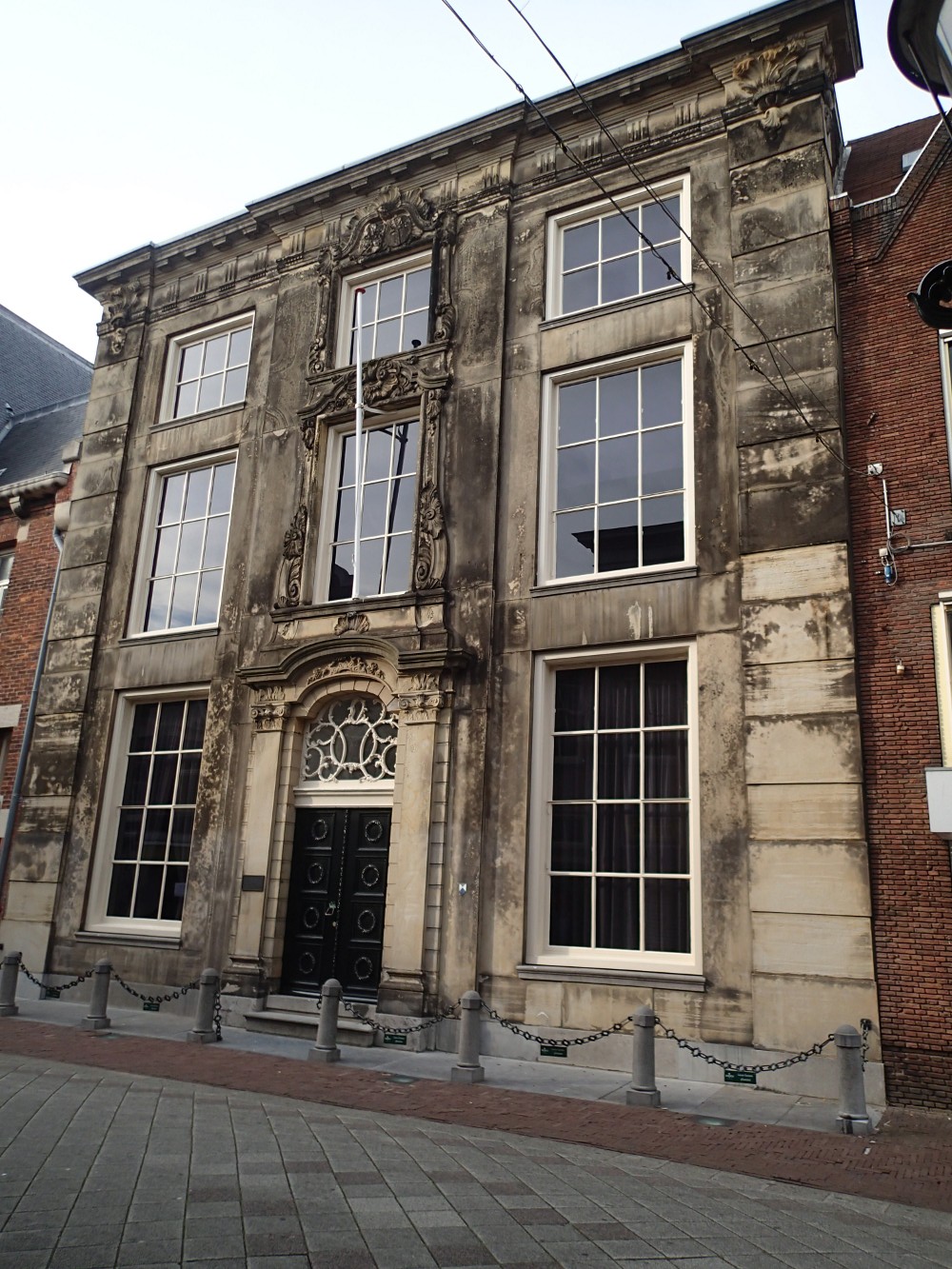
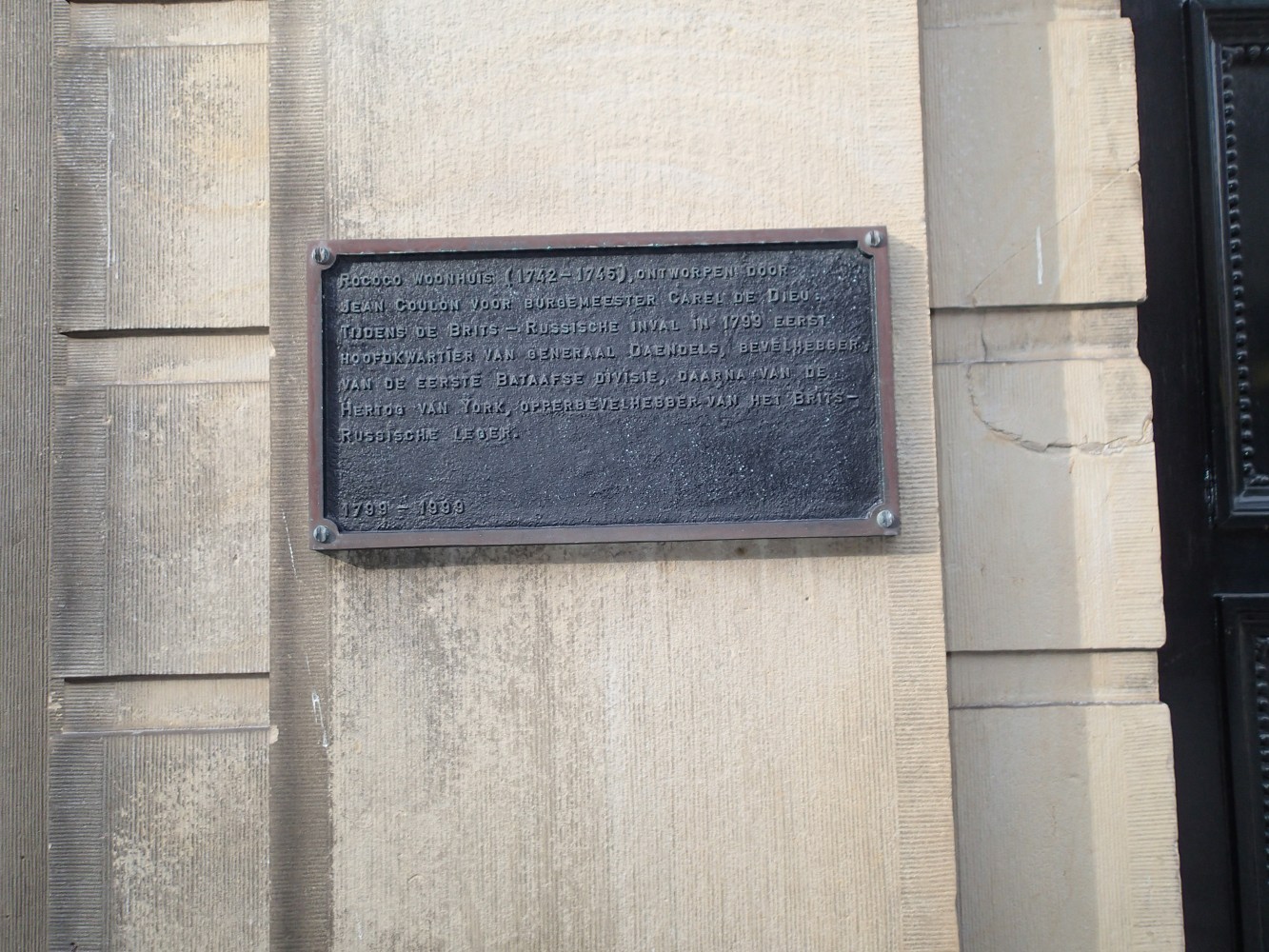
In one of those odd twists of fate, I was just telling my husband that I did not know where exactly the Duke of York’s headquarters were when we came upon an elegant Rococo-style building with a plaque next to the front door. Between us my husband and I managed to make out enough of the plaque’s Dutch to gather that we had, quite coincidentally, located the building used by the Duke as his HQ.

The headquarters of the Duke of York at Alkmaar

The headquarters of the Duke of York at Alkmaar

Plaque marking the headquarters of the Duke of York at Alkmaar

Plaque marking the headquarters of the Duke of York at Alkmaar

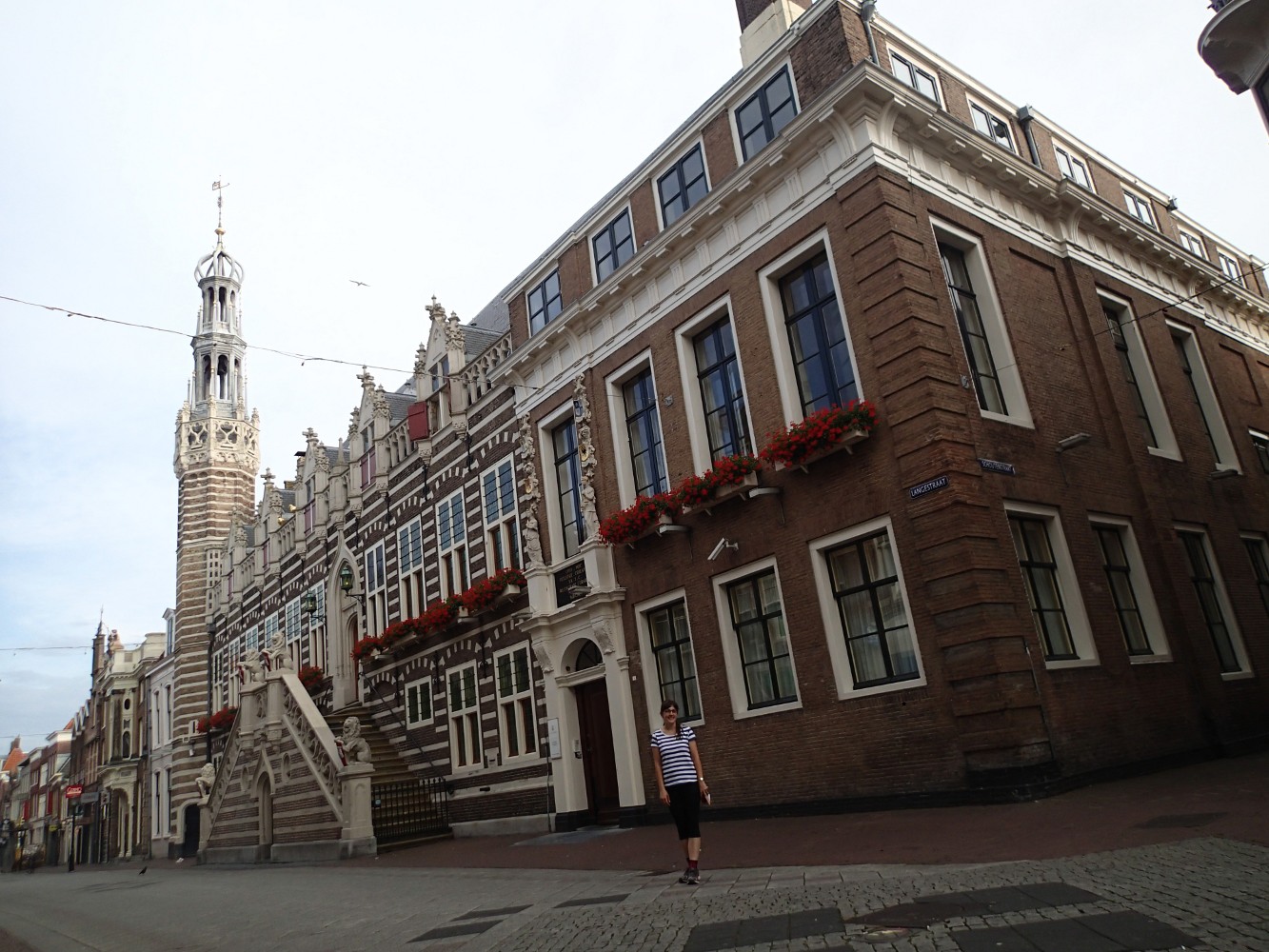
This house was originally built for the mayor of Alkmaar and must have been the best house in the town. It was just opposite the town hall, which was itself an extremely impressive building.

Alkmaar's town hall

Alkmaar’s town hall

At one end of the main street was a church, the 15th century Sint-Laurenskerk. During the battle of 6 October 1799 the rain was so heavy and the visibility so bad that the Duke of York, who remained at Alkmaar throughout, sent one of his aides up the church tower to try his best to work out what was going on!

Sint Laurenskerk in Alkmaar. The Duke of York sent his aide-de-camp up this church tower to see what was going on during the 6 October action

Sint Laurenskerk in Alkmaar. The Duke of York sent his aide-de-camp up this church tower to see what was going on during the 6 October action

Day Three: Alkmaar – Egmond-aan-Zee – Castricum – Wijk-aan-Zee

We were up super early on Day 3 in order to benefit from the weather, which continued glorious. Our intention was to follow Lord Chatham’s steps on the 6 October 1799, during the Anglo-British assault on the towns of Castricum. The battle grew out of the Allied attempt to extend their line to the south in preparation for an attack on the new French/Dutch headquarters at Beverwijk, but turned into a full-on unexpected scrap when the French poured their entire resources into repulsing them. The French commander Brune himself charged the British at the head of his cavalry. The end result was a victory for the Allies, but a Pyrrhic one, and they subsequently retreated back to Schagerbrug and shortly after gave up the whole campaign for lost.

I also wanted to go back towards Egmond-aan-Zee, since I had made a discovery just before bed the night before. Chatham’s movements on 6 October were rather nebulous, since official reports of the battle were comparatively sketchy. His activity can be deduced only from the fact that his brigade (along with that of Lord Cavan) suffered the most casualties. I’m still not entirely sure where and how he was deployed, and nobody else seems to have worked it out either. The great Sir John Fortescue also failed to work it out, but came to the following, somewhat unprofessional, conclusion anyway:

The brigade that suffered most severely was Chatham’s, in which the three battalions of the Fourth lost nearly 150 officers and men killed and wounded, and over 500, including 13 officers, prisoners; while the 31st lost over 100 killed and wounded and 33 prisoners. In what part of the field these battalions were engaged I have been unable to discover, but under so incompetent a brigadier they were likely to come to misfortune in any position (Fortescue, History of the British Army IV (II) 697)

To which I of course say “Hey!”, since in my opinion this is a 20/20 hindsight conclusion to make, particularly as Fortescue admits he does not know where Chatham was to be found.

The large number of captured troops was due to the poor weather on the day of the battle. The Sun of 16 October 1799 contained the following account:

sun16oct1799chathamatcastricummencaptired

From looking over the Army Lists the captured units clearly belonged to Lieutenant Colonel Cholmondeley, who was captured along with a number of several of his officers. They were exchanged the following year.

I had spent the previous evening in our hotel reading through my 1799 campaign notes, and I thought I was beginning to work out what Chatham might have been doing on 6 October. My initial impression of the post-2 October campaign was that Chatham had remained with General Dundas and followed the same order of battle on the 6th as on the 2nd, but I found the following letter from Chatham to his mother quoted in my own notes:

Egmont: Oct 4 [1799]

My dear Mother,

I have but a moment to write to you a single line to say that I am perfectly well … We succeeded in a general attack on the enemy on Wednesday … and I moved in the course of yesterday before this place to reinforce Sir R[alph] Abercrombie [sic], but the enemy, on his approach, unmasked the place, and we have marched in this morning. (Quoted in Lord Ashbourne, Pitt: Some Chapters of his Life and Times (London, 1898), pp 168-9)

From this it seems clear that Chatham did not remain with the division of 2 October, but joined with Abercromby at Egmont, with whom he presumably remained for the action of 6 October.

So back to Egmont we went. Egmont is now a tiny, generic seaside resort town, and although there were a few old buildings left, most of them now converted to shops selling miscellaneous seaside-related tat. It was clearly nestled right in the middle of the dunes, however, and must have been in quite a commanding strategic position in 1799.

Dunes rising near Egmond-aan-Zee

Dunes rising near Egmond-aan-Zee

From Egmont we cycled back through the dunes towards Castricum, passing through Heiloo and Limmen on the way: two villages where the Russian force received a strong check from the French on 6 October, and where I originally thought Chatham’s men might have come unstuck. The dunes here strongly resembled the ones north of Egmont, rising up and down for miles between the sea and the flat polders of the interior. Once again, it was obvious that British infantry would have had a hard time marching up and down without being split up into divisions. The sand underfoot gave way easily, though it was largely kept in place by the omnipresent scrub and heather.

Scrubland on the dunes near Castricum

Scrubland on the dunes near Castricum

As I mentioned before, the weather on 6 October 1799 was awful in the extreme, with driving rain on and off from early afternoon until long into the night. In wet, misty conditions the visibility in the dunes cannot have been good. I do not know how Lt Col Cholmondeley’s division got separated from the rest of Chatham’s brigade, but one thing is for sure: this was not ideal terrain for the British troops.

After a lot of up-and-downing (who knew there were quite so many hills in Holland?!) the land flattened out towards Castricum. Like Egmont, today it is a nondescript seaside town, very modern.

OLYMPUS DIGITAL CAMERA

After lunch we cycled on towards Beverwijk. Once again we entered the dunes. Somewhere on this terrain Lord Chatham received a spent musket ball to the shoulder, which glanced off his epaulette but apparently forced off his coat and waistcoat on its path. Obviously I couldn’t tell exactly where, but it was odd to be on the spot I had read about so many times.

Dunes between Castricum and Beverwijk. If you squint you can juuuust see my husband

Dunes between Castricum and Beverwijk. If you squint you can juuuust see my husband

We did not manage to get into Beverwijk that day, but stopped at our hotel at Wijk-aan-Zee. In 1799 much fighting took place in this tiny village; now it’s a beach resort. Because it was such a lovely day we had to paddle, and I took an amazing shot of the sand dunes rising away to the north.

Beach at Wijk-aan-Zee looking down towards the bigger dunes in the north

Beach at Wijk-aan-Zee looking down towards the bigger dunes in the north

Day Four: Wijk-aan-Zee – Beverwijk – Amsterdam

Much like the British and Russians, the push to Beverwijk was our last effort. In 1799, the Allied forces fell back on a long, nightmarish march to Schagerbrug, where the decision was made on 14 October to abandon the campaign and return home. A convention was signed with General Brune on the 18th by which the British and Russians were to be permitted to re-embark unmolested in return for the release of eight thousand French prisoners of war.

We decided to pop into Beverwijk to see if we could see any trace of its 1799 past, but we might as well not have bothered. Like Castricum, Beverwijk is virtually 100% modern. We found the church, which was clearly very old, and one or two older-looking houses close to the shopping centre, but otherwise, since we were not there to spend money in a high street boutique, we high-tailed it.

OLYMPUS DIGITAL CAMERA

After getting snarled up in Beverwijk’s spaghetti-like network of motorway and dual carriageway junctions, we managed to find our way out and spent the next hour and a half or so cycling into Amsterdam, which we reached in time for lunch.

Following in the footsteps of the Helder campaign was quite an experience, and one I have been planning for nearly a year. I am very glad we managed to see the terrain. Needless to say the relevant chapters in my novel will be getting a significant rewrite!